Five Hundred Mile Walkies
The Salt PathFive Hundred Mile Walkies is the book Ray discovers in a packing box as bailiffs search the house she shares with Moth, and the immediate catalyst for their decision to walk. Remembered from her twenties and reread as they face homelessness, Mark Wallington’s account offers a ready-made image of the South West Coast Path as an adventure. Its influence is decisive but not simple: the book gives Ray a way to imagine moving forward, while the realities of their journey steadily outgrow that reassuring model.
Discovery at the threshold
Ray finds the book while she and Moth are hiding beneath the stairs. Bailiffs have begun hammering on the door and are trying to enter through the back of the house. In the packing box, the familiar title interrupts a moment defined by fear, anger, and the loss of a home they had rebuilt together. Ray remembers having read it in her twenties: it tells of a man walking the South West Coast Path with his dog.
The discovery brings a possibility into focus before Ray has worked out its practicalities. She has not considered how to pay for the journey, the prospect of nearly one hundred nights of wild camping, or what might happen afterwards. Nor has she yet told her partner of thirty-two years that he is coming with her. The book does not solve these problems; it gives her a direction at the moment when the life they had made on the farm is ending. When the bailiffs see them and retreat is no longer possible, the couple leave together.
A borrowed model for the journey
Ray rereads Five Hundred Mile Walkies and uses its example to persuade herself that the walk can be done. Wallington, she recalls, had romped along the South West Coast Path with a borrowed rucksack and a scruffy dog. The contrast matters: his story seems to make the undertaking look almost easy, while Ray and Moth are older, financially strained, and carrying the consequences of a prolonged legal battle and Moth’s worsening inability to work.
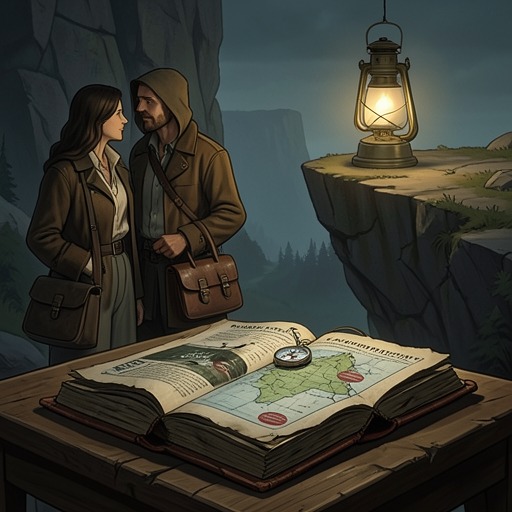
The book also becomes a point of reference for planning their route. Ray concludes that they should walk from Poole to Minehead rather than follow the direction in which the guides run. She considers the section from Minehead to Padstow the hardest and the stretch from Plymouth to Poole the easiest, so starting with the easier miles should give Moth time to adjust. But the practical guidance she needs is missing: the guidebooks she finds describe the route from north to south, not in their chosen direction. Her search for a suitable guide exposes the distance between borrowing a journey from a book and having to make one under their own conditions.
The couple’s resources are meagre. After repaying people who had booked the farm barn and meeting other expenses, they have only £320, alongside a weekly tax-credit payment of £48. Ray’s confidence that Wallington managed with a borrowed rucksack cannot remove the demands of their own equipment, finances, or bodies. The book offers encouragement, not a plan that can be transferred intact.
The path corrects the idyll
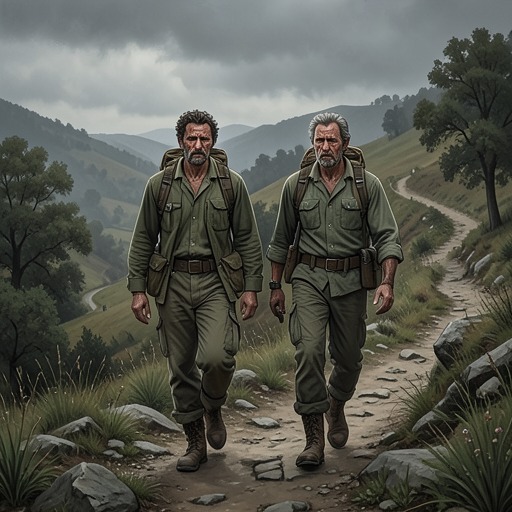
The remembered prospect soon gives way to the actual scale of the walk. Ray admits that, when she first decided to go, she did not understand that the 630-mile trail would involve climbing the equivalent of Mount Everest nearly four times, negotiating a path sometimes only a foot wide, and sleeping wild. At the monument marking the start in Minehead, the couple delay their first step by taking photographs and adjusting their packs; they begin at half past three on a Thursday afternoon, excited and afraid, with the walk supplying a purpose they otherwise lack.
The first steep ascent above Minehead tests the gap between expectation and terrain. Rereading Paddy Dillon’s guidebook on a bench, Ray and Moth find that its description of the path as drifting inland and uphill has not prepared them for the climb. This is not a failure of Wallington’s book so much as a shift in what the journey requires: no remembered account can substitute for learning the ground through exertion, fatigue, and weather. Later, a bus journey from Barnstaple to Westward Ho! leaves Ray feeling as if she has cheated and the couple disconnected from the trail, another reminder that their route cannot be made to match an ideal of uninterrupted walking.
From inspiration to a way of living
As the miles accumulate, walking becomes less an adventure borrowed from a book and more a daily practice that shapes what the couple can bear and understand. Ray describes pain and hunger settling into a rhythm, while the repeated movement of the trail turns each climb and each survived day into a small reason to continue. Rather than producing a settled plan, the walk becomes a kind of meditation in which attention narrows to the next step, the salt wind, dust, and light. The original impulse to walk has become a means of living through grief and uncertainty without resolving either at once.
The journey also changes what home means. Near Land’s End, Ray reflects that she will not return to the farm and that the narrow strip of path has become home, even though she owns none of it. Later, when she and Moth resume walking amid the familiar grass, wind, and salt, the path’s pull feels right despite their unresolved future. These experiences give the book’s initial invitation a meaning it could not have supplied on its own: walking is not simply a scenic escape but a chosen way to retain some control when housing, money, and the next stage of life remain uncertain.
Five Hundred Mile Walkies therefore remains important as the remembered spark and provisional model for the journey, not as a script the couple simply follows. Its vision helps Ray act at the threshold of homelessness; the route then teaches her, through effort and repeated movement, what that decision entails. The book opens a way forward, but the meaning of the walk is made on the ground by Ray and Moth.