Foreland Point
The Salt PathForeland Point is a headland on the South West Coast Path where exposure to wind, height, and mist briefly overwhelms the walkers’ ability to judge the terrain. Its significance in the account lies in the sharp transition from woodland shelter to an almost invisible cliff path: the coast becomes not simply scenery but a force that tests whether Ray and Moth can keep going.
Approach and Exposure
The approach has already established the physical demands of the route. Above Minehead, Ray and Moth stop halfway up a steep zigzag through the woods, struggling to breathe and checking Paddy Dillon’s guidebook against the ground beneath them. Its description of the route as drifting inland and uphill seems a poor measure of the climb. At Foreland Point, the difficulty changes from steepness to exposure.
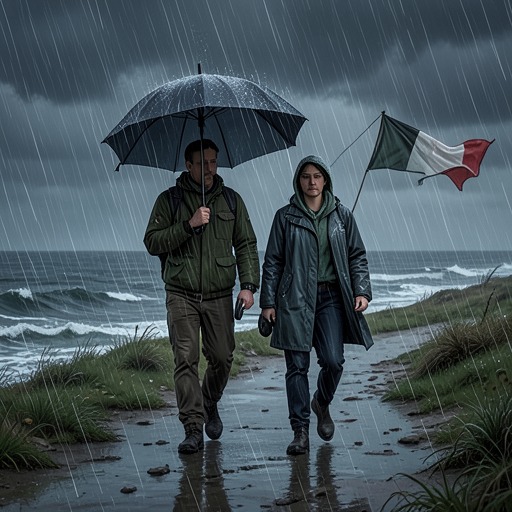
Rhododendron canopy initially shelters the walkers from gentle rain. Once they leave the trees, weather blows in from the Bristol Channel: the rain becomes a howling gale, water streams across Ray’s face, and their flapping waterproofs and heavy packs make it harder to stay balanced. A rainbow forms ahead, briefly colouring the landscape, but the sea then disappears into swirling black and grey mist. Moth, unsteady from the height, wind, and exhaustion, clings to the grass for support.
The Path in the Mist
The cliff path narrows to about two feet, with cloud obscuring what lies beyond it. The walkers cannot tell whether they are crossing a grassy slope or walking beside a drop. The uncertainty is more than a problem of visibility: without a clear horizon or view of the edge, they have no reliable way to read the land beneath their feet. The route’s narrowness and the wind’s force make each step consequential.
A church tower appears suddenly out of the fog. It gives the walkers a visible point toward which they can move, but it does not erase the danger or Moth’s worsening physical strain. At the church, he drops into a pew. His shoulder is in agony from bracing against the wind, and his leg has begun to buckle unpredictably, making him stumble. The scene brings the journey’s wider bodily costs into focus: the path demands not only endurance but constant adjustment to terrain and weather.
Shelter and Consequence
Ray and Moth consider spending the night in the aisle of St John the Baptist. Instead, lights from the Blue Ball pub lead them a short distance onward. They stagger through its door, drenched enough to leave water across the floor and over a dog sitting by the entrance. Moth lifts his pack, instinctively trying to make things easier for the people inside despite his pain and exhaustion.
The storm thus changes the immediate objective from continuing along the exposed coast to finding shelter. The church provides a moment of rest and a landmark in the fog; the pub offers a place to escape the weather. The walkers’ arrival carries the conditions of the path into the shelter with them, visible in their steaming packs and the water on the floor.
Place in the Journey
Foreland Point concentrates the memoir’s recurring tension between forward movement and physical limit. Elsewhere, walking gradually becomes a way of living from one step to the next, a rhythm in which daily survival supplies its own reason to continue. Here that rhythm is interrupted: Moth’s buckling leg and painful shoulder make stopping necessary. The episode shows that perseverance on the coast path does not mean pressing on regardless, but responding to what the body and landscape will allow.
The headland also gives the walkers’ dependence on the route a stark form. In the fog, the path is barely more than a strip of ground and the sea is no longer visible; a church tower, then the pub lights, provide the next points of orientation. The surrounding weather makes shelter a practical need, while the act of reaching it preserves the possibility of walking on. Foreland Point is therefore both an ordeal and a threshold between exposure and refuge within the journey.