Greencliff
The Salt PathGreencliff is remembered as both a landscape shaped by extraction and a test of endurance on the South West Coast Path. In the account of Raynor and Moth’s walk, its black rock and exposed cliffs frame a day of worsening heat, thirst and exhaustion; the place becomes a point where the freedom of walking and the danger of having nowhere else to go meet sharply.
Setting and material history
The route across Greencliff runs above a coast where black rock slides away towards the sea. The dark seam, described as running from Bideford to the cliff edge and thinning into fingers offshore, is not merely a striking feature of the view. It records a history of mining: Bideford Black was extracted as fuel for lime kilns scattered along this coast. Those kilns processed Welsh limestone into fertilizer and building materials. By the time Raynor and Moth passed through, the same mineral had found a different market as an artists’ pigment, sold through fashionable galleries.
That shift—from industrial fuel to gallery pigment—makes the landscape a record of changing uses rather than an untouched wilderness. The rock that gives Greencliff its dark character links the present walk to earlier work and commerce. Yet the immediate conditions of the crossing are not historical or picturesque: the cliff path absorbs heat, and the open ground offers little relief from it.
Heat, thirst and physical crisis
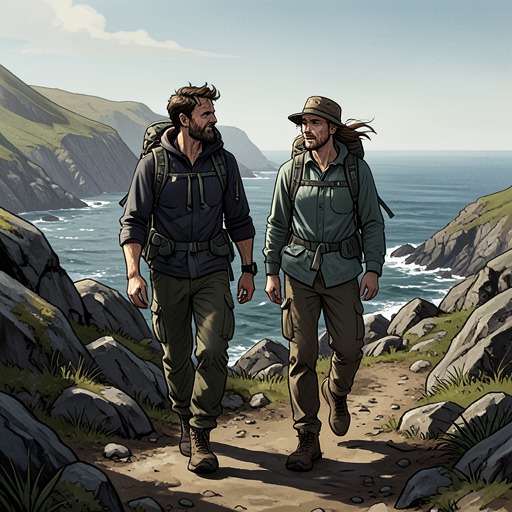
As the pair headed out over Greencliff, the heat intensified. Raynor’s nose had become visibly red from sun exposure, and the new skin burned before the old layer had shed. Moth began stumbling more often; he fell for the first time, grazing his arm and leaving himself shaken. His worsening steadiness made the terrain more threatening, while the water supply dwindled. After drinking, he had only about two inches of water left in the bottle. It had been filled at a bar in Westward Ho! and much of it had already been used overnight; the next possible supply might require turning inland to knock on a door.
The pair continued, hoping a stream near Babbacombe Cliff would provide water. Instead, they reached a dry stream bed. By then the afternoon had become a burning shimmer, with no trees or shade between the cliff top, sea and sky. At three o’clock Moth dropped his pack and lay down. He said he was finished, could not continue and felt shivery; he wanted to go home, return to his own bed and never wake up. The episode gathers exhaustion, illness and homesickness into a single moment: the walk that gave the couple a direction also demanded that they keep moving through conditions they could not control.
Greencliff’s difficulty was not limited to Raynor and Moth. Another walking group later recalled that it had begun with four people at Great Hangman. One had already dropped out at Woolacombe; a second gave in on Greencliff because of the heat. The remaining walkers accompanied him back to Westward Ho!, took a bus to Barnstaple to see him off, bought supplies at a supermarket, then returned by bus to Westward Ho! and had to walk Greencliff again. This account shows how the exposed stretch could interrupt a planned route, force a retreat and make the same ground have to be covered twice.
A test of the journey
The couple later described Greencliff as a nightmare and acknowledged that they had nearly given up there. Their near-collapse belongs to a wider pattern in the walk: the route’s demands were registered through bodily changes—slowed steps, thirst, pain and the need to stop—rather than through distance alone. Elsewhere, the rhythm of walking could soften immediate needs into a steadier pulse, but Greencliff shows how quickly that rhythm could break under heat and physical strain.
The place therefore stands for more than a difficult section of coast. The black seam makes human use of the land visible across time, while the crossing exposes the limits of the walkers’ strength and supplies in the present. For Raynor and Moth, continuing the journey depended not on an uncomplicated sense of adventure but on confronting points where stopping, turning back or asking for help became real possibilities. Greencliff remains one of the clearest places where that precariousness came into view.