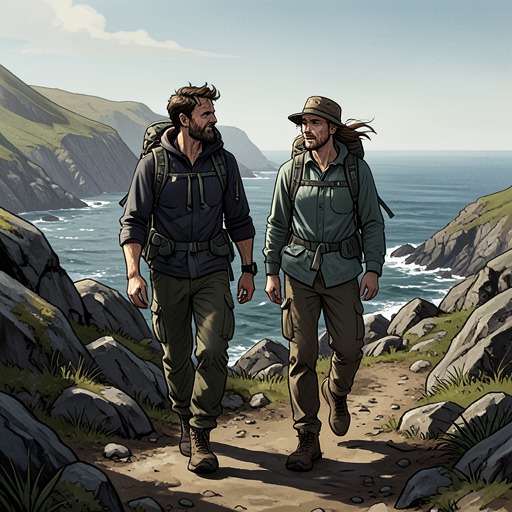
Hartland Quay
The Salt PathHartland Quay is presented as a practical waypoint on Ray and Moth’s South West Coast Path journey, where the promise of a hotel and food meets the physical cost of keeping moving. The route onward to Bude becomes a measure of the distance between a guidebook’s compressed itinerary and the couple’s lived experience: a section described as a day’s walk took them three days to survive.
A waypoint shaped by need
Hartland Quay enters the narrative when food has become an immediate concern. With only half a bag of fudge and some couscous left, Ray and Moth consider whether they can manage the ten miles to a hotel there in a single day. The hotel is not yet a confirmed refuge; it is a destination they are trying to reach while unsure how much more walking they can manage. That uncertainty makes the quay significant less as a scenic stop than as a point on the route where hunger, distance, and stamina converge.
The episode belongs to a journey undertaken after Ray and Moth had become homeless and begun walking to give themselves a reason to keep moving. Their choices along the path were shaped by limited money and scarce supplies, so the prospect of food at Hartland Quay carries a practical weight. The place marks a hoped-for end to a demanding day, not an assured solution to the pressures that accompany the walk.
The difficult route to Bude
The stretch from Hartland Quay to Bude is described as one of the most remote and difficult sections of the entire path. Paddy Dillon’s guidebook covers it in a day; Ray and Moth take three. The comparison gives the place a role in the narrative’s recurring contrast between an itinerary on paper and the embodied pace of walking. Their slower progress is not an abstract delay: it registers the demands of the route and the limits imposed by pain and exhaustion.
By the time they have made it through, the walk has become a way of bearing what they had previously thought impossible to endure. The pain is still a burden, but Ray describes it as less jagged, rounded by movement into something easier to carry. Hartland Quay therefore stands at one end of a stretch whose difficulty is both geographical and personal: its remoteness tests their bodies, while completing it alters how the suffering they carry is felt.
Significance in the journey
Hartland Quay anchors a small but consequential sequence of need, expectation, and endurance. It is first imagined as a destination with food and a hotel, then remembered as the beginning of a route that took far longer than the guidebook suggested. The difference between one day and three makes the couple’s actual progress visible, while their survival of the section turns a difficult passage into evidence of what they can continue to withstand.
The account does not make the quay a final refuge or a cure for their circumstances. Its importance lies instead in the fragile, practical hope attached to a place ahead on the path—and in the fact that reaching the next stage required more time and effort than they had expected.