Homeless couple’s South West Coast Path walk
The Salt PathRay and Moth’s South West Coast Path walk turns the loss of a home into a journey whose meaning changes as it proceeds. What begins as a practical answer to homelessness also becomes a daily means of living with Moth’s illness, testing their resilience, and gradually loosening the hold of the life they have lost. The walk does not erase its material hardship: it carries them through insecure shelter and uncertain income before bringing them, at last, to a possible home of their own.
From dispossession to a route
The crisis behind the walk was financial and personal at once. After Cooper’s failed company left debts, Ray and Moth became litigants in person when their savings were consumed by solicitors’ fees and their case was judged too complex for legal aid. A charge was registered against their farm as security for Cooper’s claim, followed by a claim for possession of their home. After three years and ten court appearances, they believed they had found evidence that could save the property, but the struggle did not give them a secure way forward. They lost the house and the holiday-rental business that had provided their income.
Renting was not a straightforward alternative. A campsite wanted eighty pounds a week, with no housing benefit available for the fee; in midsummer, holiday caravans were booked by visitors who could pay more. Repossession had damaged their credit, while the council offered only low-priority status and, at that moment, a bed-and-breakfast room in accommodation used mainly by people with drug and alcohol problems. The possibility of Moth’s declining health sharpened the stakes: Ray wanted to spend the time they had together, rather than leave him to work. In that narrow field of choices, the tent became preferable to the accommodation on offer.
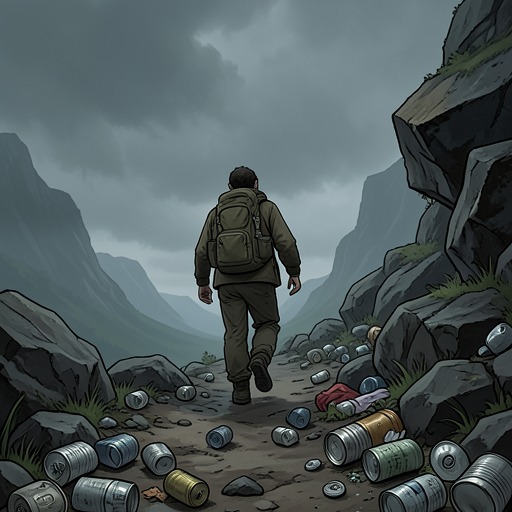
At Minehead, the pair lingered by the monument of giant metal hands holding a map, delaying the first step with photographs and adjustments to their packs. They were excited and afraid, homeless and facing illness, but the route gave them somewhere to go and a purpose for setting out. Their intended walk was 630 miles. Almost immediately, the body’s encounter with the terrain contradicted the guidebook’s mild description of a path that merely drifted uphill: on a steep zigzag through the woods above Minehead, they stopped on a bench to breathe and reread Paddy Dillon’s guide. The mismatch established a recurring tension between a mapped route and the strenuous ground they actually had to cross.
The moving body and the changing story
Walking first made itself felt as pain and effort. Legs, hips and shoulders hurt as Ray and Moth climbed, while the heat radiated from the rock path. Yet reaching the sea cliff brought a sudden expansion of feeling: the height, wind and salt air gave Ray a sense of flight, even as Moth leaned away from the sea. The same path could therefore expose their physical limits and make movement feel like freedom. Its hills were not scenery apart from the journey; each ascent demanded exertion and made arrival a small, immediate achievement.
The repeated rhythm also altered what occupied Ray’s attention. On the path, hunger and pain could settle into a more manageable ache, then recede into the steady sound of the sea. Ray describes the walk becoming a meditation rather than the planned interval in which to sort out their thoughts and make a plan. Each step had its own moment of power or failure; each combe climbed became a victory, and each day survived a reason to continue. The landscape supplied neither a solution to their problems nor a guarantee about Moth’s future. It gave the couple a present tense measured in the next step.
Their account of why they were walking changed as well. Telling strangers that they had lost their home often ended the conversation: people recoiled, and the encounter broke off. Ray and Moth therefore said they had sold their home to pursue an adventure, a story that made the same unsettled life appear inspirational rather than socially discrediting. Repeating it softened their grief, though Ray also wondered whether a similar process of denial was shaping the response to Moth’s diagnosis. The walk thus carried not only their belongings but a carefully altered explanation of their circumstances. Its apparent freedom was inseparable from the stigma attached to being penniless and homeless.
Disruption, return and acceptance
The route did not unfold as uninterrupted coastal freedom. After months away from the coast, Ray and Moth lived in a disused meat-packing shed on Polly’s farm, where rain struck the corrugated roof and they put their tent inside the building. The shed had moss at the windows, exposed insulation and plastic wall covering curled by a wood burner; it offered a roof, but not the sense of belonging they had found on the path. Polly did not want rent in exchange for their help with the building and farm, making the arrangement a friendship-based exchange of shelter and labour. Even so, the inland confinement left Ray feeling uprooted and disconnected.
Moth’s application to university introduced a possible next stage, but also another risk. He was accepted after an application and Skype interview, and student finance offered the prospect of a reliable income despite their poor credit history. Ray and Moth considered whether they could live on one student loan while Ray found work, but hesitated to give up the roof over their heads and return to homelessness. Meanwhile, Ray completed two and a half months of seasonal sheep work and received fifteen hundred pounds, a striking contrast with an earlier week when only eleven pounds remained. The money offered some breathing room, but Moth’s pain and the uncertain future of the shed kept their plans unsettled.
When they resumed the coast path from Poole, the return to sea air and open horizon felt like relief after months inland. They camped on Ballard Down, looking across the bay at the lights of Swanage, while Moth sat with four painkillers in him and Ray rubbed his shoulders with a pain-relief gel that did not work. Their decision to move on was not made from confidence that everything would go well. It rested instead on a practical possibility: they could pay for a room with money they had earned, Moth could retrain, and Ray could look for work or retrain too. The old route had become a way to imagine a life beyond other people’s goodwill.
Completion and what the walk leaves behind
Near the end, Anna offered them the chance to rent her flat in Polruan after her tenants moved out. The coastal path ran past its front door. The offer transformed the prospect of finishing: they had enough for the deposit and first month’s rent, noodles in their packs and a student loan due in a few weeks. They pitched their tent one last time, with the Channel visible from its entrance, knowing that a roof was no longer only an uncertain hope. The night also brought a different uncertainty. Once they stopped walking, Ray did not know who she would be without the daily task of putting on a rucksack, but she was able to leave that question open and look towards the future with hope.
The final stretch ended at Pencarrow Head. Ray and Moth sat overlooking Lantic Bay, shared the last of a pack of wine gums, and watched a peregrine follow the cliff line before disappearing from sight. Their homeless trail was over, though the experience had not restored what they had lost. They still expected to sell possessions to pay for a hire van, and Moth planned to begin a degree without confidence that he would live to finish it. Their ending is therefore not a neat return to security but a shift from forced movement towards a fragile, concrete next step: a place to live, study and work.
Ray understands homelessness as both deprivation and a stripping away of possessions that leaves a choice about what comes next. The walk had not spared the couple from illness, poverty or the consequences of the court case; it had helped them endure those circumstances without surrendering to a life of waiting and regret. By the last headland, Ray can imagine the couple as reshaped by sun, storms and wind, while remaining conscious that Moth’s illness may eventually break the bond they have relied upon. The route’s significance lies in that double vision: it offers no promise that the future will be easy, but it allows Ray to choose hope and continue writing a life beyond the losses that sent them walking.