Land's End
The Salt PathLand's End is the destination that gives Ray and Moth's homeless walk a direction, but its arrival does not close their journey. First an ambition they are hesitant to voice, it becomes a real place reached through pain, weather and dwindling money; when they finally stand at its signpost, they leave again on foot. Its narrative significance lies in that reversal: the end of the land offers no ready-made future, while continuing along the coast preserves a measure of choice.
A destination that gives the walk a purpose
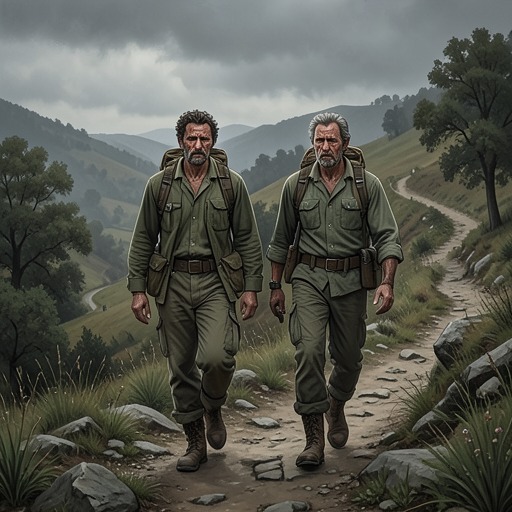
In early August, after leaving Taunton with their rucksacks and no home to return to, Ray and Moth set out for Minehead. Their first step on the South West Coast Path gave them somewhere to go and a reason to keep moving. The scale was daunting: they expected to walk 630 miles, and at the outset even the steep path above Minehead made Paddy Dillon's guidebook sound optimistic. Land's End lay roughly 250 miles ahead, a distance they could not yet confidently imagine completing.
The destination initially came with a qualification. When an Australian met them on an exposed stretch beyond Lynton and asked where they were going, Ray answered that they hoped to reach Land's End if they made it. The hesitation mattered: a named endpoint could lend purpose to their movement, but it did not remove uncertainty about whether their bodies or circumstances would carry them there. On the path, distance was not abstract. Legs, hips and shoulders hurt; steep climbs and exposed cliffs had to be met one by one. A high path above the sea could bring vertigo and exhilaration together, while the imagined finish remained far away.
The name also became a repeated answer to strangers, although the idea of the journey did not always sound plausible to Ray. At one encounter, saying Land's End came more readily than the possibility of continuing to Poole; the latter seemed ridiculous to her. Two young walkers, Josh and Adam, told the couple they wished they had time to go all the way. They themselves had obligations pulling them back: Adam was supposed to help move house within days. For Ray and Moth, however, Land's End was not a holiday detour with a return date. It was the near horizon of a life without a home, and the walk supplied a structure for facing what came next.
The approach: a landmark in difficult country
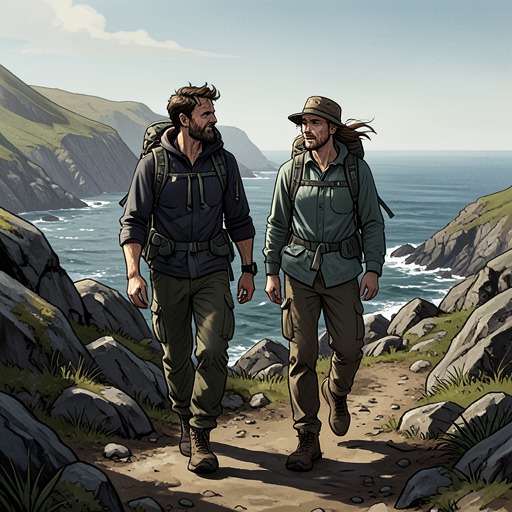
The final approach made the endpoint visible before it made it accessible. From the headland at Carn Leskys, Longships Lighthouse stood on the small islet of Carn Bras beyond the last headland. The couple could have reached Land's End that day, but they did not hurry. Beyond the landmark lay an unknown future, and there was no reason to rush towards it. Scrubby growth closed around the path, offering nowhere suitable to camp; camper vans occupied the few flat places at Porth Nanven. As the trail turned away through the scrub, they spotted a green patch on a rocky finger extending into the sea and considered whether it might shelter them, though it was exposed.
Weather made the last miles less like a ceremonial approach than a test of endurance. At Sennen Cove, sand blew inland, then rain struck sideways against their waterproofs and exposed skin. The town battened down, and Ray and Moth took refuge in a café, spending a valued note on mackerel baps and tea. When the owner was ready to close, they shouldered their packs and walked back into the gale. Their exchange about having nothing better to do registered the stubborn, unsentimental logic of the undertaking: the destination was not being reached in comfort, and the weather did not turn them towards an easier plan.
Arrival without a welcome
Land's End appeared as both a geographical edge and a developed tourist attraction. The path led through cloud and past cliffs into a large concrete complex, which Ray described as deserted when they arrived in the late afternoon. The photographer at the signpost pointing towards John o’ Groats had shut up for the day. The shops and exhibition centre were closed, and even the Arthurian attraction was empty. Ray and Moth jumped the barriers and used their mobile phone to take rain-streaked photographs beside the signpost.
There was no welcome committee and no celebration. The two wet walkers stood alone at the marker, clinging to it as water ran down them. Ray asked whether that was all; at that moment a double-decker bus pulled into the empty car park. The image turns the expected climax into something anticlimactic and almost estranging: after hundreds of miles, the famous endpoint offered closed doors, concrete and rain rather than a public recognition of their arrival. Their description of themselves as zombies leaving a wasteland captures the exhaustion of the scene, not a triumphant finish.
More than 250 miles of pain, exhaustion, hunger, wild nights and bad weather lay behind them. The bus could have taken them away towards the familiarity of Wales, where they might seek council housing and a cheap winter campsite. Moth held Ray's hand as its doors closed. Yet the couple watched it drive away from the shelter of the visitor-centre archway. Their choice to remain was not presented as proof that hardship had become easy: they were dripping, cold and tired, and the coming season remained uncertain. Rather, they valued the ability to decide whether to continue or stop, without imposing on friends or family until their goodwill wore thin.
Beyond the apparent end
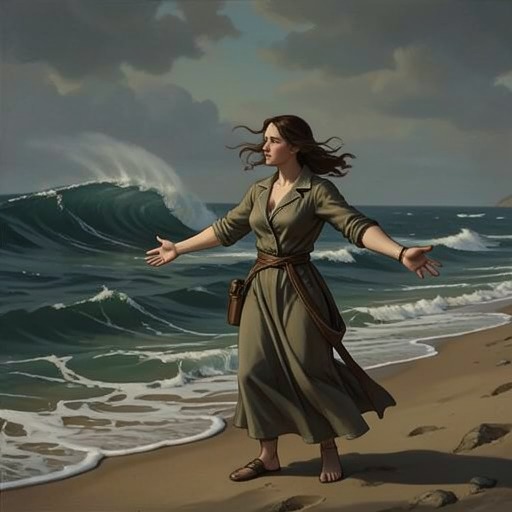
Within a few hundred metres of the tourist complex, the wilderness returned. Sheer granite cliffs faced the Atlantic Ocean, and immense plumes of water drove through the Armed Knight Rock Arch offshore. The contrast between the concrete development and the force of the cliffs made Land's End less a final enclosure than a border that could be crossed. The couple stood exposed on the headland with little food: five pounds and twenty pence, a Mars bar, a bag of rice, a banana and half a bag of wine gums. With the rain stopped, they eventually hid their tent among rocks, with only two sheets of nylon between them and Canada.
The continuation also changes what the endpoint means. Land's End could have marked a return to settled arrangements, but the couple chose the coast path again, accepting uncertainty in preference to the bus ride back. The narrative does not claim that this decision resolved homelessness or provided a secure home. It shows instead that walking kept an immediate form of agency within reach: they could put on their wet packs and choose the next stretch of ground.
Later passages describe that agency as something formed through repeated steps and exposure to the elements. Ray reflects that the path had become a strip of ground that felt like home, and that she could belong to the natural world without owning land. On a later return to the coast path, the familiar grass, sun, wind and salt again drew her forward. Those reflections extend the significance of Land's End beyond the day of arrival: it was a milestone in a longer passage through homelessness, not a finish line that could settle the couple's future. Its concrete landmark promised an ending; the choice to walk on made it a beginning of another kind.