Lizard Point
The Salt PathLizard Point is the southernmost point of mainland Britain reached by Ray and Moth on their walk. Its importance lies not only in the route’s geography: at the place where the path can go no farther south, Ray confronts the loss of the life they left behind and begins to understand home as something other than property.
Arrival at the southern limit
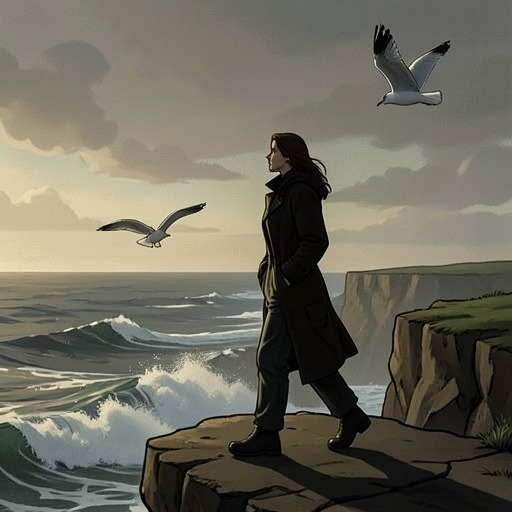
After walking across open heathland from the crowded Kynance Cove, Ray and Moth reach Lizard Point and the mainland’s southernmost rocks. The point is a literal edge: any farther south would mean swimming. From here, every direction of travel on foot leads north, turning the headland into a place of choices rather than an endpoint.
The contrast between the cove and the headland sharpens the arrival. At Kynance Cove, visitors stream down the paths and fill the shore; at Lizard Point, the walk reaches its furthest southern extremity. The pair have not arrived for a brief excursion before driving away. Their route must continue, and its next direction will involve deciding how to face the winter.
A turning point in the journey
Ray considers the account of Phoebe Smith, who camped at Britain’s extremities for a book about wild camping. At the southern point, Smith waited for darkness, slept badly in a bivvy bag on a ledge above the waves, then walked back to her car and drove on to the next outlying place. Ray envies the security of knowing that discomfort would be temporary, but recognizes that this is not their journey: they must turn north and make decisions about what comes next.
That distinction gives the headland its force. For a traveller on a tour, the southernmost point can be one stop among several; for Ray and Moth, who have no home to return to, it opens onto the practical and emotional uncertainty of the months ahead. The walk has supplied a daily direction, but reaching the bottom of the mainland makes the coming change in direction impossible to ignore.
Swallows and the changing sense of home
At the lighthouse, hundreds or perhaps thousands of swallows gather, swooping and circling as if poised to begin their southward migration. Ray wonders whether the birds include the swallows from the farm, now waiting with their new family for the moment to leave. The thought connects the headland to a lost home through the seasonal lives of animals, without making the birds’ departure a simple answer to the couple’s own unsettled future.
Ray’s sense of home is changing here. The old house and its familiar routines are understood as irretrievable; the path, sometimes no more than a foot-wide strip of dirt, has become home through the act of continuing along it. Ray describes a softer acceptance taking the place of anger and the effort to reverse what cannot be changed: belonging no longer requires ownership of a patch of land. The landscape is not merely a view at the journey’s limit; walking through it helps alter what home can mean.
Turning north
Moth stands stiffly while Ray holds his pack so he can put his arms through the straps. The practical gesture makes the transition physical: after reaching the southernmost point, the pair look down at the path and follow it north. At nearby Carrick Luz, the narrative returns to the Lizard Point lighthouse, whose light rhythmically crosses the sea as they camp in exposed conditions. The landmark thus remains present beyond the moment of arrival, while the route carries them into the next stage of their journey.