Lynton
The Salt PathLynton is a steep, exposed waypoint on Ray and Moth’s walk along the South West Coast Path, where the demands of the terrain meet the sharper pressures of having almost no money and being treated as social outsiders. A diversion into town for food supplies turns into a public mishap: coins scatter down a hill as a dog lunges, and an angry woman casts the couple as tramps. Leaving Lynton, the path narrows above the hillside and opens onto a cliff-edge route, carrying them onward while the encounter remains a measure of how far their circumstances have changed.
Approach and Place in the Walk
The couple reach Lynton after diverting up a steep, winding road because they need more food. Their budget makes the detour consequential: the South West Coast Path is said to generate around three million pounds a year, while they have only forty-eight pounds a week. Ray has become reluctant to open her purse, but supplies cannot be postponed. Lynton is therefore not simply a place to pass through; it is where the routine need to eat forces their precarious finances into the open.
The physical approach already sets the terms of the stop. The road winds uphill, and their next stretch out of Lynton narrows along the hillside until it bends sharply at a cliff edge. The walk repeatedly makes distance bodily: a town reached by a climb offers necessary provisions, while the route beyond it demands renewed effort and exposes the walkers to the drop beside them. In Lynton, even the act of stopping to count money takes place on a slope, where coins can roll away faster than they can be gathered.
The Scattered Coins
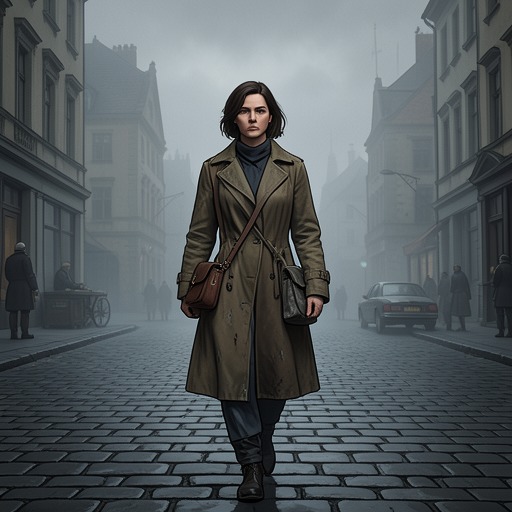
Outside a grocery shop on a street corner, Ray counts the coins in her hand and tries to decide what they can afford. A woman in a bright yellow and blue sailing coat rounds the corner with a large white dog. Ray is standing between the shop door and a rail where a black Labrador is tied. The white dog lunges at the Labrador, which had been quietly dozing, and grazes Ray’s rucksack as it passes. The impact spins her into a wall and sends her money down the hill.
The coins become a small, urgent chase. Ray throws herself onto the ground as a pound coin spins towards a drainage grille and nearly slips from her fingers. Moth follows a two-pound coin weaving between holidaymakers, but a small boy picks it up first. From the pavement, Ray watches him stoop after the money; the immediate scramble makes their limited cash public in a way no explanation could. Moth returns uphill with a few stray coppers, and the remaining total is nine pounds and twenty-three pence. The exact sum gives the incident its force: this is not loose change, but the measure of what they have left for necessities.
Poverty Made Visible
When Ray challenges the woman’s assumption that she has been hurt, the woman defends her dog and calls the couple tramps, condemning their presence on the street as disgusting. The accusation turns a moment caused by the dog’s aggression into a judgment on the people knocked down by it. Ray has been counting money for food; to the stranger, their struggle to retrieve it marks them as an offence to be controlled rather than people in need of help.
Ray’s recollection places that insult against the life she had only recently lost. A few weeks earlier, she had owned a home and business, a flock of sheep, land, a garden, an Aga, washing machines and a lawn mower. Those possessions had carried responsibilities, respect and pride. Now she is on the pavement with her hand in the gutter, being identified as a tramp. The coins rolling away make the change feel as sudden as it is material: a former life of ownership and standing has given way to an existence in which every coin matters and a stranger’s label can define the encounter.
The Route Beyond Lynton
The path out of Lynton tightens against the hillside and reaches a right-angle bend on a cliff edge, the most exposed point the couple have encountered so far. Rounding it nervously, they meet an Australian walker who asks where their loaded packs are taking them. Ray answers that they are aiming for Land’s End, if they make it; even the destination is stated conditionally. The conversation marks a transition from the humiliating immediacy of the grocery-shop street to the uncertain scale of the journey ahead.
Farther along, the physical experience of the coast becomes a counterweight to the town’s narrow encounter. On a rock path above a valley, heat radiates from the stone, the wind lifts beneath Ray’s rucksack, and the height brings vertigo and exhilaration together. Moth leans away from the sea and towards the cliff, while Ray describes herself as flying with the gulls. The walk does not erase poverty or the insult in Lynton; it gives the couple a direction and a continuing task beyond them. As a result, Lynton stands in the narrative as a compact turning point: a necessary stop for food, a glimpse of their diminished means, and a reminder that the path offers movement without protecting them from social contempt.