Minehead
The Salt PathMinehead is the threshold from planning into movement in Ray and Moth’s journey along the South West Coast Path. They arrive without a home to return to, little money, and no certainty about what the walk will lead to. At the seafront, beneath a monument marking the route’s start, the first step gives their precarious circumstances a direction. Yet the town’s first gift is not an easy beginning: after barely half a mile, they are already struggling up a steep wooded path, learning that a route described in a guidebook can feel very different beneath a heavily loaded pack.
Planning a beginning
Before reaching Minehead, Ray and Moth have to decide how to attempt a walk they can scarcely afford. Ray rereads Five Hundred Mile Walkies, drawing encouragement from Mark Wallington’s account of travelling the coast path with a borrowed rucksack and a dog. The practical problem is not only how to walk, but which way to go. Ray judges the stretch from Minehead to Padstow the hardest and the later section from Plymouth to Poole the easiest, so they plan to walk in reverse, from Poole towards Minehead, allowing time to adjust before facing the more difficult ground.
The plan runs into a problem of equipment and money. Most of what they had earned has gone towards the court case and supporting themselves; Ray has refunded holiday bookings for the barn, and their remaining cash is just £320. Their two children are at university, while Moth’s increasing inability to work has reduced their income. They qualify for £48 a week in tax credits, but the benefit requires an address, and they cannot stay in the area. They leave the credits registered at the farm and have the post forwarded to Moth’s brother. A lighter tent is needed, but they cannot afford one. The intended reverse itinerary gives way to a more immediate necessity: they travel to Minehead to begin walking west.
Ray searches the shelves at Cotswold Outdoors for a guidebook that follows the route south to north, only to discover that the available guides describe the opposite direction. Paddy Dillon’s South West Coast Path guidebook becomes their practical reference, even as its wording starts to seem at odds with the ground. The mismatch is already built into the beginning: Minehead is both the chosen point of departure and the place where plans meet conditions the book cannot make easy.
The first step
The couple reach Minehead after staying nearly two weeks on Jan’s floor in Taunton, where Moth’s back pain and stiffness had taken time to ease. In early August, they stand beside their rucksacks on a Taunton roadside and understand that they are homeless in a way they had not been before. Travel in a van had still left them with a possible point of return; now, Ray feels there is no door to go back through. The bus to Minehead costs ten pounds each. After the drive to Somerset, food, and a small thank-you for the use of the van, only £50 remains, though Ray counts on another £48 arriving each week.
In Minehead, they have no map of the town and only a broad sense of direction: the coast is north, and they need to head west. They wander downhill past buckets, spades and flip-flops, and crowds of older visitors eating cream teas, until they reach the seafront. There they drop their packs and sit with tea and chocolate bars. The great hill to their left looks almost vertical. The guidebook says the path drifts, a description that seems to promise something gentler than a climb.
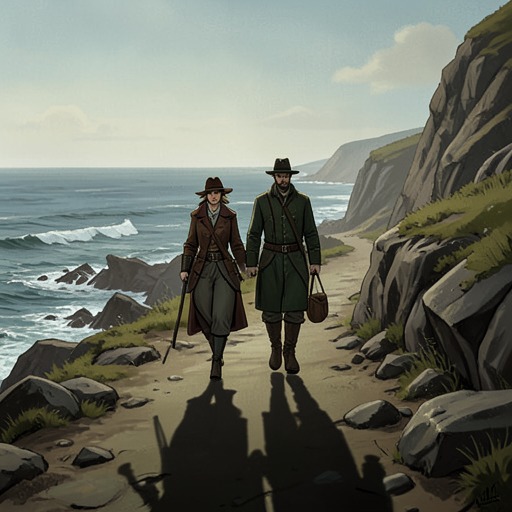
Moth checks the orange route line on the Ordnance Survey map in The South West Coast Path and identifies the monument as their next point of reference. The monument’s giant metal hands hold a map and mark the path’s start. They remain there longer than necessary, taking photographs, adjusting their packs, and delaying the moment of departure. Their circumstances crowd into that pause: they are excited and afraid, homeless and exhausted, and Moth is seriously ill. But beginning the walk will give them somewhere to go and a purpose for the afternoon. At half past three on a Thursday, they take the first step of a 630-mile walk.
The terrain answers back
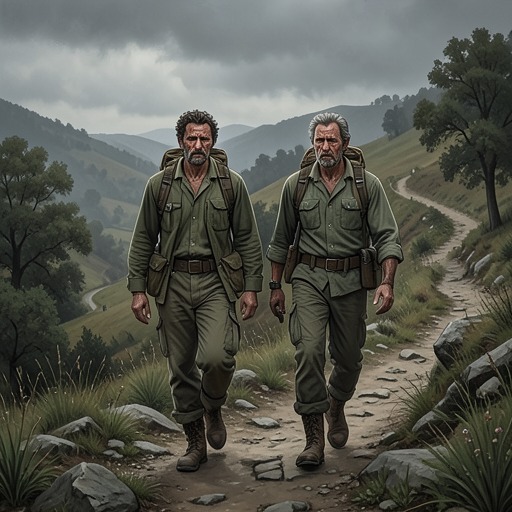
Minehead’s beginning quickly turns the abstract route into a physical test. Halfway up a steep zigzag through the woods, Ray and Moth stop on a bench with a glimpse of the sea through the branches. They reread the guidebook’s description of a path that drifts inland and uphill, then compare it with the climb beneath them. Their exchange registers both the guide’s understatement and their own alarm: the route has barely begun, yet the effort already feels disproportionate to the distance covered.
After half a mile, they have drunk half a litre of water, and Ray’s head feels close to bursting. A large family passes them going downhill and asks where their heavily filled packs are taking them. Ray answers that they hope to reach Land’s End. The encounter makes the scale of the undertaking visible to other people, while the immediate physical strain makes its uncertainty visible to the walkers themselves. Minehead does not offer a gradual transition from settled life to the path; it puts the climb directly after the commemorative first step.
The contrast persists in how the couple read the landscape. The map supplies a line to follow, and the guide supplies a verbal estimate, but each has to be tested against steepness, heat, thirst and pain. Later, as the walk becomes a means of living with fear and grief, Ray describes its repetitive movement as a meditation in which each step has its own weight and each difficult valley crossed becomes a victory. That understanding is not yet established at the Minehead monument. Its first, harder lesson is that forward movement has to be made with the body, one exertion at a time.
A departure point that keeps returning
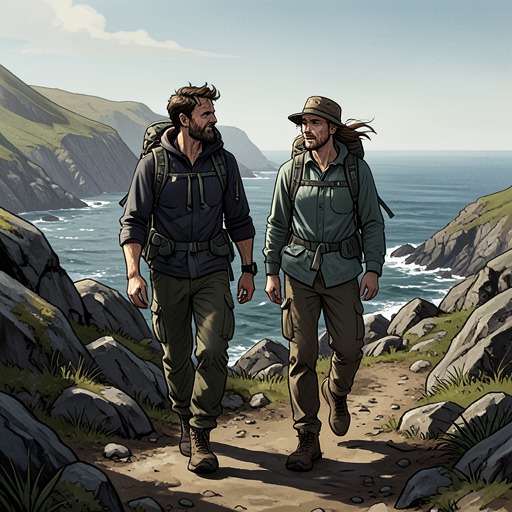
Minehead remains the point of origin even as the journey changes shape. On the first leg, Ray and Moth travel from Minehead west, telling people they have lost their home and are walking wherever the path takes them. In a conversation with another walker, Ray presents the journey plainly: they have come from Minehead, are heading west, and do not know what comes next. Elsewhere, their encounter with a man who wants to walk for days gives rise to Ray’s advice that he should begin rather than wait, since no one knows how long their fetch will be. The open-endedness of that counsel belongs to a walk that began without a settled destination beyond the next stretch of coast.
The first journey does not complete the entire trail. After more than 250 miles, Ray and Moth consider leaving the path and returning to Wales to seek a council house and a winter campsite. Instead, they choose to continue. Later they leave the coast for a period, and the renewed journey begins from Poole. Ray tells a young woman that they walked from Minehead to Polruan the previous year and have resumed from Poole; together the two journeys have covered 630 miles, with about 40 miles still missed. Minehead therefore anchors the first stage of a longer, interrupted undertaking rather than a single continuous expedition.
By the time the trail’s end is close, its beginning has become a measure of change. Ray handles the familiar guidebook, its pages marked by elastic bands, and sees only a little of the route left untrodden. The walk has not solved the couple’s uncertain future: they still have to find a room or a campsite, and Moth is due to begin a university degree. But Minehead marks the moment when the path first gives their homelessness a chosen direction. Its importance lies in that double meaning: the walk begins there as an act of survival, while the steep climb immediately beyond the town prevents that beginning from becoming a simple story of escape.