Moth
The Salt PathMoth is Ray’s husband and companion on the South West Coast Path, a journey begun after the couple lost their home and livelihood and learned that he might have corticobasal degeneration. His story is shaped by a tension between bodily vulnerability and unexpected capacity: illness makes ordinary movement difficult, yet on the trail he can carry a pack, climb steep ground and, for a time, recover abilities that had seemed to be disappearing. The improvement does not erase the diagnosis. It gives the couple room to live beyond its immediate threat while leaving the future unresolved.
Identity and diagnosis
Moth is identified by his nickname, which becomes a small point of friction when other people assume that he is a writer. Ray explains that Moth is his name but that he is not a writer; the people they meet nevertheless insist on calling him Simon. The exchange shows how quickly strangers substitute an expected identity for the one he gives them, even as the couple move through unfamiliar places and encounters.
A doctor tells Moth that he believes Moth has corticobasal degeneration, or CBD, while stressing that the diagnosis cannot be certain. There is no test, and the doctor says certainty will come only after death. The diagnosis therefore gives a name to what is happening without providing a definitive answer or a clear timetable. In Ray’s account, Moth is living under the weight of a possible fatal illness whose course cannot be predicted; he knows later that the disease has not miraculously vanished, even during a period when it seems held at bay.
The physical contrast is stark. Only two months before one scene on the coast, Moth had struggled to put on his coat without help. Now he stands on a beach in his underpants, a rucksack on his back, holding an erected tent above his head and urging Ray to run. The image is not proof that the illness has gone: it records a startling interval of strength against the memory of dependence. The pack and tent make his capability concrete, while the brief command turns the reversal into action rather than an abstract claim of recovery.
Homelessness and the decision to walk
In early August, Moth and Ray stand beside a road in Taunton with their rucksacks at their feet, homeless at last. Ray distinguishes this from travel or living temporarily in a van: those earlier departures had left a door to return to, whereas now there was no home waiting behind them. The couple’s exposure to homelessness coincides with the news of Moth’s illness and the loss of the life they had worked to build. Their explanation to other people is blunt: they have lost their house, business and savings, and Moth is dying, so they have gone for a walk, starting at Minehead and heading west without knowing where it will lead.
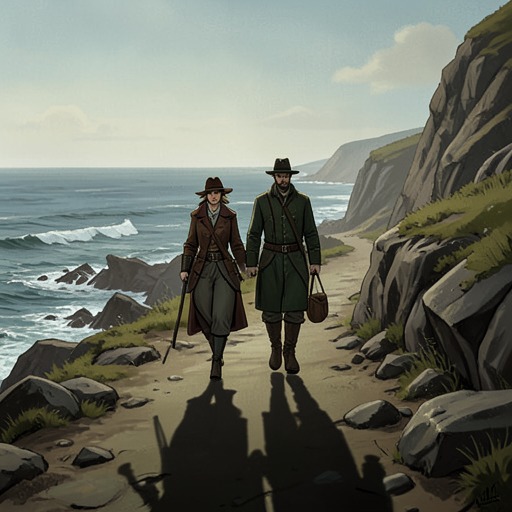
They choose the South West Coast Path as their route. The decision sets a practical direction without solving the larger crisis. Above Minehead, a steep zigzag through woodland quickly exposes the gap between the guidebook’s expectations and the effort of the ground: the couple stop on a bench, catch their breath and reread Paddy Dillon’s guidebook, which Ray concludes has underestimated the route. Walking is therefore no easy escape from bodily limits. Its repeated climbs and exertion make those limits immediate, even as continuing gives the couple a task for the next day.
The trail also makes different kinds of movement matter. When a bus takes them to Barnstaple and they change to another for Westward Ho!, Ray feels as though they are cheating. The discomfort reveals how strongly the journey’s identity has become attached to walking, though the couple’s route is not made up solely of unaided steps. Later, soaked and sitting beneath the archway entrance to a visitor centre, they watch a bus drive away and choose to continue on foot. They could have stopped, but Ray describes the choice as a form of control: they need not stay with friends or family until hospitality becomes a burden, and they remain free to walk on or stop. The freedom is real, but it exists within the harsher fact that they have nowhere secure to return to.
The body on the path
Moth’s experience of the coast is bound to the terrain and to the effort of crossing it. On a high path above the sea, Ray sees him walking with a lean away from the water and toward the cliff, while she experiences the height as exhilarating. The contrast belongs to their shared walk but not to a shared bodily response: the same exposed path gives Ray a sense of flight and Moth a more guarded way of moving. Elsewhere, the route’s rhythm of pain and hunger mellows into ache and thirst, until the repeated effort itself becomes the dominant beat. The sea and landscape do not remove the body’s needs; they accompany the couple as those needs change over the day.
At Port Quin, the visible coast behind them marks ground already covered, while the way forward seems to shorten toward another corner and another descent. That pattern gives the walk a finite, bodily measure: a view records passage, but the next stretch still has to be traversed. Ray describes each climb out of a combe as a victory and each survived day as a reason to continue. The couple’s shared movement becomes a practice of attending to the next step rather than making plans that illness and homelessness may overturn.
Moth later describes feeling stronger. He can put one foot down and trust where it will land; he is dropping things less often, and his shoulder hurts less. After he stops taking Pregabalin, the pain is initially severe, but somewhere before Newquay he realizes that he is feeling it less. He says it has been years since he felt this good and that his head is clearer, while also acknowledging that he cannot tell whether the change is temporary or whether the symptoms will return when he stops walking. His report keeps improvement and uncertainty together: the gains are specific to balance, dropping objects, shoulder pain and clarity of thought, but he cannot promise they will last.
Illness, reprieve and its return
The relief does not make the disease disappear from the narrative. As the journey continues, Ray sees confusion wash over Moth, who is hunched beneath his pack as his muscles recede. She identifies this as the beginning of the mental decline associated with CBD. The image of a sandcastle quietly falling beneath incoming water gives the change a gradual, erosive quality; it stands in sharp contrast to the earlier scene of Moth holding the tent aloft. The physical and cognitive course is not a simple recovery arc, but a succession of changes that the couple can neither predict nor control.
Then, in fog-bound heather, Ray sees Moth’s face clear. He is laughing, not hiding pain, and they hug, jump, kiss and shout together. In less than two weeks, he seems to have gone from being unable to get out of bed to being strong and in control of his limbs. Ray realizes that she had not registered the disappearance of the drag in his footprints. The scene’s force comes partly from that belated recognition: the change has been present in the way he walks, but only now becomes unmistakable to her. It feels impossible to them, yet the account does not treat it as a cure.
Ray describes this period as a reprieve from living beneath an uncertain sentence of death. Moth understands that CBD has not gone away, but for a while it is held back, and the illness no longer hangs over the tent as an immediate object of fear. That distinction matters. The reprieve is not a revised medical verdict; it is time in which Moth can think more clearly and the couple can experience him as present and physically capable. The diagnosis remains, but it does not occupy every moment in the same way.
Partnership and the uncertain future
Moth’s journey is inseparable from Ray’s, although the trail does not make their experiences identical. Ray’s account places her exhilaration beside his guarded lean, and her changing understanding beside his own reports of pain, balance and clarity. Their partnership is also practical: they carry their packs, decide whether to stop, and continue through rain and fatigue. When they walk through drizzle toward Plymouth, the city feels like a barrier and a doorway into an unknown future. The route has supplied a dependable pattern—pack the tent, walk, and do the same the next day—while the approaching end of the trail removes that structure. Ray senses that Moth is afraid too, though their fear is left largely unspoken.
The future also brings back the difficulty of making plans. In a moment of panic, Ray asks why they have never planned before, then answers herself: plans always end up like this. The line speaks to the instability around the couple, rather than to any certainty about what Moth will do next. For a time, walking has allowed them to place the next step ahead of the unknowable longer future; reaching its final stretches means confronting that future again.
Ray’s closing thanks to her children, Tom and Rowan, says that they believed she could walk 630 miles and write a book when she did not believe it herself. She then addresses Moth as kind, persistent and inspirational, and calls him the love of her life. The acknowledgment restores the journey to its intimate scale: alongside the public fact of homelessness and the medical uncertainty of CBD is the continuing relationship between two people who have walked together. Moth’s significance lies neither in a miraculous cure nor in illness alone, but in the lived intervals between them—in the effort of moving, the strength that returns for a time, and the companionship that persists without certainty about what comes next.