Moth’s street reading of Beowulf in St Ives
The Salt PathMoth’s street reading of Beowulf in St Ives turns a familiar book into an impromptu public performance. Begun without warning in a space used by buskers, it draws listeners into the street, meets a brief challenge about a licence, and ends with applause. The coins gathered afterward make the scene consequential beyond its tribute to the poem: for a couple living with little money, Moth’s reading produces both recognition and the means to buy food.
The book and the decision to read
The scene begins with Moth insisting that he needs Beowulf. His companion had not understood that he meant to sit and read there; Moth’s answer makes clear that the location is not incidental to him. He leads through the crowds to a wider stretch of street where buskers perform, finds a space near a deli, and opens the book. Its plain dark-blue cover and red writing are familiar to his companion, who recognizes it as the copy he carries. The choice is immediate and practical: he has come into the crowd for the book, and now he will use it.
The reading is not presented as a scheduled appearance or a prepared event. Moth asks whether his companion is ready, receives an anxious protest, and begins anyway. His companion tries to back away, embarrassed by his loud voice and the prospect of drawing attention. The difference between their responses gives the performance its first tension: Moth moves directly into the poem, while the person beside him is still imagining how the crowd might react. The street, with its buskers and passers-by, becomes an audience before either of them can control what that means.
A public performance takes shape
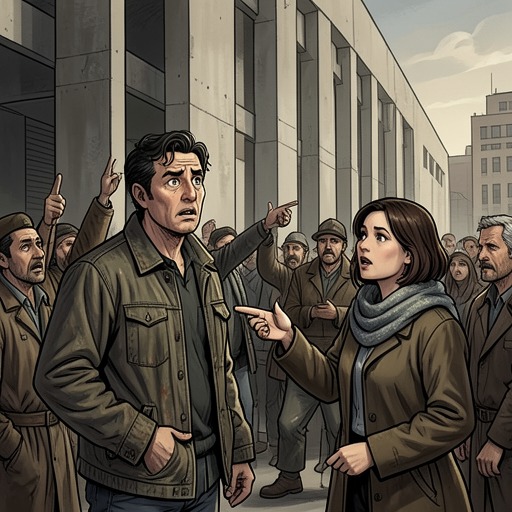
Moth begins with the opening lines about the Spear-Danes and their kings. At first, only a few people stop and turn. Then two older men stand with their arms folded and nod as he reads. Their response marks a change in the scene: the reading is no longer simply an act witnessed by his companion, but a performance held in the attention of strangers. Moth, absorbed in the words, appears oblivious to the growing crowd. His loudness, which had embarrassed his companion, helps carry the poem into the street.
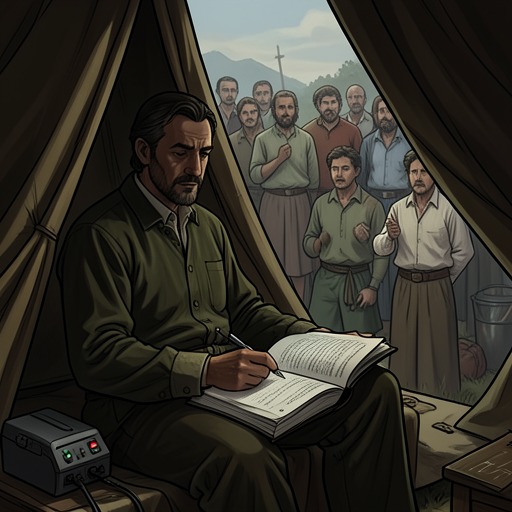
The narration connects that absorption with an earlier setting: Moth is described as being back in the builders’ snap cabin. The reading therefore links a public space in St Ives with a place recalled from his life outside it. The book is not only a literary text being recited for passers-by; through the narrator’s account, it also brings another setting into the moment. That remembered association belongs to Moth’s experience of the poem, while the expanding crowd makes the scene unmistakably present and public.
The performance is interrupted when someone from the side of the crowd asks, “Have you got a licence?” The question introduces an immediate uncertainty about whether Moth can continue. He closes the book rather than carrying on through the interruption. The reading thus ends not with a planned finish to the passage, but with a sudden stop. Yet the crowd does not disperse in silence: Moth thanks Seamus Heaney and Beowulf, and thanks those listening. The listeners clap, and one of the older men shakes his hand, calling the reading a great tribute and saying that Heaney would have been proud.
The reading’s material aftermath
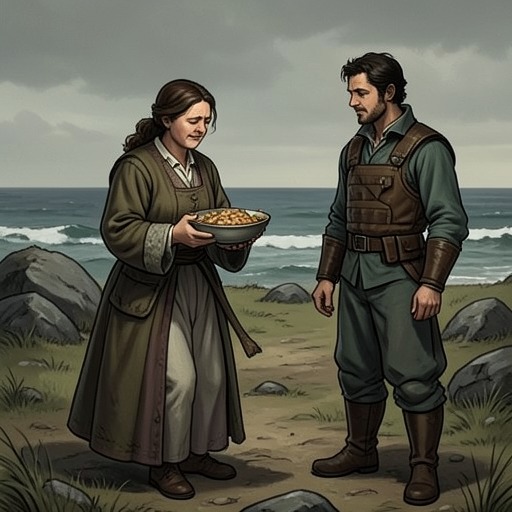
Back at the quiet end of the harbour, the couple empty the hat and count the money. They count it again, then a third time: £28.03. Their reaction is exuberant; they jump and laugh, crying as they reenact the scene. The amount matters in the circumstances of their journey. They have been craving food other than noodles, and the coins let them buy bread, fruit, and greens at the Co-op. They also get a woolly jumper each from a charity shop and two cones of chips; after adding money already in their pocket, they still have ten pounds, with another five in the bank. The reading has produced a concrete return, not just the applause of the street.
The contrast between the public performance and the quiet recounting afterward gives the event two kinds of recognition. In the street, strangers respond to Moth as a reader and offer applause and a handshake. At the harbour, the couple discover what the listeners’ coins can do for them: they can buy food and a few basic comforts. Their repeated counting and delighted reenactment show how unusual and welcome that outcome is without turning the scene into a secure income or a lasting solution.
A moment between two readings
On the way back to the campsite, the couple see a gallery poster for Simon Armitage, described as a poet walking from Minehead to Land’s End and giving readings along the way. His St Ives appearance is advertised as free but fully booked. The poster prompts the couple to recognize who he is; the reading in the street has already placed Moth in a markedly different situation, performing without a booking in a busking space and collecting money in a hat. The juxtaposition connects two acts of public poetry while preserving their difference in access and circumstance.
The episode’s significance lies in that compact reversal. Moth’s companion begins embarrassed and tries to withdraw; Moth reads, listeners gather, a question about permission cuts the performance short, and applause follows. Later, the coins turn attention into immediate help. The scene does not resolve the couple’s insecurity, but it records a moment when a book carried on their journey enables Moth to address a crowd on his own terms—and when that crowd responds with more than passing attention.