Pencarrow Head
The Salt PathPencarrow Head becomes one of the defining places in Ray and Moth’s journey: first a precarious campsite above the sea, then the setting for an unresolved decision about shelter, and finally the headland where their homeless trail ends. Its significance comes not from safety or permanence, but from what happens as they pass through it twice. The gorse offers only limited cover; the coast keeps drawing them onward; and a peregrine falcon’s return gives the landscape a pattern against which Ray can measure change in herself and in their life together.
Setting and First Passage
After crossing by passenger ferry to Polruan, Ray and Moth climbed out of the village above Lantic Bay and reached Pencarrow Head. They sheltered their tent behind gorse and watched the lights of ships leaving Plymouth in the distance. The campsite was exposed and temporary, but the headland gave them a place to stop without requiring them to return to the settled world they had left.
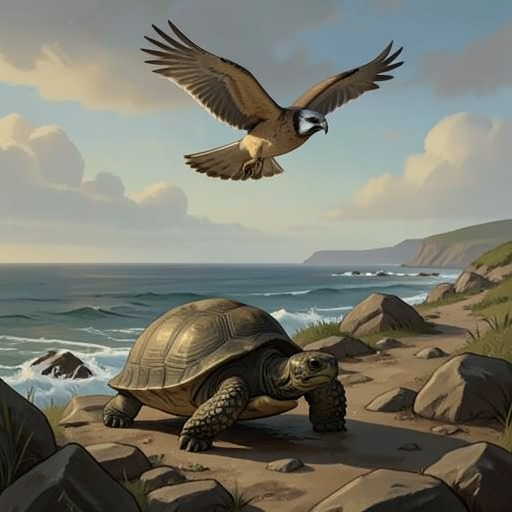
At dawn, a large bird rose from below the cliff. Its grey back and barred pale underside caught the weakening light before it swooped away at speed. Rabbits scattered and small birds fell silent. An older man approached across the headland, walking with a pole and a cut hazel rod. He spoke of a female peregrine falcon that had been there for weeks and asked whether Ray and Moth had seen her before. The exchange made the bird part of the place’s living present, rather than merely a distant feature of the view.
The first visit is framed by fatigue, observation, and uncertainty. Their route had become less jagged and more like slow-running water, but practical pressures remained acute. When a call interrupted the morning, Polly offered them temporary use of a former meat-cutting shed with a bathroom, provided they finished work on it. Pencarrow was thus also the place where an alternative to winter exposure became real, though the offer did not make the choice easy.
Shelter, Choice, and the Path Ahead
Ray and Moth could not decide at once whether to take Polly’s offer. Their tent faced east, backed into gorse and oriented toward the coast they had yet to walk: coves, headlands, sunrises, and further weather. The coming winter promised harsher storms and the likelihood that they would have to move inland. The question was not simply whether a shed would be warmer. It was whether to leave a way of life that, despite hunger and cold, still gave them control over where to go and when to stop.
They explored the coast before choosing. At Lantivet Bay they visited a white-painted granite obelisk and a lookout cottage set into the cliff, then scrambled down to Lantic Bay and searched the seaweed line. For three mornings, the peregrine falcon circled Pencarrow. Those repeated sightings gave the stay a rhythm: while the couple weighed the need for shelter, warmth, and money against the possibility of continuing on the path, the bird kept returning to the headland.
The episode belongs to a larger change in how Ray understands walking. Earlier, the journey had offered a way to keep moving through bereavement and fear, each day and each climb becoming a reason to continue. By the time she reaches this stretch of coast, acceptance has begun to replace her effort to recover the lost home or force a bureaucratic system to recognise their circumstances. She no longer needs to own land to feel part of the elements. Pencarrow’s exposed meeting of cliff, wind, water, and path gives that change a particular landscape, while the pending decision keeps it grounded in material need.
The Headland as a Place of Return
Much later, the route brings Ray and Moth back within sight of Pencarrow Head. Lantivet Bay lies below them, and the familiar headland signals how close they are to the end. They walk painfully slowly, stopping to look around: eager to finish, yet reluctant to let the final approach pass quickly. The return is not a restoration of their old life. That night they expect to unroll their sleeping bags on an unfamiliar floor; in the weeks ahead they will sell most of their remaining possessions to pay for a hire van and move what little they need to Polruan. Moth will begin a degree without confidence that he will live to complete it, while Ray plans to seek work and begin writing.
When delay is no longer possible, they walk over Pencarrow Head and sit on a bench overlooking Lantic Bay. Their rucksacks rest together as they share the last of a packet of wine gums. The peregrine falcon swoops along the cliff toward the bay, then rises out of sight. The modest details—the bench, the joined packs, the nearly finished sweets—give the ending the scale of a shared pause rather than a grand arrival. Their homeless trail is over, but the headland does not promise that the uncertainties of illness, money, or rebuilding a life have ended.
The Peregrine and the Meaning of the Ending
A figure emerges from the gorse wearing the same coat and hat as before and carrying the same stick. He tells them that the female peregrine falcon has returned after being away, and that she came back on the same day they had visited the previous year. He had expected Ray and Moth to return too. His recognition makes their passage legible to someone who belongs to this stretch of coast, while the bird’s seasonal return links the first visit to the last without making the year between them disappear.
For Ray, that encounter gathers the journey’s natural imagery into a reckoning. The walk has taken away material security and left her stripped of the assumptions attached to home as property; it has also left her with a choice about how to continue. She imagines herself and Moth as two molecules held together by a powerful bond that may one day break, an image that acknowledges both the endurance of their partnership and its vulnerability under illness. The peregrine’s flight does not resolve that uncertainty. Instead, its return accompanies Ray’s decision to keep writing the story with hope.
Pencarrow Head therefore works as more than a waypoint between bays. On the first visit it holds an unsettled choice: the path offers freedom and continuity, while winter makes shelter urgent. On the return, it becomes the point from which the couple can look back over the journey and step toward an unknown life beyond it. The headland’s recurrence supplies a form of closure without pretending that the future is secured: the trail ends, the bird rises out of sight, and Ray’s hope rests in the present rather than in a guaranteed outcome.