Pendennis Castle
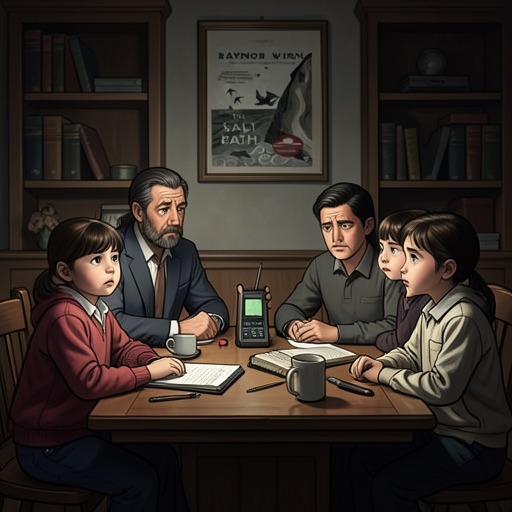
The Salt PathPendennis Castle is the setting for a night of improvised shelter in Ray and Moth’s walk along the South West Coast Path. They reach Falmouth after dark, too tired to look for anything better than a place to put up their tent near the castle. The scene makes the contrast between a familiar public landmark and their insecure circumstances concrete: for them, a patch of ground beside the route is home for the night.
Arrival in Falmouth
After crossing the Helford River by ferry, Ray and Moth mistime their arrival in Falmouth. Darkness has fallen by the time they hastily erect the tent near Pendennis Castle. A group of teenagers are drinking cider on the rocks, but neither group intrudes on the other. The teenagers remain absorbed in their own evening, while Ray and Moth are too tired to mind their presence.
The scene’s small exchange turns the nearby drinkers into a reminder of the couple’s absent family life. Ray wonders whether Tom and Row might be doing the same thing; Moth answers that they are students, though they used to be. The thought brings their children into a moment otherwise defined by fatigue and makes the temporary camp feel connected to the life Ray and Moth have lost as well as the one they are trying to continue.
A stopping place on the coast path
The night beside the castle belongs to a journey repeatedly shaped by the difference between a route as described and a route as physically lived. Near Minehead, Ray and Moth struggle up a steep zigzag and find that the guidebook’s understated directions do little to prepare them for the climb. Elsewhere, heat, pain, hunger and thirst gradually settle into the rhythm of walking. The Falmouth stop offers no dramatic resolution: it is one more practical pause in a journey whose progress depends on finding somewhere to sleep and setting out again.
That dependence on the path becomes more than a matter of navigation. As the walk continues, its repeated steps provide a focus when the couple cannot yet make a larger plan; the narrator describes the movement itself as a kind of meditation. At the southern end of the mainland, the loss of their former home gives way to a growing sense that a narrow strip of path can serve as home without being owned. The campsite near Pendennis Castle is an earlier, more provisional instance of that condition: a tent put up quickly because the day has ended and the walkers must rest.
Homelessness and temporary shelter
The couple’s night near the castle takes place against the practical barriers that follow the loss of their house and income. A campsite asking eighty pounds a week is beyond their means, and campsite fees do not qualify for housing benefit. Renting is also difficult after repossession, while the available council accommodation is a low-priority bed-and-breakfast room. Faced with these options, Ray and Moth decide that they would rather stay in a tent.
The book also challenges the assumption that homelessness has one visible form. Its discussion of rough-sleeping figures distinguishes people recorded in a one-night count from households seeking help and from others who remain uncounted or hidden. The tent near Pendennis Castle is not presented as a settled solution, but as one episode in that wider insecurity: the couple’s shelter is temporary, dependent on where the walk brings them and where they can safely stop.
The coast as a changing idea of home
Later, after months of inland confinement, returning to the coast brings the narrator a surge of relief. The familiar pull of the path restores a sense of direction, even though the future remains uncertain. This change gives the Falmouth scene a place in the book’s larger movement from displacement towards acceptance. A tent pitched beside Pendennis Castle does not restore the house Ray and Moth have lost; it shows instead how their journey makes shelter out of small, temporary possibilities while their understanding of home begins to change.