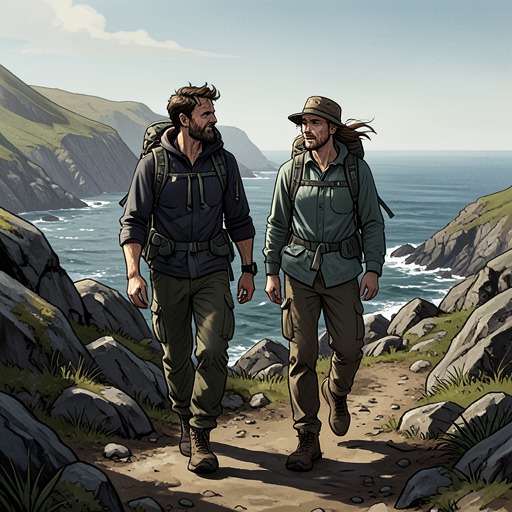
Peppercombe
The Salt PathPeppercombe is a small ravine on the coastal route where Ray and Moth seek shade, water, and relief when the heat leaves Moth struggling to continue. Its stream offers a practical refuge, but the respite does not settle the question of what is wrong with him: sunstroke seems likely, while the possibility of medication withdrawal also troubles Ray. The place matters less as a destination than as a moment when the path’s terrain directly shapes what they can do for one another.
Approach to the ravine
Ray and Moth reach the ravine after a punishing walk in intense heat. Moth says he wants to go home, get into his own bed, and never wake up. Ray lies beside him on the grass, then makes herself consult the walking map rather than give in to the fear raised by his words. She identifies Peppercombe tentatively as a little ravine with a stream and trees, reasoning that they must leave the exposed ground and cool down.
Moth says he cannot go on. Ray leaves her pack with him and walks ahead to investigate. Without its weight, her steps feel springier and her shoulders lighter, but relief at the physical ease is undercut by anxiety that Moth may genuinely be getting worse. At Peppercombe, a strip of trees and undergrowth follows the narrow valley toward the sea. The sound of running water guides Ray to a clear stream beneath the shade, a sharp contrast with the heat from which she has just come.
Water and temporary relief
Ray splashes the cold water over her burning skin and drinks repeatedly from her cupped hands. She fills a two-litre bottle to take back up the hill. The stream changes the immediate problem from enduring the heat to getting Moth down to a cooler place and keeping him hydrated. Ray tells him the water will be ready to drink after a purifying tablet has taken effect, while privately acknowledging that she has already drunk about a pint without waiting to consider bacteria.
They spend the afternoon dozing beneath the green shade. A pack of spaniels rushes into the stream, their owners appearing on the bridge above it. The scene brings other walkers and dogs into a spot that had been a secluded refuge, but it does not displace the practical importance of the water. Ray is glad the bottles are already filled. Peppercombe offers shelter and a source of water, not a solution that removes the need to keep moving or to judge what Moth’s symptoms mean.
From the ravine to the shore
Ray and Moth next decide to go down to the beach, and Ray immediately regrets leaving the path: the track descends steeply, so the lost height will have to be regained. The shoreline is made of smooth, sea-worn stones above black rock exposed by the low tide. Sun-warmed cobbles soothe their aching muscles, while scrubby vegetation gives them shade from the early-evening sun still burning their reddened skin.
The respite is physically incomplete. Moth is shivering despite feeling hot; his joints ache and he is nauseous. He asks whether he is dying. Ray tells him that sunstroke is more likely and that the illness would not simply strike in the afternoon and kill him by teatime. Her reassurance is an attempt to make sense of what she can observe, not a diagnosis. Moth later insists that it is only sunstroke and proposes making tea and eating something, but Ray remembers the doctor’s warning not to stop taking Pregabalin abruptly. Headache, nausea, sweating, anxiety, and other possible withdrawal symptoms make it difficult for her to dismiss that alternative.
Moth cannot eat and brings up a few spoonfuls of rice, though he continues drinking. As his shaking becomes more pronounced, they pitch the tent on a flat patch behind a hedge. He changes into a clean T-shirt kept at the bottom of his pack; Ray washes the vomit into a rock pool. The scene extends beyond the ravine itself, but it shows the limits of the relief its water and shade have provided: they can cool down and rest, while Moth remains unwell and the cause uncertain.
A landscape that changes the pace
The episode belongs to a walk in which physical effort continually revises the walkers’ plans. Earlier, above Minehead, Ray and Moth had stopped on a bench midway up an exceptionally steep zigzag through the woods, breathing hard and rereading a guidebook whose description understated the climb. On another exposed stretch, heat reflected from the rock path as Moth walked leaning away from the sea and toward the cliff, while Ray felt exhilarated by the height and the salt air. These contrasts sharpen the significance of Peppercombe: the coast is not a single, steady promise of freedom but a succession of demanding conditions, and a patch of shade or a drink of water can determine whether the next stretch is possible.
Ray’s account also describes walking as a way of narrowing attention to what can be managed in the present. Each step, each climb completed, and each day survived becomes a reason to continue; the salt wind and movement gradually wear at the sharpness of memory. Peppercombe gives that process a concrete form. The route’s map names a ravine, but its value becomes legible through bodily experience: overheated skin, cold water, a full bottle, and a place to lie down.
Significance in the journey
Peppercombe is not presented as a permanent refuge. Its shade allows Ray and Moth to pause, and its stream supplies water, but the steep descent to the beach creates another climb, while the evening brings fresh uncertainty about Moth’s health. The episode holds relief and vulnerability together: Ray’s practical care keeps them moving, yet she cannot know whether Moth’s distress is caused by the heat, his illness, or medication withdrawal.
Later in the journey, the return to the coast after months of inland confinement brings Ray a powerful sense of relief. She describes the familiar pull of the path, the salt on her lips, and the wind as reassurance that continuing feels right. Her understanding of belonging also changes: she comes to feel part of the elements without needing to own a patch of land. Peppercombe is one small instance of that relationship with the coast, not through grand scenery but through the immediate shelter of trees and the usable coldness of a stream. Its importance lies in how landscape, illness, and care meet at walking speed.