Peregrine falcon
The Salt PathThe Peregrine falcon is a recurring wild presence on Pencarrow Head, first seen at dawn and encountered again a year later as Ray and Moth’s homeless trail ends. Her brief, forceful appearances connect the old man’s fear of blindness with Ray’s questions about memory, and give the journey’s ending an image of return: the falcon has been away and come back, while the walkers have also returned to the headland. Her significance is not only symbolic. The narrative attends closely to her flight and to the human desire to remember what may not always remain visible.
First appearance on Pencarrow Head
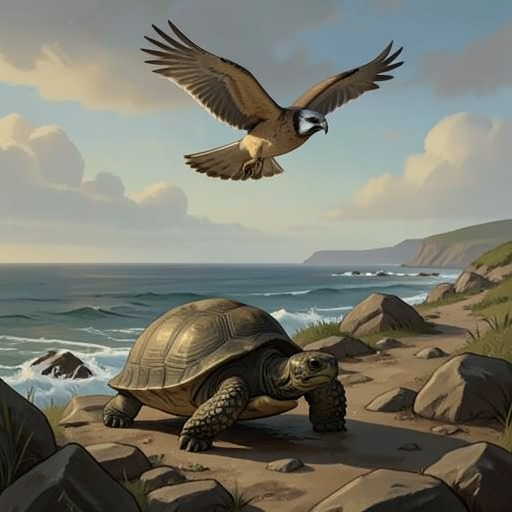
The first sighting comes in the thin light of morning, a pale yellow seam opening between layers of grey. The Peregrine falcon rises from below the cliff line, her large wings briefly outlined against the brightening sky. As she glides on the wind, she tilts to reveal a grey back and pale, barred underside, then swoops with such speed that she vanishes almost at once. The rabbits have scattered and the small birds have fallen silent. The scene registers her through a sequence of movement, exposure and disappearance: she is plainly visible, but only for a breath.
The falcon’s arrival draws the attention of an old man walking slowly across the headland. He identifies her as a female and says she has been there for a few weeks, a newcomer to a place he has known all his life. His interest is immediate and particular. He asks whether Ray and Moth have seen her before, and returns to the simple judgment that she is beautiful. The falcon is not introduced through a general description of wildlife; she enters the account as a creature whose presence matters to someone who comes to this headland repeatedly.
The old man’s reason for watching
The man describes a life rooted in the surrounding woods: he has a shed there, keeps chickens and cuts timber. He also explains that doctors have warned him he may have glaucoma and could go blind. His uncertainty about the name of the condition, which Ray supplies, sits beside his matter-of-fact account of what may happen to his sight. He says that he comes to the headland whenever he can because he needs to remember it for the time when he can no longer see it.
That explanation changes the force of the birdwatching. The falcon is a beautiful sight in her own right, but seeing her is also part of the man’s effort to carry the place forward into a possible future without sight. Ray answers that it is a sight worth remembering, and the man says he is glad she has come. The exchange is brief and does not resolve the threat of blindness. Instead, it makes the falcon’s passing flight inseparable from the work of attention: looking carefully now because looking may later become impossible.
Flight, disappearance and memory
After the man walks away, the light widens, seeming to prise the sky and sea apart. Ray’s narration turns from the visible landscape to the limits of recollection: whether enough has been seen, whether what can no longer be seen will still be remembered, and whether memory alone can make a person whole. The questions echo the old man’s practical fear, but widen it. The falcon is not merely an image to preserve; her swift disappearance prompts a larger uncertainty about whether remembering an experience can stand in for its continued presence.
The scene makes no promise that memory will be sufficient. The man’s walk back across the headland and the falcon’s sudden vanishing leave the question open. This restraint matters: the bird cannot be held in place for either observer. Her visibility is temporary, and the desire to remember follows from that fact rather than overcoming it. The falcon’s first appearance therefore gives the book a concrete form for the difference between seeing something in the present and hoping to retain it afterward.
Return at the end of the trail
A year later, as Ray and Moth walk painfully slowly over Pencarrow Head, stopping to look around even as they approach the end of their journey, the Peregrine falcon swoops close by. She follows the cliff line down towards Lantic Bay, then rises and disappears from sight. Ray and Moth sit on a bench overlooking the bay with their rucksacks propped together, sharing the last of their wine gums; the falcon’s flight takes place within this quiet pause at the completion of their homeless trail.
The old man appears again, wearing the same coat and hat and carrying the same stick. He says the falcon has returned after being away, and that she disappeared on the same day Ray and Moth were there the previous year. He had told people they would come back and understands the timing as a sign. His interpretation belongs to him; the narrative does not establish a supernatural cause for the bird’s return or for the coincidence. What it does establish is a striking recurrence: the same headland, the same observer, the same falcon, and walkers who have come back after a year on the path.
Narrative significance
The falcon’s return gives the ending an image of continuity without promising permanence. She reappears, flies along the cliff and is gone again; Ray and Moth’s journey also reaches an end without making the future certain. Ray reflects that homelessness stripped away material possessions but left a choice about whether to continue the story with hope. The falcon’s flight does not answer that uncertainty, but its recurrence offers a pattern of departure and return that can be held alongside it.
The book also resists reducing the animal to a message for the human characters. The falcon is observed in precise physical detail, arrives on her own terms, and vanishes beyond their possession or control. The old man’s wish to remember her and Ray’s later use of her image reveal what the bird means to them, but do not explain away her independent presence. She remains both a creature in flight and a point where sight, memory, aging, return and hope meet.