Polruan
The Salt PathPolruan is a small village across the river from Fowey, encountered on foot as Ray and Moth approach the end of their long coastal journey. Its importance shifts from a place reached by ferry to the site of a promised home: a flat made available to them when homelessness, illness and uncertainty had narrowed their choices. In that change, Polruan becomes both a point on the route and a threshold between life on the path and the attempt to begin again under a roof.
Setting and First Arrival
Ray and Moth reach Polruan by passenger ferry from Fowey after withdrawing money and buying a loaf of bread and a tin of soup. The crossing brings them to what Ray sees as a smaller, diminished mirror of Fowey. The village’s quay and boatyard give the arrival a working, everyday scale: from the slipway, the couple watch sparks fly as a welder repairs a boat on the opposite side.
The scene is quiet rather than triumphant. A cormorant passes low over the water; a grey sky merges with a grey sea, while the welding continues behind the boat. Ray imagines music playing in the boatyard, but recognizes that the imagined soundtrack is probably less likely than the local radio. The detail holds together observation and speculation, placing the couple’s private journey within the ordinary activity of a harbour town.
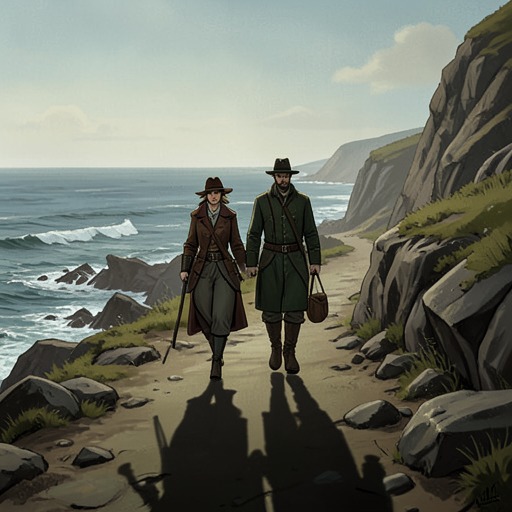
They climb steeply out of the village and continue above Lantic Bay toward Pencarrow Head, sheltering their tent behind gorse and watching ships’ lights in the distance. Polruan is therefore not simply a destination where the walking stops. It belongs to a landscape of ferry crossings, headlands and exposed campsites, where progress is measured by the next climb and the next place to sleep.
A Village on the Near Side of the Ending
As the journey continues, Polruan becomes associated with the end of the trail. In the rain, with Plymouth ahead as an imposing passage into an unknown future, Ray thinks of the last ferry crossings as symbols of the journey’s final leg. Polruan lies only a few days’ walk to the west and has come to stand for the point at which the reliable routine of walking will give way to whatever comes afterward.
That routine had offered a particular kind of control. The couple could pack their tent and walk on, or choose to stop; they did not have to remain with friends until hospitality became strain or dependence. At Land’s End, after a bus could have taken them back toward the familiarity of Wales, they chose to shoulder their wet packs and continue. Polruan’s approaching presence gives that decision a destination without removing its uncertainty: the path offers direction, while life beyond it remains unresolved.
The Offer of a Home
The decisive change comes through Anna, who tells Ray and Moth that her tenants are leaving a flat in Polruan. She has not yet advertised it and offers to rent it to them, explaining that the coastal path runs past the front door. The offer directly answers the couple’s precarious housing situation with a specific place, not merely the hope of finding accommodation somewhere.
That offer matters against the barriers they have already faced. Their savings had been consumed by legal fees, and the loss of their house also meant losing their holiday-rental business and income. A campsite cost eighty pounds a week, beyond their means, while they could not find a lasting room or garden with people they knew. Repossession had damaged their credit rating, making private rental difficult; the council regarded them as low priority and could offer only a bed-and-breakfast room. In that context, Anna’s willingness to rent to them turns Polruan into a route out of immediate homelessness.
The news is at first almost too difficult to trust. Ray and Moth keep the napkin with the address written on it, and the sudden prospect of having an address brings them to dance and shout among the bladderwrack. When they later buy two beers in Polperro, they have the deposit and first month’s rent, noodles in their packs and a student loan expected in a few weeks. The flat is not presented as a cure for every problem, but it changes what the couple can imagine doing next.
The End of the Walk and the Beginning of Settlement
On the final night under canvas, Ray and Moth pitch their tent on a cliffside with the Channel beyond its doorway. The coast to the east disappears into darkness; Polruan, and the future represented by the flat, lies less than a day’s walk away. Ray is exhilarated by the prospect that their homeless life may be ending, yet cannot know who she will be once she wakes without another day’s walk ahead. The tent’s closing flap marks both an ending and a pause before a life not yet known.
The next day, they walk slowly toward the end, stopping to look around even as they long to arrive. Ray anticipates that they will sleep that night on an unfamiliar floor, then sell most of their remaining possessions to hire a van and move what little they need to Polruan. Moth is to begin a degree without certainty that his health will allow him to complete it; Ray plans to look for work and write. The move thus depends on a mixture of concrete arrangements and uncertain hopes, rather than a sudden return to security.
Home Beside the Route
Polruan’s significance lies in the unusual closeness between shelter and movement. Anna’s flat offers a fixed address, but the coastal path passes its front door, keeping the landscape that shaped the couple’s days physically close to their new home. The village does not erase the hardships that brought them there; it gives them a place from which to face those hardships without having to carry their home on their backs.
The later image of Ray moving through the narrow apartment at the back of a chapel, with lights visible across the river in Fowey, continues this association between domestic life and the coastal setting. After a 630-mile walk, learning again to live under a roof is itself an adjustment. Polruan is therefore more than the last stop on a route: it marks the unsettled passage from chosen daily movement, which had become a form of security, to the work of rebuilding a life in one place.