Public Space Protection Orders
The Salt PathPublic Space Protection Orders (PSPOs) are a local-authority mechanism described in The Salt Path as allowing authorities to restrict conduct considered a nuisance in a defined locality. Introduced under the Anti-social Behaviour, Crime and Policing Act 2014, they can require a person to leave an area and not return. The book emphasizes how this power may reach beyond obvious disorder: councils have used orders against activities associated with homelessness, including rough sleeping, begging and loitering. Its significance in the narrative lies in the pressure it places on people without secure accommodation, for whom public space may be among the few places available to exist.
Powers and scope
The account situates PSPOs in the legal climate of 2014, the year after Ray and Moth began walking the South West Coast Path. The orders allow authorities to designate behavior as a nuisance and to direct people to leave and not return to a locality. The book describes their application as wide-ranging, citing a Forest of Dean order concerning nuisance sheep and restrictions on carrying golf clubs in a public place. These examples make the power’s breadth concrete: conduct need not be an obvious crime to become grounds for exclusion.
The consequences can extend beyond being moved on. According to the account, councils can impose a fine of one hundred pounds for breaching an order, rising to a thousand pounds and a criminal record if the fine is not paid. The rule therefore joins spatial exclusion to financial and legal penalties. For someone already without stable housing, the ability to move on is not necessarily a practical solution when there is nowhere else to go.
Homelessness, visibility, and official categories
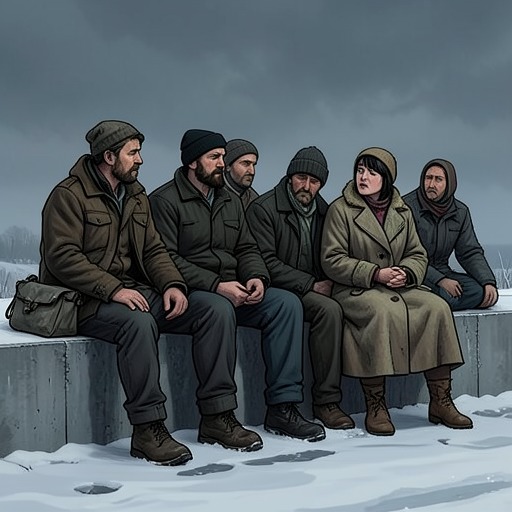
The discussion of PSPOs follows an account of how public perceptions narrow homelessness to a familiar stereotype: a rough sleeper bedding down in a doorway, perhaps with a dog, and presumed to be begging for money for drugs or alcohol. The book contrasts that image with evidence of a much larger and less visible population. Research by Crisis and the Joseph Rowntree Foundation found that in 2013 at least 280,000 UK households had claimed to be homeless or at risk of homelessness; officials accepted 52,000 as statutorily homeless, while many others received help through local-authority relief routes. These are household figures, not a count of individuals.
The statistics for people sleeping rough also depend heavily on how and when they are counted. A government snapshot estimated 2,414 people sleeping rough across England on one night in 2013. In London, the Homelessness and Information Network, funded by the Greater London Authority, recorded 6,508 people sleeping rough during the year, while the government’s snapshot figure for the period was 543. The contrast supports the book’s concern that people who are hidden, moving between temporary arrangements, or absent on the night of a count can disappear from official visibility even as public-space rules make their presence subject to control.
The rule alongside lived housing insecurity
Ray and Moth’s circumstances show why the account treats homelessness as more than sleeping on a pavement. After losing their house and income, they found that a campsite cost eighty pounds a week, beyond their means, and that housing benefit did not cover campsite fees. Renting was also effectively closed to them by their damaged credit rating. The council could place them on a waiting list, but the immediate offer was a bed-and-breakfast room; a staff member discounted Moth’s illness because he was not expected to die within a year. They decided they would rather stay in a tent. In early August, standing beside their rucksacks in Taunton, they understood themselves to be truly homeless: they had no door to return to.
The book later depicts other precarious forms of shelter without suggesting that PSPOs were enforced against these people. In a woodland camp, Ray and Moth encounter a shifting community of people living in tents, tarpaulins and shelters made from fallen branches. Their host, John, had become homeless after the farm where he worked was sold and the tied cottage was separated from the land; later jobs offered no accommodation, and his wages could not meet rural rents. Elsewhere, Ray and Moth put their tent inside a disused meat-processing shed, grateful for its roof despite its damaged plastic covering and exposed rafters. These episodes widen the picture of who may rely on marginal or improvised places to sleep, the same kinds of people that a rough-sleeper stereotype and a single-night count can fail to represent.
Narrative significance
The PSPO discussion connects historical suspicion of poverty with contemporary public-space regulation. The book traces earlier laws against begging and vagrancy before describing the 1824 Vagrancy Act, whose provisions included people lodging in barns, deserted buildings, open air, or under tents without visible means of subsistence. Against that history, PSPOs appear not simply as neutral rules for managing nuisance but as a modern means by which local authorities can restrict activities closely bound to having no home.
That tension sharpens the narrative’s distinction between chosen movement and forced displacement. Ray and Moth describe walking as a way to retain some control over their lives: on the path they can choose whether to continue or stop, unlike temporary stays that risk turning friends’ generosity into exhaustion. Yet their journey begins because they have lost the security of a home, and the rules around public space form part of the wider uncertainty awaiting anyone without a settled place. The book does not report that Ray or Moth received a PSPO or were prosecuted under one; instead, it uses the rule to expose how homelessness can be treated both as a condition requiring help and as conduct to be moved out of sight.