Ray
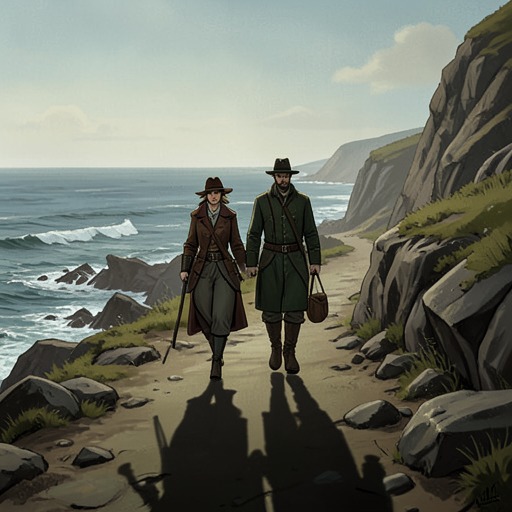
The Salt PathRay is the memoir’s first-person narrator and the central witness to a journey begun under the stairs, as bailiffs arrive to take possession of the couple’s home. At fifty, after building a life and a farm with Moth, she proposes walking without having planned the distance, cost, or destination. The South West Coast Path gives the homeless couple somewhere to go, but its changing ground also reshapes Ray’s sense of home, freedom, and what can still be chosen.
Identity and the decision to walk
Ray has been with Moth since she was eighteen. Together they rebuilt a ruined farm, restoring its walls and stones, growing vegetables and keeping hens, raising two children, and creating a barn where visitors could stay and help pay the bills. The house had held them for twenty years. When their legal defeat and the arrival of the bailiffs made that life unrecoverable, Ray’s attention turned to a book in a packing box, Five Hundred Mile Walkies, about a man walking the South West Coast Path with his dog. She had not worked out how to finance a long journey or imagined its nearly one hundred nights of wild camping. She had not even told Moth that he was coming with her.
The proposal came while the pair were hiding beneath the stairs, pressed together and listening as the bailiffs tried the windows and skylight. Ray suggested that they could walk; Moth’s question about whether they would do it together received her immediate assurance. They came out of hiding and crossed the threshold hand in hand, leaving the house and the life it contained behind. The departure is at once a practical response to losing their home and an intimate act of commitment: the destination is uncertain, but Ray and Moth face it together.
Homelessness, movement, and choice
The journey did not begin cleanly at a trailhead. After staying on a friend’s floor for nearly two weeks, Ray and Moth were driven to Taunton. In early August, standing beside their rucksacks on the roadside, Ray recognized that this was different from travelling or living temporarily in a van: there was no door to return to. The place where she stood felt safer than the prospect of moving on, even though it offered no lasting security. They had fifty pounds left, and the bus to Minehead cost ten pounds each. They boarded because walking required a beginning, and the path offered a reason to keep moving when their previous future had disappeared.
At Minehead, the giant metal hands holding a map marked the start of the South West Coast Path. The first step took time: the couple delayed with photographs and adjustments to their packs, aware that they were exhausted, frightened, homeless, and facing 630 miles. The route soon made the gap between a guidebook’s language and bodily experience unmistakable. On an excruciatingly steep zigzag above Minehead, Ray and Moth stopped to breathe and reread Paddy Dillon’s description of a path that supposedly drifted inland and uphill. What the book made sound slight was, beneath their packs, punishingly steep.
Walking did not make every movement voluntary. When the couple travelled by bus from Barnstaple to Westward Ho!, Ray felt that they were cheating, and the break in the trail left them disconnected. Yet later, after more than 250 miles of pain, hunger, exhaustion, wild nights, and bad weather, they chose not to board a bus away from the path. They were cold and drenched after rain at the Land’s End visitor centre, but Ray understood that continuing meant retaining some control: they could decide whether to walk, stop, or move on without becoming dependent on the goodwill of friends until generosity wore into irritation. The choice was limited by poverty and circumstance, but it mattered precisely because it remained a choice.
The body, the landscape, and Moth’s illness
For Ray, the coast is not scenery separate from the journey; weather, gradients, and the rhythm of walking alter what she can attend to and endure. Climbing from a valley, her legs, hips, and shoulders ache, and the rock path throws heat back at her face. Yet, high above the sea, a blue wind lifts beneath her rucksack and the height brings exhilaration. Moth leans away from the sea and towards the cliff, while Ray feels herself lifted by the salt air and heather. Pain and exhilaration occupy the same ascent rather than cancelling each other out.
The daily rhythm also changes how hardship registers. Ray describes the march between gorse and stone, the sea’s constant booming, and hunger and pain settling into a softer, recurring ache before giving way to thirst and the rhythm of walking. A climb becomes a victory; surviving a day supplies a reason to face the next. The path does not resolve the losses that brought them there, but its repeated steps give their days a form and a manageable scale.
That form exists alongside Moth’s declining physical capacity and Ray’s fear of what it means. At one point, she voices the sensation of homelessness as being like a balloon cut free in the wind and says she is scared; Moth replies that he would hug her but cannot sit up. Later, he explains that he sometimes wakes unable to remember what he is supposed to do, and must tell himself to eat, drink, or go to the bathroom because he should, not because he wants to. He asks whether he is dying. Ray’s account holds this question beside the practical details of caring for him, including helping with his pack and rubbing his shoulders when pain makes the walk harder. The landscape can bring relief and exhilaration, but it cannot remove the uncertainty of Moth’s illness.
Loss, narration, and belonging
Ray’s understanding of homelessness is also shaped by how other people respond to it. She and Moth find that saying they lost their home can make conversations end abruptly, while claiming they sold it to pursue an adventure earns admiration. The single changed word determines whether their mobility is read as a choice or as a condition associated with stigma. They adopt the more palatable story for strangers, even as Ray wonders whether repeating it also helps them bear their grief. The journey thus includes a struggle over who gets to name their circumstances, not only a struggle to find shelter.
The walking itself becomes a space in which memory and fear change shape. Ray reflects that the walk has turned less into a time for making a plan than into a meditation, a mental void of salt wind, dust, and light. This does not mean that practical concerns vanish: money, shelter, fatigue, and Moth’s future continually return. Rather, attention narrows to the step being taken and the next one, while the physical demands of each combe and each day create small measures of survival.
Near the southern end of the mainland, Ray’s relationship to home begins to alter. She knows that she will not return to the old house, with its slate floor, cats, garden, and view of the Plough. The path, often no more than a foot wide, has become home in a different sense. She describes a movement away from anger at the system and the unchangeable, towards an acceptance of being part of the elements without owning land. This change does not erase the farm or the pain of losing it; it lets Ray imagine belonging without possession.
Continuing into an uncertain future
At Old Harry Rocks, after months of inland confinement, Ray feels relief at returning to the coast. The familiar pull of the path steadies her, and the couple camp on Ballard Down, looking across to the lights of Swanage. Their decision to set out again carries material hopes as well as emotional need: they intend to pay for a room with money they have earned, Moth plans to retrain, and Ray expects to find work or retrain herself. They want somewhere of their own rather than a life sustained by other people’s goodwill.
The path does not provide a final answer before it ends. When John drives away on the Isle of Portland, Ray and Moth consider taking a slower route along Chesil Beach because she is drained; they reject the idea that they must follow the trail as purists. Later, rain and the approaching urban threshold of Plymouth sharpen the fear waiting beyond the walk. Its familiar routine has offered certainty—pack the tent, take the next step, and know what tomorrow requires—while the future raises questions about money, starting again, and what will happen to Moth when they stop walking. When their plans are disrupted near Plymouth, Ray feels panic, and the pair face the prospect of moving through a town to find somewhere to sleep. Her story therefore does not turn homelessness into a simple tale of freedom: movement gives her purpose and agency, while the need to keep moving exposes how precarious their security remains.