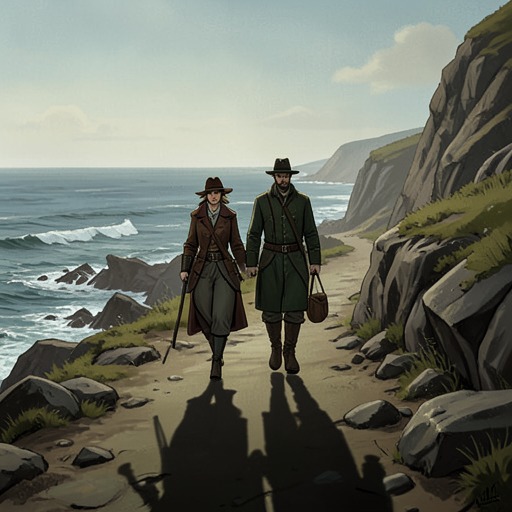
Ray and Moth’s staged South West Coast Path journey
The Salt PathRay and Moth’s staged South West Coast Path journey makes walking both a practical response to homelessness and a fragile form of self-determination. With no home to return to, they begin at Minehead and move west through pain, hunger, weather and changing landscapes. Reaching Land’s End does not end the walk: they choose to continue, later return to the route from Poole, and confront the approaching point where the path will no longer supply the certainty of a next day’s walk.
Beginning without a door
In early August, after leaving Taunton with their rucksacks, Ray and Moth are no longer travellers who can rely on a homecoming. Ray distinguishes their situation from earlier journeys and van-dwelling: previously, even an unhappy home remained a place where they could put down their bags. Now there is no door to return to. The roadside, at that moment, feels safer than the absent home, and moving on is at once a necessity and a way to give the future some shape.
Money makes the decision tangible. The bus to Minehead costs ten pounds each; after their other expenses, they have fifty pounds left, while forty-eight pounds is due to arrive in the bank each week. The figures offer a narrow margin rather than security. Still, the South West Coast Path gives them a reason to keep moving, and the journey begins as both a route across the coast and an attempt to act within circumstances they did not choose.
At the monument marking the path’s start, a pair of giant metal hands hold a map. The crowds thin while Ray and Moth delay: taking photographs, adjusting their packs and trying to make themselves take the first step. They are excited and afraid, homeless and conscious of illness, but the walk promises a destination for the immediate future. That promise is quickly tested. Above Minehead, a steep zigzag climb contradicts the guidebook’s understated description of a path that merely drifts inland and uphill. The discrepancy between the printed route and the slope underfoot establishes a recurring pattern: the coast must be understood through exertion, not just through a map or guide.
Learning the route through the body
As the walk continues, the physical world changes what the journey means. On a steep climb above a valley, Ray and Moth’s legs, hips and shoulders hurt; heat radiates from the rocky path. Yet at the cliff top, wind beneath Ray’s rucksack and the view towards Wales bring a moment of exhilaration. Moth walks leaning away from the sea, while Ray describes feeling lifted by the height and salt air. The landscape is not simply scenery behind their hardship: its slopes, exposure and weather shape what they can do and how they experience being in motion.
The daily route also brings small encounters and temporary fellow-feeling. Near a steep path, Ray and Moth meet other backpackers, whose tidy equipment and youthful freshness make them feel connected to a community of walkers. Later, after meeting a couple who have started at Tintagel and intend to walk for a week, Moth says they are heading to Land’s End, perhaps beyond. Their astonishment at the ambition leaves the couple walking with renewed energy. They forage mushrooms and unripe blackberries, pitch their tent on Bounds Cliff, and eat noodles as the evening light fades. Such episodes turn distance into a sequence of practical decisions: what to carry, where to sleep, and how to keep going.
Walking also becomes a way of attending to the coast’s human history. At Morwenstow, Ray and Moth shelter in the driftwood hut built by Robert Stephen Hawker, a Cornish vicar and poet. Hawker’s exposed refuge prompts Ray to imagine the freedom of thought its setting offered; his work rescuing shipwrecked sailors and burying the dead gives the hut a history of shelter beside danger. Their own need is more immediate: they are hungry and have been living on fudge, but cannot spend scarce money on a café. The encounter brings the vulnerability of their present into contact with an older story of life on the coast.
Other stretches reveal less romantic histories. Near Nancekuke, a site first built as RAF Portreath during the Second World War became a government chemical-weapons plant using equipment brought back from Nazi Germany. Sarin B production continued for two or three years. A newspaper investigation reported forty-one deaths and serious illness among workers; a 1970 study found elevated rates of serious illness and respiratory disease among those involved in production. The government suppressed and altered the study’s conclusions, later admitted negligence and paid affected workers around £120 each. It finally acknowledged in 2000 that production machinery had been dumped in mineshafts on the common; site cleaning began in 2003. The coast through which Ray and Moth walk thus holds not only natural forces and local memory but concealed damage and official denial.
The story told along the way
The couple’s homelessness also shapes the conversations they have with people they meet. When they explain truthfully that they lost their home and became penniless, people recoil and end conversations. They begin instead to say that they sold their home for a midlife adventure. That version prompts admiration. The difference, Ray observes, rests on the word sold: homelessness framed as a choice can be inspirational, while homelessness caused by loss invites rejection.
Repeating the more acceptable account changes how the loss feels. Ray wonders whether telling the lie often enough might soften grief, and whether a similar process is at work in refusing to accept Moth’s illness. The walk, once expected to help them gather their thoughts and make a plan, becomes a meditation shaped by salt wind, dust and light. Each climb out of a combe becomes a victory; each day survived supplies a reason to face the next. Movement does not settle the truth of their circumstances, but it gives attention a rhythm and makes the next step, rather than an imagined long-term solution, the immediate task.
Land’s End and the decision to continue
After more than 250 miles of pain, exhaustion, hunger, wild nights and bad weather, Ray and Moth reach Land’s End in rain. The famed destination is a deserted concrete development: shops and the exhibition centre are closed, and no one is there to welcome them. They take photographs at the signpost on a phone, two wet people clinging to a post rather than participants in a triumphant finish.
They could take a bus back towards Wales, seek a council house and find a campsite for winter. As the bus doors close, Moth holds Ray’s hand. But after watching the bus leave, they remain beneath the visitor-centre archway, dripping and sitting on their packs. They choose to walk on. Ray’s account presents the decision as a recovery of agency: on the path they can choose whether to walk or stop, whereas staying with friends or family risks making them feel like a burden. Within a short distance of the theme park, the cliffs return. They camp among rocks with little food and two sheets of nylon between them and Canada; the weather has at least stopped raining.
At the southernmost point, Ray describes a changed relation to home and ownership. The old house, its slate floor, cats and garden belong to a past they will not recover by turning back. A strip of path has become home in a different sense. The shift is not simply from distress to contentment: it is an emerging acceptance that belonging need not depend on owning land. Moth stands stiffly while Ray holds his pack for him, and together they turn north.
Resuming the unfinished journey
The decision to continue remains subject to winter, money and Moth’s need for warmth. Near Lantic Bay, Ray and Moth explore the coast, eat rice and tuna, and weigh whether to return to ordinary life or face winter on the path. They need shelter, warmth and money; Ray recognizes that some decisions cannot be judged as wrong until it is too late to reverse them. Eventually, the journey resumes from Poole. After getting off the ferry, they photograph the marker showing 630 miles from South Haven Point to Minehead. A route that could have been their finish line after a winter of wild camping is now their starting point: they head west towards Polruan, where their walk had stopped almost a year earlier, with about 250 miles left.
Returning to the path brings relief and a new warning. After months of inland confinement, Ray feels drawn back to the sea and the familiar uncertainty of the coast. Moth, however, is hunched beneath his pack, his muscles receding and confusion beginning to wash over him; Ray identifies this as the start of the mental decline accompanying CBD. They camp on Ballard Down, looking across at the lights of Swanage, and talk about whether coming back was the right choice. Ray says it is the most right thing they have ever done. The affirmation is grounded in a plan to pay for a room with money they earn and in Moth’s intention to retrain, but the return to walking is itself part of what feels right.
As Plymouth approaches, the path’s reliable routine becomes more precious because it cannot last. Packing the tent and walking each day have supplied certainty; the next ferry crossings mark the final leg towards Polruan and an unknown future. Ray fears what will happen to Moth when walking stops, alongside the practical problems of starting again. Their later choices remain constrained and ordinary: whether to pay for a ferry or walk through the city, where they might camp, and whether they will make the last crossing. When a plan fails and they face the prospect of sleeping in town, panic rises. The journey’s significance lies in this unresolved balance: walking gives them movement, shared purpose and moments of chosen freedom, but it cannot make homelessness, illness or the end of the route disappear.