Ray working as a wool presser for the shearing team
The Salt PathRay’s work as a wool presser begins with an offer of employment from Polly and becomes a demanding test of speed, coordination, and endurance. Over a two-and-a-half-month shearing season, Ray learns to turn each newly shorn fleece into a tight bundle and pack it away while the next sheep is already arriving. The job brings a substantial lump-sum payment, but its significance is larger than the money: it gives Ray useful work and a temporary foothold on a farm where shelter, friendship, and labor are closely entangled.
Shelter, Friendship, and the Offer of Work
By the time Ray and Moth are living on Polly’s farm, their shelter is a disused meat-packing shed. They pitch their tent inside its rain-lashed, industrial interior, grateful for a roof but not at ease: moss grows in the windows, insulation hangs from the rafters, and the wood burner has melted the plastic wall covering. Polly does not ask them for rent. Instead, she proposes that they help with the building and the farm, beginning with Moth doing plasterboard and plastering work. Their arrangement rests on a long friendship, formed through teenage crises and adult anxieties, and on the possibility that each side can help the other.
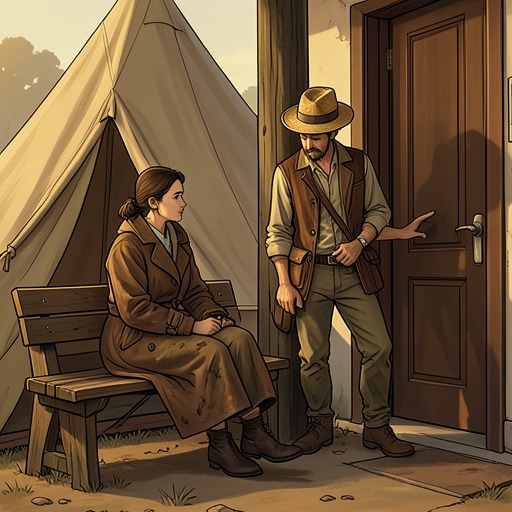
That practical usefulness does not dispel Ray’s sense of displacement. Away from the coast and among familiar people, Ray feels hollow and without a meaningful routine; work and shelter keep the couple warm and dry, but do not by themselves create a new life. Against this background, Polly’s offer of farm work is concrete and welcome. One early May morning, she rushes into the shed with a place for Ray on a shearing team: the team needs a wrapper, and Ray agrees despite not knowing whether the work will be manageable.
Learning the Pace of the Shearing Team
Ray has wrapped the couple’s own few fleeces after shearing, but recognizes that this is poor preparation for a professional team. The three shearers are competition-standard workers, each able to shear a ewe in under four minutes. Their speed turns wrapping from a simple task into a race to clear a small working space before the next fleece lands.
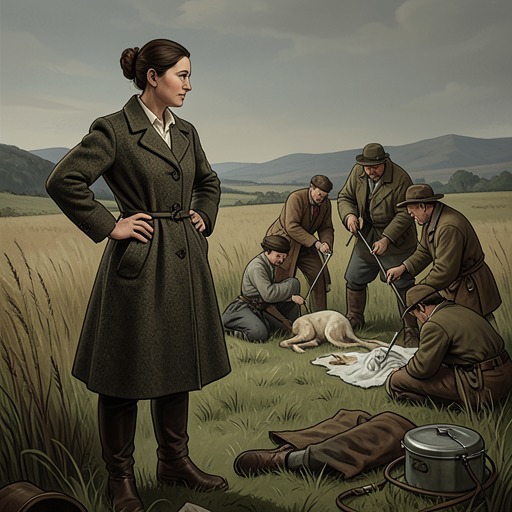
The working day begins before dawn. At six in the morning, a pick-up truck arrives with a rattling trailer assembled from strips of boarding and metal. Ray sits among tools, grease-covered clothing, sandwich boxes, and a panting black dog as the team collects other shearers and travels to a farm contracted to have more than eight hundred ewes shorn. The team expects the job to take about two days if all goes well. At the farm, the sheep fill more than half a large barn, the collecting yard, and part of a field.
The trailer’s improvised structure organizes the work. A ramp guides the sheep into a narrow race; three doors open from it onto the shearers’ raised platform, where each worker has a set of equipment. Small electric motors power the shearing heads. The shearers take off their boots and put on thick leather moccasins soaked with dark lanolin. Below the platform, Ray works beside a frame holding a woven plastic sack roughly two metres long, ready to receive the fleeces. By eight, the operation is set up.
The Work of Wrapping
As each shearer releases a fleece onto the platform, Ray must make room for the next ewe. The task is precise: turn the fleece onto its clean side with the head end facing Ray, fold the leg sides inward, roll it to roughly a foot wide, and tuck the final piece from the rump end into the bind to make a compact bundle. Ray then stuffs the fleece into the sack and clears wool and debris from the platform with the flat edge of a stick.
There is little spare space or time. A shearer has already turned back to the race for another ewe while Ray is still working beside the next animal. If the fleece is not cleared quickly, loose wool tangles around the kicking ewe’s feet and clutters the platform. With three shearers working at once, Ray has to move continually from one station to another. The first few fleeces are difficult because all three shearers are moving at roughly the same speed, but their pace begins to vary as the morning progresses. Ray finds a rhythm and adjusts to the changing intervals.
When a sack is full, Ray takes an eight-inch wooden peg from a bucket and drives it twice through both sides of the sack’s top. Four pegs secure the closure. One of the shearers then jumps down to help drag the heavy sack to the side of the barn. The process makes the job’s dependence on cooperation plain: Ray’s wrapping keeps the platform clear for the shearers, while their help is needed to move the finished sacks.
A Season’s Earnings and Its Limits
The first day stretches far beyond the morning’s early start. After breaks at half past ten, one, and four, the team continues until seven in the evening. The farmer brings out the final pen of sheep, the rams—muscular Texel animals nearly as large as the smaller shearer when seated on their haunches. Once they are shorn, the team sorts the sheep into separate fields, according to whether they have been clipped. Ray returns to the shed just after eight.
The work continues through the season. In early July, the last unshorn ewes are beginning to suffer from maggots. Flies lay eggs in dirty wool, often around the sheep’s rear; the hatched maggots burrow toward the skin, producing raw sores and, if left untreated, potentially killing the animal. As Ray picks the maggots from the final fleece, the last handful of green wool, skin, and fish-bait-like matter falls to the floor. The two and a half months of work are over.
The payment arrives all at once at the pub, where Gordon distributes the season’s earnings. Ray has fifteen hundred pounds in hand, a striking contrast with the eleven pounds Ray and Moth had to make last a week in Bude. The money is locked in a metal tin under the bed. It is a valuable reserve, but not a resolution: Ray continues doing laundry and cleaning holiday lets, while Moth is in enough pain to consider returning to Pregabalin and the prospect of university remains uncertain. Ray’s shearing work therefore marks both a practical gain and a limit. It provides income and a place in the farm’s working life, yet the seasonal payment cannot settle the couple’s longer-term question of how to build a life there.