Rocky Valley
The Salt PathRocky Valley is a rugged passage on Ray and Moth’s coastal walk, remembered for its boulder-strewn route, exposed rock formations and a rain-soaked pause that brings Ray’s fears for Rowan sharply into view. The place concentrates two kinds of strain: the physical cost of continuing over difficult ground and the emotional cost of being unable to help a daughter from afar.
Setting and place in the walk
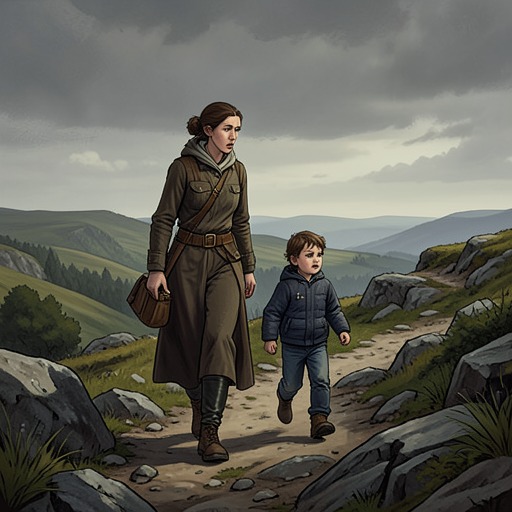
The account reaches Rocky Valley after the walkers have pressed on from Boscastle, where they camped on an old hill fort above the village. The following coastal stretch is marked by rock stacks facing the Atlantic Ocean and the Ladies’ Window, an arch through which the waves surge and recede. In Rocky Valley, a family in flip-flops struggles over the boulders as a queue forms behind them. The scene presents the path not as an empty wilderness but as difficult terrain shared by walkers with unequal preparation and capacity.
Rain arrives while Ray and Moth are sheltering beneath a rock overhang. The valley’s shelter is immediate but limited: it gives them a place to stop and take a call, not a way out of the weather or the arduous walk. Soon after, the narrative moves toward Tintagel, where Moth leaves their packs in a hotel lobby and orders water while Ray, exhausted, needs medical attention.
Physical strain and exposure
The surrounding coastal passage is rendered through abrupt bodily changes: Ray is hot and sweaty, then cold and shivering as the wind rises and dark clouds arrive from the west. The account’s clipped alternation of green, blue, exertion and landscape conveys the repetitive demand of climbing and descending. Ray’s symptoms become more alarming during the walk: after stopping in the undergrowth to urinate, she experiences burning pain, and at the next stop finds blood in her urine. She also has a pounding head and an aching body. The account does not name a diagnosis, but the sequence makes clear that the walk has become a medical concern as well as an ordeal of stamina.
The weather and terrain remain active pressures rather than scenery behind the walkers. Rain begins as they negotiate the boulders; the overhang offers brief cover, while the wind and difficult path continue to shape what they can do. The valley’s particular force in the narrative comes from this conjunction of exposure and interruption: the walkers must keep moving, yet the call that reaches them requires an emotional pause they cannot prepare for.
Rowan’s call
Under the rock shelter, Ray receives a call from Rowan, who is travelling to a late-summer job in Croatia and is stranded in Venice, believing she has missed her connecting bus. Ray remembers the difference between her former role as a parent able to send money for a flight and her present circumstances: she feels like a helpless friend, unable to make Rowan safe from a distance. As Rowan panics and talks, the warning that the phone battery is failing adds urgency to the exchange.
The feared emergency proves to be a delay rather than a missed connection: Rowan discovers that the bus is there, only late. Her reassurance and expression of love allow the call to end without the danger Ray had imagined. But relief does not immediately dissolve the accumulated distress. Ray curls up on a rock ledge and sobs; Moth holds her and strokes her hair until she can breathe again. The gesture gives the scene its quiet resolution: Moth cannot solve the distance between Ray and Rowan, but he can stay physically present with Ray as she absorbs it.
Movement, choice and significance
Rocky Valley belongs to a journey whose mobility is both a response to homelessness and, at moments, a chosen source of control. In Taunton, Ray recognizes that she and Moth are truly homeless, without a door to return to. A later bus transfer to Westward Ho! leaves them feeling disconnected from the trail, and Ray feels as though the ride is cheating. These interruptions sharpen the importance of walking as a route they can still choose, even when poverty, weather and physical distress narrow their options.
That tension continues beyond the valley. After the walkers have covered more than 250 miles, they consider leaving the route, but choose to continue because walking preserves a sense of agency and control over their lives. Later, they decide not to press on through the Isle of Portland, opting instead for slower days along Chesil Beach; as Plymouth approaches, the security of knowing that each day will involve packing the tent and walking gives way to fear about what will happen when walking ends. Against this larger pattern, Rocky Valley marks a particularly intimate limit: the trail carries Ray and Moth forward, but it cannot restore the practical means to protect a daughter at a distance. Its rugged passage and brief shelter hold that contradiction together—movement as a form of freedom, and movement without the resources to answer every need.