Seals
The Salt PathSeals appear at several points in the coastal journey, sometimes as grey bodies on rock and sometimes as voices whose source is difficult to distinguish in the dark. Their significance lies in this double presence: the animals have their own lives between rock and sea, yet the walkers repeatedly encounter them through conditions that make human interpretation uncertain. Their calls can sound sorrowful, comic, or uncanny, but the narrative also questions the meanings people project onto them.
Encounters at Hell’s Mouth
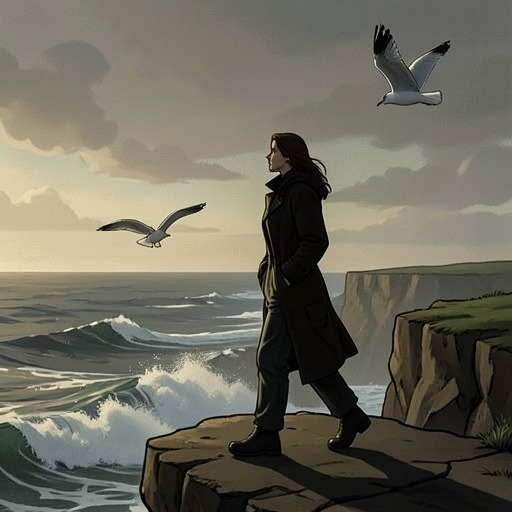
At Hell’s Mouth, the narrator and companion lean over the edge to watch Seals on the rocky shore below. Some lie in the sun; others drop into the water. The view comes in a brief interval of quiet between the streams of tourists walking from the car park and beach café. The animals are not presented as performers for the visitors: their resting and entering the water continue amid the human traffic, and the walkers have only caught a pause in the surrounding noise.
The wind carries the Seals’ deep calls up through the rocks, where they sound sorrowful. The narrator immediately tests that impression rather than treating it as a fact about the animals. Their sadness, the account suggests, may be a human reading of a sound that contains no actual sense of doom or longing. The Seals may instead be bickering over space, living and dying between rock and sea. The distinction matters: the sound affects its human listeners, but its emotional meaning remains theirs to supply. The narrative makes the animals present without claiming access to their inner lives.
As more tourists arrive, the walkers move away, passing Godrevy Lighthouse. The coastal view prompts a reflection on distance travelled: the people who once stood at Hartland Point and first stepped off a bus in Minehead seem remote from those now watching the Seals. Their former home, too, has drifted beyond reach. The sharpest pain of loss has receded, though the memory remains available when summoned; at Godrevy, it is described as an echo left on another headland. The Seals’ calls belong to this passage, but they are not reduced to symbols of the walkers’ grief. The account explicitly separates the animals’ likely disputes and survival from the human sadness that their voices can evoke.
Calls in the Wet Night
During a night of rain and fog, the walkers search for somewhere to camp. A garden is ruled out when a compost heap reveals the field’s connection to a house; they instead climb through bracken to a bare patch on a headland, with a farmhouse’s lights at a distance. They mop out the tent with a wet towel and wait for it to dry enough to use their sleeping bags. At one in the morning they are wet and shivering, eating rice and tuna in the exposed field. From the cove below come low, moaning calls, followed by a fainter reply farther away. The calls make the darkness feel inhabited, with voices travelling between unseen animals across the wet air.
The walkers jokingly give those sounds words, imagining two speakers exchanging complaints about how wet it is. The joke does not settle what they have heard. Later, a complaint about a noisy mermaid is followed by the admission that the sound could simply have been Seals; in the night, it was hard to tell. The shift from animal call to imagined speech and back again makes uncertainty part of the encounter. The Seals are audible but unseen, and the human voices laid over their calls reveal the walkers’ own discomfort as much as anything about the animals.
Even so, the encounter changes the scale against which the night is judged. Getting into a wet sleeping bag in a wet tent on a windy headland is miserable, but the narrator feels grateful not to be sleeping on cardboard behind bins in a back alley. The calls accompany that thought without becoming a promise of safety or comfort. The Seals remain outside the tent, part of the exposed night; their presence helps mark the difference between hardship endured outdoors and the more dangerous vulnerability of having no shelter at all.
Watching from Kynance Cove
On the Lizard peninsula, the walkers’ pace slows as they spend time attending to the landscape. They examine rare plants, linger over an orchid and try to photograph a butterfly; in the evening they hang over Kynance Cliffs watching Seals in the cove below. These encounters take place within the Lizard National Nature Reserve, created in the 1970s to protect a large part of the peninsula. The account gives no further description of the animals at Kynance, but their appearance is part of a pattern in which watching wildlife takes precedence over covering distance.
The walkers realize in the dark that they have probably covered only three miles and put the tent up around the corner from where they took it down. The Seals’ presence is therefore linked to an unhurried way of moving through the coast: the day is measured not only in miles, records, or targets, but also in time spent looking. At Hell’s Mouth, the animals’ calls prompt reflection on the limits of human interpretation; at Kynance, watching them is one of several reasons the journey slows.
Narrative Role
Across these encounters, Seals are neither simply scenery nor a ready-made emblem for human feeling. The narrator notices that their calls sound sorrowful, then resists turning that response into a claim about animal emotion. In the night, the calls become difficult to identify and briefly acquire imagined voices; by morning or in retrospect, the uncertainty remains rather than resolving into certainty. This repeated movement between sound, interpretation, and correction keeps the animals partly beyond the human account.
Their place between water and rock also suits the conditions in which the walkers meet them: from a cliff edge, across a cove, or through the darkness below an exposed campsite. Each encounter depends on distance and limited access. The Seals can be seen resting or entering the water, watched from above, or heard without being seen. The narrative’s attention to those different forms of encounter allows the animals to retain a life beyond the walkers’ immediate needs, while their calls and appearances give recurring form to the coast as a place inhabited by more than human travellers.