Simon Armitage
The Salt PathSimon Armitage is a poet whose name travels ahead of him along the South West Coast Path before a poster in St Ives reveals why it has been mentioned. He is not shown meeting Ray and Moth; instead, he enters their story through questions, teasing, and the discovery of a public event already fully booked. This limited but recurring presence makes him a passing point of comparison between two journeys on the same route: one undertaken by a poet giving readings, the other by a couple whose walk has become a way to endure homelessness and uncertainty.
Identity and Introduction
The memoir identifies Simon Armitage simply as a poet. A poster in a St Ives gallery window announces that he is walking from Minehead to Land’s End and giving readings along the way. His St Ives reading is scheduled for Sunday, is free, and is fully booked. These details establish a concrete public itinerary, but the account gives no description of a meeting with him and no account of the reading itself. He remains a figure encountered through information about him rather than through a scene in which he speaks or acts directly.
The route is what brings him into Ray and Moth’s awareness. Their own walk gives the poster an immediate context: it names a fellow walker travelling a stretch of coast they know from experience. Yet the two journeys are not presented as equivalent. Armitage’s walk is associated with scheduled readings and a booked audience; Ray and Moth’s is shaped by their precarious circumstances and the need to keep moving. The parallel is brief, but it places their private passage beside a public literary event.
A Name That Becomes a Mystery
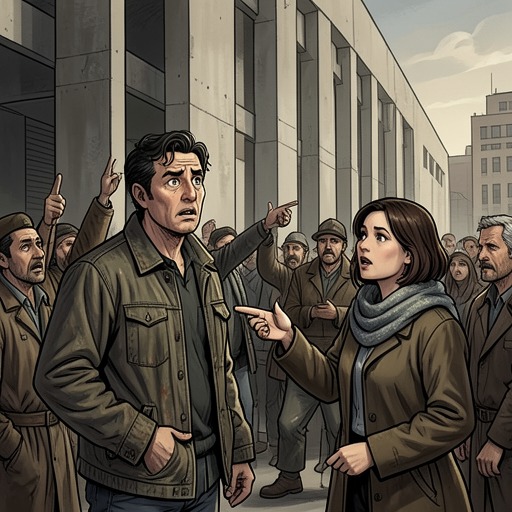
Before the poster explains the reference, Simon’s name has already been heard repeatedly. In a conversation, someone asks who Simon is. Ray answers, “Simon Armitage.” The reply prompts an exasperated question: “Who the fuck is Simon Armitage? We’ve been hearing the name since Combe Martin and we still don’t know.” The exchange makes the name a running puzzle rather than an introduction to a character who has appeared in person.
The conversation also treats the uncertainty playfully as concealment. The other speaker says that Moth is good at keeping it hidden and warns that they will catch him out. The passage does not establish that Moth is Simon Armitage; rather, the later poster resolves the question for the walkers by identifying Simon as the poet on the coast path. Until that recognition, the name circulates as a joke and a suspicion attached to Moth. The comic effect comes from the contrast between how often the name has been heard and how little the speakers know about it.
Recognition in St Ives
On the way back to the campsite, Ray and Moth spot the gallery poster. Its information makes the earlier references legible: Simon Armitage is walking from Minehead to Land’s End and giving readings, with one planned for St Ives on Sunday. The event is free but fully booked, a small detail that marks the limits of their chance to attend. The account records discovery of the notice, not an attempt to obtain places or a later encounter with the poet.
Moth responds, “Well, at least we know who he is now.” Ray jokes that he looks nothing like Moth, and Moth answers, “What can I say, maybe people are just drawn to my poetic nature.” Their exchange closes the name’s brief mystery without turning it into a meeting. The joke depends on the earlier confusion: now that the poster supplies Simon’s identity, the walkers can laugh at the imagined resemblance and at Moth’s mock claim to poetic appeal.
Narrative Role
Armitage’s importance in the memoir lies in this compact sequence of reference, uncertainty, and recognition. He remains offstage, but his name gives a minor conversational thread its payoff and connects Ray and Moth’s walking to another journey along the same coast. The contrast is especially resonant because the couple’s own story is being shaped by how they describe their circumstances to other people. Their account of homelessness can provoke recoil, while a more palatable version of their journey draws admiration; against that background, the poster’s clear public description of a poet’s walk offers a different, openly announced identity for someone travelling the path.
The memoir does not claim that Armitage’s walk resembles the couple’s in purpose or experience, and it does not supply a personal relationship between them. Instead, the shared route is enough to bring his name into their passing conversation. He becomes a small figure at the edge of their narrative: first an unexplained name, then the subject of a poster, and finally the occasion for a joke that lets the walkers carry on with the knowledge they had lacked.