St Petroc’s
The Salt PathSt Petroc’s is a charity aimed at helping single people experiencing homelessness who fall through gaps in social care provision. Its brief appearance in the account of Ray and Moth’s journey through Newquay shows both a practical point of access to food and the limits of services designed around narrower definitions of need. The encounter also brings the charity into a wider discussion of hidden homelessness, inadequate counting, and the scarcity of safe places to stay.
Purpose and Place in the Support Network
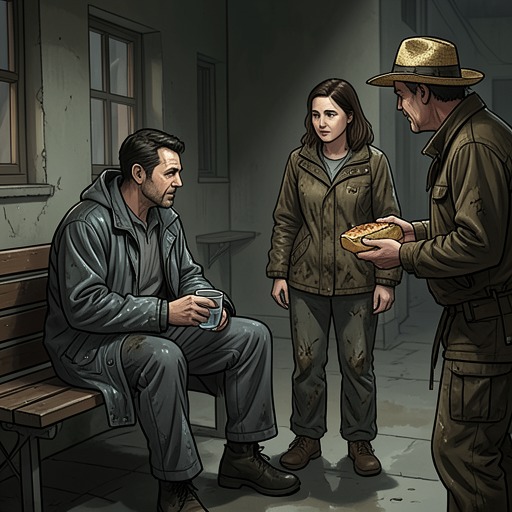
St Petroc’s appears in Newquay after Ray and Moth encounter a tall, broad former soldier asking for money. When they explain that they have no money and are homeless themselves, he accepts their account, gives them directions to a soup kitchen, and receives coins and Moth’s last chocolate bar. His directions lead them to St Petroc’s, which the narrative identifies as a charity serving single homeless people who fall through the net of social care. The couple are redirected to the soup kitchen despite not fitting that single-person focus.
The episode distinguishes the charity’s stated remit from the immediate needs of people seeking help. St Petroc’s is presented as a point of connection to assistance, not as the source of every service encountered there: the account says that the couple are redirected to a soup kitchen, without identifying the kitchen as a St Petroc’s operation. For Ray and Moth, who have very little left and have been walking in the rain, that referral leads to a free bowl of soup.
Homelessness Beyond the Official Count
The Newquay visit takes place against a striking disparity between visible need and the available estimates. The narrative reports that Cornwall was said to have either forty or sixty-five rough sleepers, depending on the statistics consulted. At the soup kitchen, a volunteer explains that the count included only people found in a designated area during set hours who confirmed they were homeless and sleeping rough; someone asleep could not be woken to ask. The account therefore makes clear that a count of people visible under particular conditions cannot stand for everyone without a stable home.
The volunteer describes people sleeping in woodland as well as on the streets. The council, the volunteer says, wanted them out of the woods to create public-access space, while what they needed was shelter for overnight stays. New shelters were expected to open that winter, with ten beds here and ten there, but the volunteer considers that provision far from sufficient. This account situates St Petroc’s within a broader support network whose reach is limited by both scarce beds and administrative definitions of who can be counted.
Significance in the Narrative
St Petroc’s provides a concrete counterpoint to the public image of homelessness as a single person sleeping visibly in a doorway. Ray and Moth arrive as a homeless couple, while the charity’s stated focus is on single people who miss out on social-care provision; the distinction exposes how a service remit may leave needs at its edges. Their referral to food offers immediate help, but it does not resolve the larger problem of finding somewhere secure to live.
The scene also connects the charity’s local presence to the book’s criticism of stigma. A volunteer acknowledges that people often assume those living on the streets are addicts and that this belief discourages assistance, while insisting that people deserve help whatever caused their homelessness. St Petroc’s is thus part of an episode that joins direct aid to a wider challenge: people whose circumstances do not fit public stereotypes or official counting rules can remain unseen even when their need is present.