The prophecy of walking with a tortoise
The Salt PathThe prophecy of walking with a tortoise is a prediction Ray and Moth encounter early in their journey and dismiss for much of the year that follows. Near the end of their walk, they meet a man leading a tortoise on a customized dog harness. The strange, ordinary sight turns the old prediction into a vivid coincidence and gives the journey’s ending a touch of wonder without settling whether it is fate or chance.
A prediction carried along the path
The prophecy reaches the reader through its fulfillment: Ray recalls that the encounter behind it happened in the woods on the second day of the walk from Minehead. The supplied account does not give the original prediction’s full circumstances or exact wording. It does make clear that Ray and Moth eventually dismissed the idea that they would “walk with a tortoise.” The prediction therefore persists less as a plan than as a curious fragment from the journey’s beginning, remembered only when events give it new force.
That distance matters. Their walk begins amid uncertainty and physical strain. At Minehead, Ray and Moth hesitate before the monument marking the start of the path, then begin a 630-mile walk without a fixed home or a clear destination beyond the route. On the steep woodland ascent, they stop to catch their breath and reread Paddy Dillon’s South West Coast Path guidebook, whose description of the path as drifting inland and uphill seems comically inadequate to the climb. The tortoise prediction belongs to this same long passage through unpredictable terrain: it is one more possibility the walkers carry without knowing whether it will come to anything.
Walking as a changing way of life
As the walk continues, its meaning changes. Ray describes the body’s pain and the landscape’s pull together: on a hot cliff path, a strong wind and the height bring a feeling of flight, even as Moth leans away from the sea and toward the cliff. Later, the repeated climbs, hunger, thirst, and booming sea settle into a rhythm. The path is not simply distance to be covered; its demands shape what Ray can attend to and how the past is experienced.
The walk also becomes a form of refuge from grief and fear. Ray reflects that the couple had hidden their homelessness behind a more acceptable story: they said they had sold their home to seek adventure rather than lost it and become penniless. Repeating that lie made the grief feel less immediate, though Ray cannot tell whether it changed the pain or only postponed confronting it. Step by step, the walk narrows attention to the present; each climb becomes a small victory, each survived day a reason to continue. Against this background, the tortoise prediction is not a solution to their troubles. It is a modest, improbable thread that travels with them through a life whose direction remains uncertain.
The tortoise appears
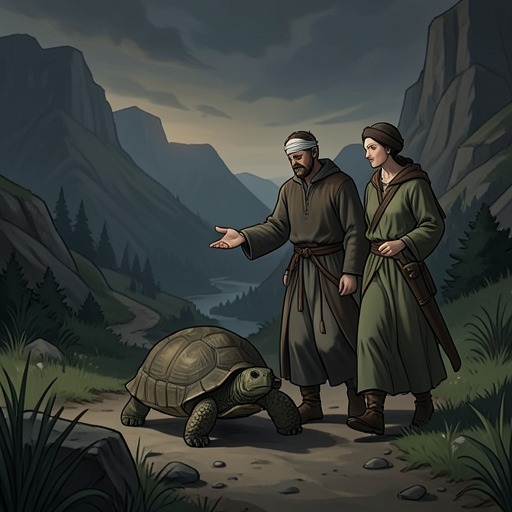
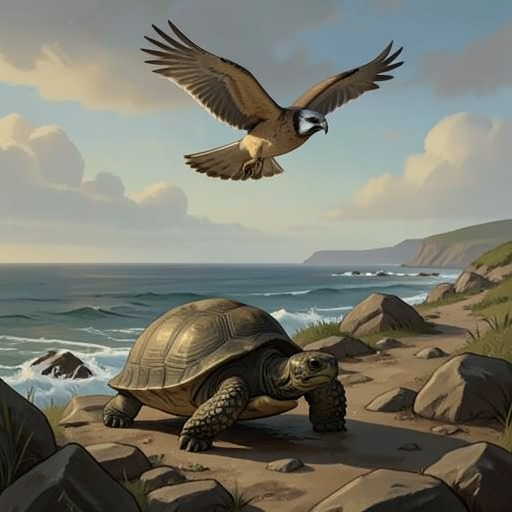
Well over a year after the woodland encounter, as the journey nears its end, Ray and Moth see what first looks like a rock. It is a tortoise, fitted with a customized dog harness and being led along the path. The man explains that he is taking her for a walk. When Ray and Moth question the need for a lead and suggest the tortoise could stay in a garden, he insists that she needs to get out and stretch her legs: she is a wild animal, he says, and he brings her there every day. Her name is Lettuce.
The scene makes the prophecy literal in an unexpectedly everyday way. There is no revelation that transforms the tortoise into something other than an animal being walked; the humor comes from the contrast between the walkers’ long-held, nearly forgotten prediction and the matter-of-fact man leading Lettuce along the trail. Ray and Moth climb the next headland before speaking again. Then Ray tells Moth, “Don’t even try to tell me that was a coincidence.” The shared laughter gives the encounter a place in their final stretch, where excitement at reaching the end is already mixed with a reluctance to let the walk finish.
A figure then appears from the gorse, wearing the same coat and hat and carrying the same stick as a year earlier. He says that “she” had returned the same day Ray and Moth had been there the previous year, and that she had told people they were coming back. He calls it a sign. The passage does not fully clarify the identity of the female figure he refers to, so his words add an echo of return without explaining the tortoise prediction’s origin or proving a supernatural connection. Their force lies in how closely the remark fits the walkers’ experience of repetition and return.
Coincidence, home, and an ending
The tortoise appears when the path is bringing Ray and Moth toward a new life. Earlier, at the southernmost point, Ray understands that the route will now lead north and that the old home will not be recovered. In its place, the narrow strip of dirt underfoot has become a kind of home. Ray describes a change from resisting the past and feeling anger toward acceptance: belonging no longer depends on owning land. Later, as Ray and Moth resume the walk, the familiar pull of the path feels right despite uncertainty about what will come next.
By the final stretch, they have money for a deposit and first month’s rent, food in their packs, and a student loan due soon. They plan to live in Polruan; Moth will begin a degree, while Ray will look for work and begin writing. On their last night in the tent, they debate whether the fact that they will live where the path ends, both now and the year before, must be fate. Moth says, “It has to be fate”; Ray answers, “I’ll give you that – it is weird. But I’ll stick with coincidence.” The exchange preserves both interpretations rather than choosing between them.
The prophecy’s fulfillment thus belongs neither to a grand explanation nor to a plot mechanism that resolves every uncertainty. It is a small encounter, made memorable by timing, repetition, and the walkers’ recognition of a phrase they had stopped expecting to see fulfilled. As their homeless trail ends and their future opens, the tortoise offers a comic, tender reminder that a journey can carry possibilities whose meaning only becomes visible much later.