Tom
The Salt PathTom is one of Ray and Moth’s children, a mostly offstage figure whose brief appearances connect the family’s domestic crisis to the parents’ long walk. He is told that the South West Coast Path journey will mean roughly 630 miles of walking and camping, and calls the idea cool. Later, when Ray and Moth need money for a train, Tom agrees to send twenty pounds but says his gut tells him the plan is a mistake. Between those moments, the narrative places him among the children whose home and family life are being unsettled, while leaving his private response largely unspoken.
Identity and place in the family
Tom is identified through his parents’ conversation with him and through references to Ray and Moth’s children. The evidence offers no independent account of his age, appearance, occupation, or daily life. Instead, his presence is registered in the details of family communication: Row tells Ray to tell Tom about the coming walk, and Ray does so, explaining that she and his dad intend to travel the South West Coast Path.
That brevity matters to his characterization. Tom is not given a separate plotline or an extended viewpoint; he enters at moments when the parents’ choices reach beyond themselves. The family has lost its home, and Ray’s thoughts turn to what must be done for the children as well as the farm animals and the practical business of leaving. Tom belongs to the group caught up in those consequences, although the account does not specify how he experienced the loss. The narrative marks the stakes without supplying a response on his behalf.
Hearing about the walk
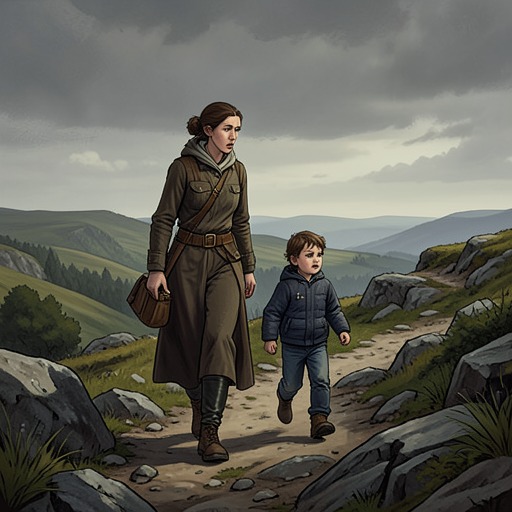
Ray tells Tom that she and his dad have decided to walk the South West Coast Path and that the journey may take at least two months, perhaps three. She explains the scale more concretely: 630 miles, with camping all the way. Tom’s first recorded response is brief and positive: he thinks it is cool.
The exchange sets his reaction beside the uncertainty of the adults’ decision. Ray and Moth are asking whether a long walk can take them toward answers about who they have become; Tom receives the plan as an extraordinary undertaking. His response is not presented as a considered endorsement of the risks or as evidence that he understands every consequence. It is simply the immediate enthusiasm recorded in the conversation. That limited reaction gives the scene its contrast: the parents’ question of identity and survival meets a child’s uncomplicated recognition that the journey sounds exciting.
The practical arrangements also frame the announcement. Row has asked Ray to keep in touch, to answer calls, and to tell Tom. The walk therefore begins not as a clean break from family life but as news that must be shared and a relationship that will continue across distance. Tom’s place in this moment is as the recipient of that news, not as a companion on the route.
The family’s illness and its unspoken weight
Later, while Ray and Moth camp near Pendennis Castle after taking a ferry across the Helford River, Ray wonders whether Tom and Row are doing what students do. Moth answers that they are students, then corrects himself: they were. The brief exchange makes their changed circumstances visible without explaining what either child is doing at that moment. The parents are outside, tenting in the dark; the children’s lives are invoked from a distance, through a question about what they might be doing and the acknowledgment that their status has changed.
Ray’s concern soon turns to whether the parents have abandoned the children. She says that they have talked about losing the house but not properly about Moth being ill or what the illness might mean for the family. She recalls having discussed the children’s ordinary hurts and heartaches, yet says that this largest subject has remained too painful to address. Her fear is that what is happening to the family will leave them lasting scars.
Moth replies that the children do speak with him, that they have talked frankly about everything, and that they are strong. His assurance does not erase Ray’s fear, but it complicates her sense that the subject has gone unspoken within the family. Tom is not given a direct voice in this exchange; what the reader learns is that Moth says he and the children have discussed the situation. The scene keeps a distinction between what the parents know and what Ray fears, rather than claiming access to Tom’s private feelings.
Practical help and divided judgment
In another exchange, Ray asks Row for forty pounds for a train. Row cannot provide that amount but offers twenty. Ray then asks Tom for twenty pounds, and he agrees while saying that, in his gut, the plan feels like a mistake. His contribution is modest and specific: he is asked for help with the fare, not with financing the whole journey, and he agrees to provide the amount Row cannot.
Tom’s response holds assistance and doubt together. He does not refuse Ray’s request, but neither does he present himself as convinced by the decision. The warning is personal and qualified—an instinctive sense that the plan is wrong—not an explanation of the danger or a demand that his parents change course. His words give the family’s practical exchange an emotional edge: support does not require confidence, and closeness does not prevent disagreement.
Across these scattered appearances, Tom remains defined less by a developed account of his own life than by his position within the family’s changing circumstances. He hears of the walk with enthusiasm, is included in his parents’ thoughts about illness and separation, and helps with the cost of a train even as he voices misgivings. The narrative does not resolve those tensions through a later account of his feelings. Instead, his brief responses register what the journey costs and depends on: the family remains connected, but its members do not necessarily share the same confidence about what comes next.