Vango tent
The Salt PathThe Vango tent serves as Ray and Moth’s shelter after losing their home, but never makes their homelessness secure or comfortable. Carried along the coast, it is at once a practical refuge, a vulnerable piece of equipment, and the small, moveable boundary they inhabit between the weather and the open landscape.
Shelter Without a Secure Home
After the loss of their house and income, ordinary alternatives proved difficult to obtain. Campsite fees were beyond their means and ineligible for housing benefit; their damaged credit made renting nearly impossible, while the council offered only low-priority placement and a bed-and-breakfast room. Faced with these choices, Ray and Moth decided they would rather be in the tent. It did not resolve their housing insecurity, but gave them a place they could occupy together without depending on a landlord or the continuing goodwill of friends.
Their homelessness became concrete in Taunton, where they stood with their rucksacks and no door to return to. The tent belonged to the life of movement they began from there: a shelter they could carry, but not a substitute for the lost home or a settled future. Its portability made continued travel possible precisely because there was no stable place to stop.
A Shelter Tested by the Sea
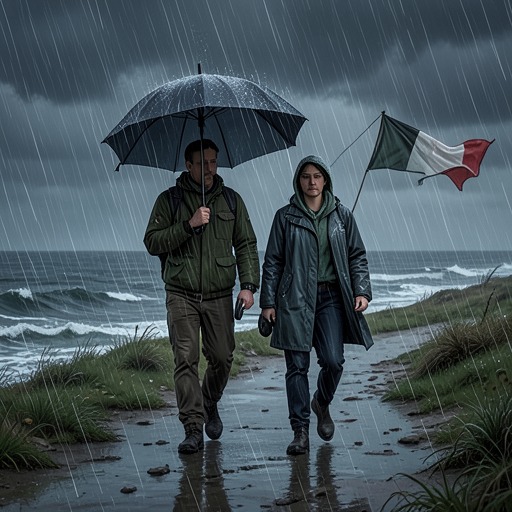
On a beach near Pendeen, Ray and Moth pitched the tent well back from unstable shale cliffs and above the tide line, on the far side of a freshwater stream. Their experience of the tides had taught them to judge where the water might turn. At night, however, the sea rushed beyond the expected line and kept rising. The tent had been chosen because it could stand without tent pegs, but that strength could not keep it grounded when the water hoisted it into the air with the airbeds and sleeping bags still inside.
Moth ran across the beach in his underpants, holding the tent above his head, and continued wading through knee-deep salt water where the sea had run up the stream. The episode makes the tent’s limits literal: it could resist ordinary exposure, but not the force of the rising sea. At the same time, the effort of rescuing it became a striking test of Moth’s physical capacity. Ray understood his strength and movement as changed, against the doctors’ expectation that his condition could only worsen; the moment offered evidence of change, though not certainty about what would follow.
Exposure and Temporary Refuge
Near Land’s End, the tent was hidden among rocks as the light faded, with the Atlantic between its thin nylon walls and the two walkers. The description reduces shelter to its bare material fact: two sheets of fabric between them and the open water. They had little food, and the previous rain and wind had left them aching and slow. By morning the sky had cleared enough for them to sit at Gwennap Head, take off their boots to dry, and share a Mars bar before continuing east.
Later, on Carrick Luz, the tent sheltered them on a headland as wind drove in from the Channel and the Lizard Point lighthouse swept its beam across the sea. It was nearly October, and their sleeping bags were thin. Ray recognized that they could have sought a hostel or camped in a friend’s garden, where warmth, a bathroom, and proximity to a hospital were available. Instead, they remained in the tent, peeing among the blackthorn in the dark and refusing to accept that Moth might need medical care. The shelter therefore represents not only chosen independence but also the exposed conditions in which Ray’s denial of his illness persisted.
The tent also provided a familiar enclosure when the couple’s journey moved inland. In a disused meat-processing shed, they erected it in the middle of the floor as rain battered the corrugated roof. The building offered a roof, but its peeling plastic, mossy windows, exposed insulation, and flickering industrial light made it feel like a processing room rather than a home. The tent supplied a recognizable, intimate space within that unfamiliar interior; its refuge was psychological as well as practical.
A Portable Idea of Home
The tent’s meaning shifts with its surroundings. On the beach, it is vulnerable to a tide that overturns the careful calculations of its occupants; among rocks, it is only a thin barrier against the weather; inside the shed, it recreates familiarity beneath a roof that otherwise feels alien. In each setting, shelter is temporary and conditional, shaped by terrain, weather, money, and the couple’s ability to keep moving.
As the walk continues, Ray comes to understand the path itself as home, rather than believing that belonging depends on owning land. The Vango tent is not that home in any permanent sense. It is the portable shelter through which the couple endure a life without one: materially insufficient, repeatedly tested, and still important because it allows them to make a shared place, however briefly, wherever the journey takes them.