Wales
The Salt PathWales is the home Ray and Moth build together, lose, and then struggle to imagine returning to. Its importance lies not only in the farm they leave behind but in the contrast between a place once experienced as a private refuge and the exposed, uncertain life that begins when they can no longer live there.
The farm as home and refuge
Ray and Moth had met when Ray was eighteen; by the time the farm was taken from them, she was fifty. Together they rebuilt the ruined property, restoring its walls and stones, growing vegetables and keeping hens, raising two children, and creating a barn where visitors could share their lives and help pay the bills. The farm was both their home and the foundation of their livelihood. Losing it meant losing the holiday-rental business as well as the place in which their shared life had been made.
The countryside around the farm shaped its sense of separation from the outside world. After the road, the route into the forest seemed to leave ordinary life behind. Beyond the trees, old field systems divided by hedge-topped banks opened towards mountains in the west and a cloud stretched across the view. A buzzard circled above the landscape. In Ray’s recollection, forest and hills seemed to close a door on roads, villages, and human noise. The farm was an island not because it stood apart from the land, but because the surrounding land made withdrawal from the wider world feel possible.
Losing the Welsh home
The end of that refuge followed years of legal and personal upheaval. When the bailiffs came, Moth was exhausted and furious, and Ray remembered the changing colour and texture of his hair across the years they had spent together. At the moment they were about to leave, the rebuilt farm, their work, and their family life seemed to belong entirely to the past. Ray’s suggestion that they could simply walk sounded absurd, but it opened a way forward when the home they had made was no longer available to them.
After closing the door for the last time, they had two weeks to put their few belongings in a friend’s barn and decide what to do. Their children were students living in shared accommodation and could not support them. Moth’s brother could offer his house temporarily, but only until his family returned from holiday. That refuge was twenty miles from their former home: close enough for Wales to remain physically near, yet the couple could not go back. The short distance sharpened rather than eased the loss. They were also confronting the doctor’s diagnosis and the possibility that Moth’s remaining time in relatively good health would be limited. Finding work and somewhere to rent seemed logical, but Ray felt she could not leave him to work when she wanted to spend that time with him.
Leaving and looking back
Moth could not bear to stay near the farm and wanted distance from Wales, though he did not know what the longer term would bring. Ray agreed to pack their rucksacks and make plans as they went. The decision turned departure into a form of movement without a settled destination: they were not setting off from a secure home with a door to return to, but trying to find somewhere else that could become home.
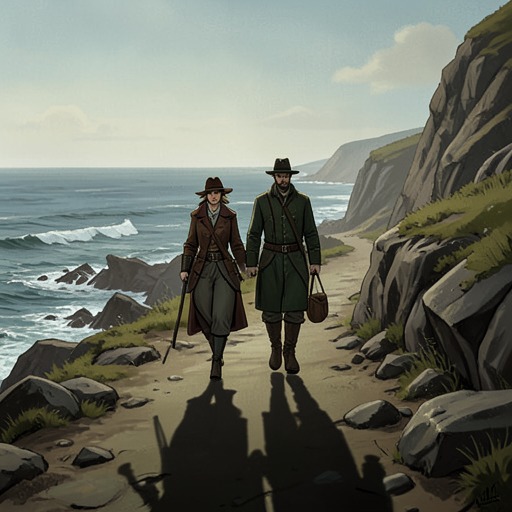
In early August, after their temporary arrangements ended, they stood in Taunton with their packs and understood themselves to be homeless. They took a bus to Minehead to begin the South West Coast Path, with little money and a weekly payment to rely on. As they started the long walk, Wales remained visible across the water from the path. At dusk, the lighthouses of South Wales marked the darkness beyond them. Ray could still feel the warmth of the farm’s fire and the stone walls beneath her hands in memory, but the land they had left was already receding. Wales was at once nearby in sight and out of reach as a place of return.
That distance acquired a different meaning as the walk continued. From high ground, Ray saw the coast of Wales grow farther away. The physical separation gave visible form to a loss that had first seemed impossible to accept, while the repeated effort of walking redirected attention to the next stretch of path. The couple’s movement was partly chosen—they could keep walking or stop—but it was also shaped by homelessness and the lack of a stable place to go back to. The route offered a daily purpose without restoring the security they had lost.
Wales in the changing meaning of home
At the southern end of the mainland, the prospect of turning north brought the question of winter and the future into view. Ray knew she would not return to the farm: its slate floor, garden, cats, and familiar night sky belonged to a life that had ended. Yet she began to experience the path itself as a kind of home, a narrow strip of ground that carried her forward. The change was not a recovery of the Welsh property. It was an altered understanding of belonging: she no longer believed that owning a patch of land was necessary to be part of the world around her.
This acceptance did not erase the loss or resolve the couple’s uncertainty. Later, after months of inland confinement, reaching the open coast again brought relief, and walking still gave them a sense of direction. As they neared Plymouth and the end of their trail, however, the path’s dependable rhythm gave way to fear about what would happen when they had to stop, including concern about Moth’s future and how they would begin again. Wales therefore remains more than the place they left: it is the measure of the home they had built, the past they could not recover, and the question of whether belonging can survive without a permanent address.