Weymouth
The Salt PathWeymouth is the largest urban area Ray and Moth encounter on the South West Coast Path since Newquay, a year earlier. Their passage through it is defined less by sightseeing than by a sudden collapse of their plans: after a punishing storm on the approach, Ray becomes severely ill, and the town turns from a place to buy supplies into a search for somewhere safe to stop. Their onward route leads from Ferrybridge towards Chesil Beach, with the couple choosing to bypass the Isle of Portland.
A town on the coastal route
The journey reaches Weymouth after a day of dramatic weather. A sudden downpour turns the path near Osmington Mills into a slick, treacherous surface. Ray falls into a blackthorn shrub and is pinned by its barbs until Moth helps pull them out, one by one. Their waterproof clothing proves inadequate, and Ray continues with mud covering them and puncture wounds throbbing. The sun returns almost as abruptly as the rain, drying the mud until it cracks and falls away as they follow the evening lights towards town.
The contrast between exposed coastal walking and an urban stop is important to the passage. The travellers arrive intending to buy supplies and, if necessary, camp on the beach; they have no firm alternative plan. Weymouth is also described as a markedly larger settlement than the places they have passed on the route for many months. Its scale and holiday crowds interrupt the day’s isolated rhythm: families are heading out to eat during the first week of the summer holidays, and the town is busy around the statue of George III.
Illness and an improvised stay
After buying an ice cream near the statue, Ray walks through town with Moth. A strange sensation in Ray’s stomach intensifies, followed by vomiting. Fatigue, the earlier fall, and hunger all seem possible explanations at first, but the sickness continues: after about half an hour, Ray is bringing up frothy green bile. Moth finds a taxi and asks the driver to take them to a campsite, only to be told that every campsite is full.
They sit on a beach bench while Ray continues retching. After two hours, Ray can no longer walk and drifts between sleep and heaving. The search for shelter is no longer a matter of convenience: Ray is too ill to continue on foot. The narrative then records a stay in a tiny hotel, where a lift, a bed, and a toilet become the limits of Ray’s world for roughly thirty-six hours. Ray moves between the bed and toilet, sleeping and being sick, and only gradually realizes that a second night has passed. When Ray worries that they cannot afford the room, Moth says it has already been paid for.
The sequence makes Weymouth a point where the couple’s precarious finances and physical dependence become especially visible. Their intention to camp if necessary cannot withstand the combination of full campsites and incapacitating illness. Instead, their immediate needs are met through a hotel stay whose cost has been covered, though the account here does not identify who paid.
A refuge beyond the town
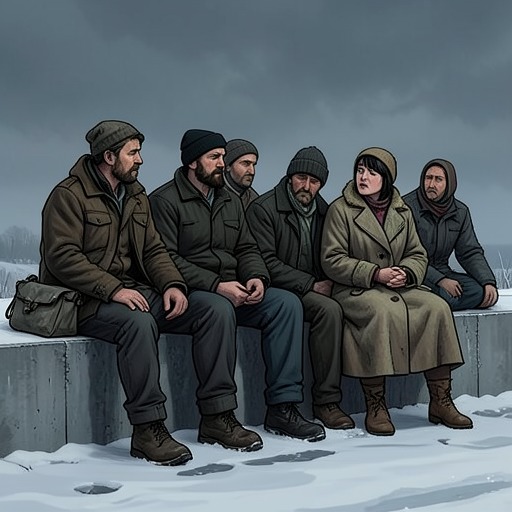
After the hotel episode, Ray and Moth accept an offer from John and Gav to stay for one night at a woodland camp outside town. The offer involves leaving the street lights behind in a van and travelling into dark country lanes. In a woodland car park, the travellers find tents, tarpaulins, and shelters made from fallen branches, with residents sitting together, talking, and cooking. John shows them where to pitch their tent; Gav shares the bags of shopping brought on a regular supply run.
This temporary refuge differs sharply from the full commercial campsites the taxi driver had described. It is an inhabited woodland community, not an official campsite, and its residents speak of the countryside as essential to their lives. The group’s presence is also uncertain: John warns that the wood might not remain available the following year. The couple sleep in their tent on a bed of pine needles, protected from the wind moving through the branches.
The next morning John drops them at Ferrybridge on his way to work. The lift carries them out of the woodland and back to the road, leaving Weymouth behind as a sequence of practical necessities and contingent kindness: a taxi, a hotel room, a place to pitch, and a ride to the next point on the route.
Ferrybridge and the decision to continue
At Ferrybridge, Ray and Moth look along the road linking the Isle of Portland to the mainland. Ray asks whether they should miss Portland and take a few slow days along Chesil Beach, explaining that they are exhausted. Moth agrees, adding that they are not pursuing a purist version of the walk. Their choice makes the route adaptable to their condition rather than an obligation to complete every section in the most exacting way.
The account introduces Chesil Beach as a substantial coastal landform rather than an ordinary stretch of sand: it is a bank of pebbles fifteen metres high and eighteen miles long, running from the Isle of Portland eastwards to beyond West Bay. The sea has rounded the stones over millennia, and the account describes the formation as a barrier beach, or tombolo. Pebbles are fist-sized near Portland and shrink to grape size towards West Bay. Inland, the Fleet Lagoon lies behind the bank, separated from the sea but still affected by its tides. This coastal geography frames the couple’s decision to rest and continue west rather than cross Portland.
Narrative significance
Weymouth is neither simply a destination nor a scenic pause. It is where the planned walk is interrupted by illness, where the option of camping fails, and where the travellers depend on help they could not have arranged in advance. The movement from the busy town to the quiet woodland camp also shows how their route passes between different kinds of shelter, none guaranteed to last. By the time they reach Ferrybridge, the question is not whether they can preserve a fixed itinerary, but what pace and route their exhausted bodies can manage. Their decision to bypass Portland and follow Chesil Beach carries that adjustment forward.