Wildness as refuge
The Salt PathWildness as refuge names a changing source of safety in Ray’s account of homelessness and the South West Coast Path. It begins as a bodily and spiritual encounter with the landscape, reaches back to a childhood shaped by farm life, and becomes a way to understand belonging after the loss of home and land. The refuge it offers is not comfort in the ordinary sense: it includes exhaustion, exposure, pain and uncertainty. What changes is Ray’s sense that safety must depend on possessing a place to return to.
From homelessness to the open path
In early August, Ray and Moth stood by their rucksacks in Taunton, newly and fully homeless. Ray distinguishes this from travel or sleeping in a van: those circumstances had still left open the possibility of returning somewhere. Now there was no door to return through, and the roadside felt like the safest place available. The pair went to Minehead with little money and no settled destination beyond the walk. At the path’s starting monument, they delayed their first step, caught between excitement and fear; beginning the 630-mile route would at least give their days direction.
The landscape did not immediately make walking easy. On the steep wooded ascent above Minehead, Ray and Moth stopped on a bench to catch their breath and consult Paddy Dillon’s guidebook, whose description had understated the climb. Their bodies carried the strain of the journey as surely as their packs. Later, the effort of climbing above a valley gave way to a sharp sense of release: on a hot cliff path, wind lifted beneath Ray’s rucksack, and height brought vertigo and exhilaration together. Moth leaned away from the sea, while Ray felt carried by the salt air and the sight of gulls. Wildness here did not remove physical limits; it made the experience of moving through them vivid.
A human spirituality in the landscape
At Culbone Church, the path brought Ray and Moth into a small, peaceful place after a difficult climb from Porlock Weir. Ray had watched a solitary man moving as though practising yoga in the clearing above the church. Once in the graveyard, Ray felt a knot begin to loosen. The experience seemed spiritual but, as Ray understood it, not religious: the quiet of the place offered a profoundly human kind of connection. Ray even cupped both hands and threw air towards Moth, a small gesture of hope amid their pain and fatigue.
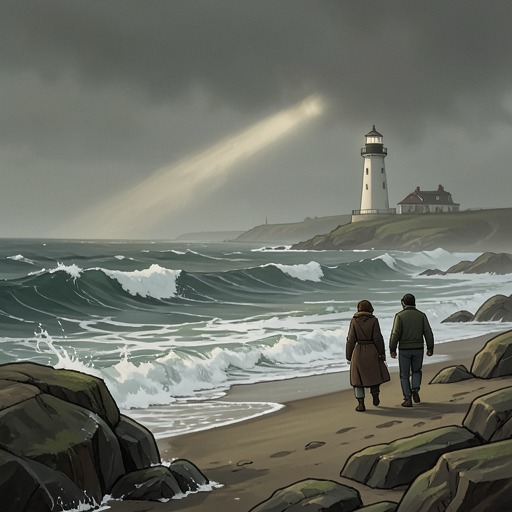
The refuge of the coast also took shape through repetition. On the route near Port Quin, the path rose and fell among gorse and stone while the sea sounded continuously. Pain and hunger softened into a rhythm of ache and thirst; the succession of headlands made the distance behind visible even as each new bend brought the next stretch of ground. These places were not simply a backdrop to Ray’s thoughts. The wind, sea, terrain and the histories attached to the shore shaped the pace and attention of the walk. At Port Quin, the reported departure of fishermen for Canada and their abandoned lobster pots, now used as garden ornaments, registered as traces of a life changed by movement away from the coast.
Childhood memory and the loss of land
A storm near the end of August brought Ray’s most direct account of wildness as a childhood refuge. As an adult, Ray still remembered the seasonal work of farm life: gathering sheep, trimming their hooves, dosing them for worms and preparing the land for winter crops. Losing the farm had cut Ray off from that familiar measure of the year, leaving a feeling of being unrooted. Yet the wind outside the tent could still summon a connection to the land.
The memory behind that connection was specific. As a child, Ray went into a field to bring a ewe and her newborn lamb to shelter. When the ewe began giving birth to a second lamb, Ray lay in wet spring grass, watching the clouds pass while the first lamb found its feet. Ray later understood that moment as a feeling of being part of everything: soil, worms, clouds and the life unfolding nearby. The wild was not something to hide from, but somewhere Ray ran to for safety.
Ray had hoped that the family’s land would give their children a similar strength: roots that could bend in a storm without breaking. Its loss raised the fear that the tie to reality had gone with it. But sitting in the grass as the wind roared overhead, Ray felt that connection return. The storm was uncontrolled and potentially dangerous, yet it also seemed to hold Ray up. Material security was disappearing, while an inner strength began to form again. In this account, the landscape does not restore the farm or resolve homelessness; it helps show that the bond with the living world was never identical to ownership.
Walking as refuge, and as a choice
The walk gradually became less a means of planning a future than a discipline of attention. Ray describes its mental space as filled by salt wind, dust and light: each step had its own force, and each combe climbed became a small victory. The next day’s walking supplied a reason to survive the present one. This inward narrowing did not make the couple’s situation less precarious, but it gave their movement a daily structure at a time when the future could not be planned with confidence.
Nor did every stretch of the journey amount to freely chosen wilderness. A break in the trail took Ray and Moth by bus via Barnstaple to Westward Ho!, leaving them feeling disconnected from the path. Their dwindling money, Moth’s need for a beer and their uneasy stay in a dismal bar made the interruption feel different from walking through an exposed landscape. The contrast matters: wildness could feel like refuge, but poverty also constrained how the couple moved and where they could stay.
At Land’s End, after more than 250 miles of pain, hunger, exhaustion and rough weather, Ray and Moth could have taken a bus away. Instead, they chose to continue. Waiting in the rain beneath the visitor-centre archway, they understood walking as a form of control they could still exercise: they could decide whether to stop or go on, without wearing down the goodwill of friends or family. Beyond the nearby tourist attraction, the cliffs and sea again made the scale of the natural world immediate. Their camp that night was only nylon between them and Canada, but the decision to keep walking was theirs.
Belonging beyond possession
At the southernmost point, the path’s direction changed: further south would mean swimming, and the route ahead turned north. Ray’s thoughts about the lost Welsh home included familiar details—the slate floor, the cats, the garden and the Plough over the mountains—but these no longer offered a future to return to. The narrow strip of path had become a kind of home because it carried Ray forward, not because it could be owned. A softer acceptance began to replace the effort to change what could not be changed. Ray felt part of the elements without treating that feeling as dependent on having a patch of land.
When Ray and Moth later resumed the coast path after months of inland confinement, the return to an open horizon brought a rush of relief. At Ballard Down, with the lights of Swanage across the bay, the familiar uncertainty of walking felt right. That assurance did not cancel Moth’s pain or settle their future. He had taken painkillers, and Ray rubbed his shoulders with a gel that did not work; they still faced the practical question of finding somewhere to live. The coast’s refuge was therefore a source of orientation, not a cure.
As Plymouth approached, the difference between the path and ordinary life became harder to ignore. Walking had offered the security of knowing what came next: packing the tent and setting off again. Beyond the city lay an unknown future, financial difficulty, and fear about what might happen to Moth when the walking stopped. Even so, the natural world remained an active presence in the account—from rain that softened the morning to the river they crossed by moonlight and the owl calling along its bank. Wildness as refuge holds these contrasting truths together: the landscape can sustain a sense of belonging and agency, while leaving the material need for a home unresolved.