Zennor Head
The Salt PathZennor Head marks a hard-won return to the path during a day of driving rain and poor visibility. The approach turns the headland into more than a point on a route: after the walkers lose their bearings among broken rock, their feet find the way before they consciously know where they are, and the open ground brings them into contact with other people equally unsure of their position.
Approach Through Rock and Rain
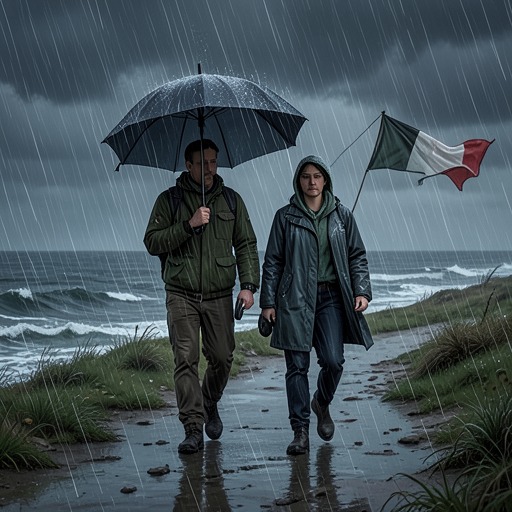
The way to Zennor Head crosses ground that seems to resist forward movement. Boulders break up the path, forcing the walkers to scramble through, around, over, and behind them. Rain soaks their clothes and swells out of their boots; the sea roars somewhere nearby, unseen through the dense, wet air. With no clear point ahead to aim for, they stumble through the rocks and imagine they may wander the boulder fields indefinitely.
The change comes without a deliberate decision or a visible landmark. Bowed by the wind and moving with the rain, the narrator realizes that the walkers’ feet have instinctively found the path as it climbs to Zennor Head. Rock gives way to bracken, and the ground eventually flattens. The shift from scrambling through giant scree to squelching along a recognizable track is a small but consequential recovery of direction.
The Meeting on the Headland
At the top, the walkers encounter the first people they have seen all day: two elderly Germans. The encounter reverses the expectation that reaching open ground will simply mean safety or certainty. The newcomers are themselves distressed and have passed the same place three times, unsure of where they are; they are as grateful to find other walkers as the narrator is to see them.
Their meeting makes the headland a shared point of disorientation and relief. The path has brought both parties together, but it has not made either of them omniscient: one group has recovered the route by instinct, while the other still needs to ask where they are. The scene locates practical knowledge in movement through difficult ground, rather than in a secure view of the landscape from above.
A Place in the Walking Journey
Elsewhere on the journey, walking becomes a narrowing of attention to the next step: exertion and need settle into rhythm, and each day’s passage becomes a reason to continue. The storm approach to Zennor Head gives that pattern a particularly stark form. With visibility and landmarks diminished, progress depends on continuing through the weather until the path is found again.
The headland also belongs to a larger change in the walkers’ sense of home. After the loss of their former place, the route increasingly offers a kind of belonging that does not depend on owning land: in time, the narrator describes acceptance of being part of the elements rather than fighting to recover what cannot be changed. Zennor Head is not presented as the scene of that realization, but its storm, uncertain footing, and eventual return to the path make it a precise instance of the journey’s recurring negotiation with landscape: hardship does not disappear, yet movement can still make a way forward.