hidden homelessness
The Salt PathHidden homelessness in The Salt Path is the housing insecurity obscured by the stereotype of a lone rough sleeper in a doorway. The book widens the frame to include people whose homelessness takes the form of tents, forest camps, temporary shelter, or an inability to secure a home at all—and shows how statistics and public policy can make such lives difficult to see.
Beyond the stereotype
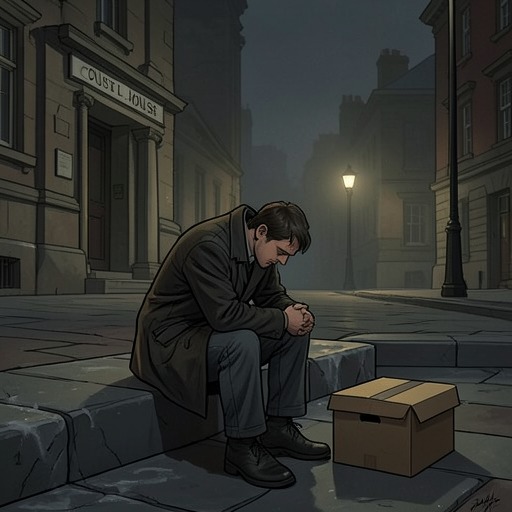
The book begins its account of homelessness with the familiar public image: a person unrolling bedding in a street, perhaps beside a dog, and assumed to be begging to fund an addiction. That image, it argues, narrows public understanding. People sleeping in doorways are visible, but they are only one part of a larger population that includes squatters, sofa-surfers, people sleeping in less exposed places, and those whose circumstances never enter an official list. A person without a home may therefore be present in a community while remaining socially and administratively hard to recognize.
The account also challenges the assumption that addiction or mental ill health explains homelessness. Such problems are common among people who are homeless, but the book stresses that they may follow from homelessness as well as precede it. Treating them as proof that a person is undeserving of help turns a possible consequence of housing insecurity into a reason to withhold assistance. The distinction matters to the book’s argument: need should not have to conform to a sympathetic or familiar image before it is taken seriously.
Numbers and the limits of counting
Figures cited for 2013 expose how strongly a count depends on what it measures. Research by Crisis and the Joseph Rowntree Foundation found at least 280,000 UK households claiming to be homeless or at risk of homelessness. These were households that had applied for recognition, not a head count of individuals. Of them, officials accepted 52,000 as statutorily homeless because they had neither family nor friends able to house them; many of the remaining 228,000 received help through local-authority relief routes. The scale is substantial even within a measure that begins with people who sought official help.
Rough-sleeping figures are narrower still. Government statistics recorded 2,414 people sleeping rough across England in 2013, but the method was a snapshot of a single night. For London, the Homelessness and Information Network, funded by the Greater London Authority, recorded 6,508 people sleeping rough during the year, while government figures using the snapshot method gave 543. These numbers arise from different approaches and should not be treated as equivalent measures; their stark contrast nevertheless shows how much the chosen counting method can alter the apparent scale of the problem. A one-night count can register only people found at that moment, leaving those in woods, temporary arrangements, or other less visible situations outside its frame. The book consequently presents the unknown remainder not as a statistical footnote but as part of the problem: the people absent from a list can disappear from public understanding as well.
Law, suspicion, and public space
The book traces the policing of homelessness through a long history of laws directed at people who appeared suspicious or lacked visible means of support. It links early anti-begging measures to the Peasants’ Revolt in 1381 and later measures to the Dissolution of the Monasteries, enclosure, and the Industrial Revolution. An 1744 Vagrancy Act established categories such as beggars, idle people, vagabonds, and rogues; repeat offenders could be classified as incorrigible rogues. The text also describes an earlier practice under which local authorities paid five shillings to anyone who apprehended an idle or disreputable person, a financial incentive associated with more than five hundred arrests in one year.
The Vagrancy Act 1824, introduced after homelessness rose following the Napoleonic Wars, remained partly in force. As the book explains it, Section One could be used against people begging in public, while Section Four encompassed people without visible means of subsistence lodging in places including barns, deserted buildings, the open air, or under a tent, if they could not give a satisfactory account of themselves. The legal categories thus reached beyond begging on a street: the circumstances of sleeping outside or under canvas could themselves attract suspicion.
The Anti-social Behaviour, Crime and Policing Act 2014 added Public Space Protection Orders, which can require a person deemed to be causing a nuisance to leave an area and not return. The book describes councils using such orders against conduct associated with homelessness, including rough sleeping, begging, and loitering. Breaching an order could bring a fine of £100, with a £1,000 fine and criminal record for non-payment. The effect, in the book’s account, is that the insecurity of having nowhere to stay can be compounded by restrictions on where a person may remain. Public space becomes both a place of refuge and a space from which authorities can exclude them.
Housing insecurity in lived experience
Ray and Moth’s circumstances show how homelessness can develop through successive restrictions rather than a single night on the street. After losing their home and holiday-rental business, they had no income from the business and needed somewhere to live while facing Moth’s serious diagnosis. Long-term camping was not an affordable fallback: the best campsite offer was £80 a week, beyond their means, and housing benefit did not cover campsite fees. There was no room available from their acquaintances for more than a few weeks, and no caravan could be found in a holiday area during midsummer, when visitors filled them.
Renting was also blocked. Following repossession, their credit rating was severely damaged, making a rental property close to impossible to obtain. The council could place them on a waiting list, but they were a low priority; its immediate offer was a bed-and-breakfast room in accommodation mainly used by people with drug and alcohol problems. The official test they encountered also measured illness against an expectation of imminent death: because Moth was not expected to die within a year, a council worker said he did not qualify as a priority. The couple concluded that they would rather remain in a tent. Their decision was made among constrained options, not from a simple preference for outdoor life.
A later roof did not immediately end that precarity. In a disused meat-packing shed, with rain striking the corrugated roof, Ray and Moth erected their tent on the floor and used it as a familiar enclosure. The building offered shelter, but its peeling plastic wall covering, melted insulation, mossy windows, open rafters, and flickering industrial light made clear that it remained a former processing room rather than a settled home. They were grateful for the roof while feeling uprooted and far from the coast where they had found some peace. The scene makes the difference between having cover and having secure, suitable housing tangible.
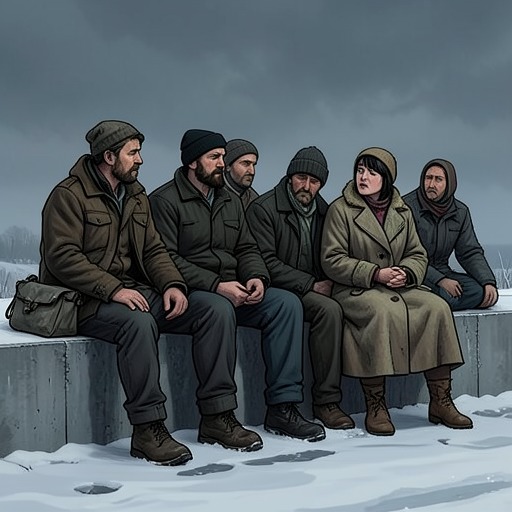
The book also encounters people living in a woodland camp. John and other residents had tents, tarpaulins, and shelters assembled from fallen branches; they sat together, cooked, and shared the practical routines of camp life. John had been a farm worker in a tied cottage, but after the farm was sold, the houses were separated from the land and bought as second homes. His later jobs did not include housing, while rural rents were beyond his wages, so he began camping in the woods. Others joined him, and the camp became a changing community whose members came and went as need arose. Their situation illustrates how the loss of employment-linked housing can produce homelessness even for someone with a long working life, and how a forest settlement can function as shelter and community while remaining vulnerable to efforts to clear it.
Visibility, assistance, and belonging
A conversation about people sleeping rough in a wooded area makes the conflict over visibility explicit. The camp residents were described as being everywhere, including in the woods, while the council wanted them gone to create a public-access space. The speaker argued for overnight shelters rather than attractive paths that would remove what little safety the residents had. New shelters were expected to provide ten beds in one place and ten elsewhere: an improvement, but nowhere near enough. The exchange identifies a gap between making a place accessible to visitors and providing a place where people without housing can stay safely.
The book’s later reflections compare people made homeless in their own country with refugees displaced by war. At a beach, the narrator thinks of families who, after the war, built shelters from salvaged timber and saws to begin again. The contrast raises the question of why crisis may make some people’s need appear legitimate while people experiencing homelessness at home are presumed to have brought it on themselves. The book cites the 280,000-household figure again and emphasizes that the true number remains unknown; aggregated together, people of different ages and circumstances would look unlike the solitary, visibly addicted figure through which homelessness is often imagined. The comparison is not that all circumstances are identical, but that public recognition of need depends partly on whether those in need fit an accepted story.
Against this background, the book records small, specific possibilities for greater security without presenting each as a completed resolution. Moth’s acceptance to university offered the prospect of a reliable student loan, while Ray worked on the farm and in laundry and holiday-let cleaning; the shed’s future remained uncertain. Later, Anna offered them the chance to rent her flat in Polruan after her tenants moved out, with the South West Coast Path running past its front door. The offer shows a potential route from precarious shelter into a rental home, but the excerpt records the offer and their disbelief, not its eventual outcome. Across these changing circumstances, hidden homelessness emerges not as one fixed condition but as a spectrum shaped by money, credit, administrative decisions, access to shelter, and the security of the place where a person can remain.