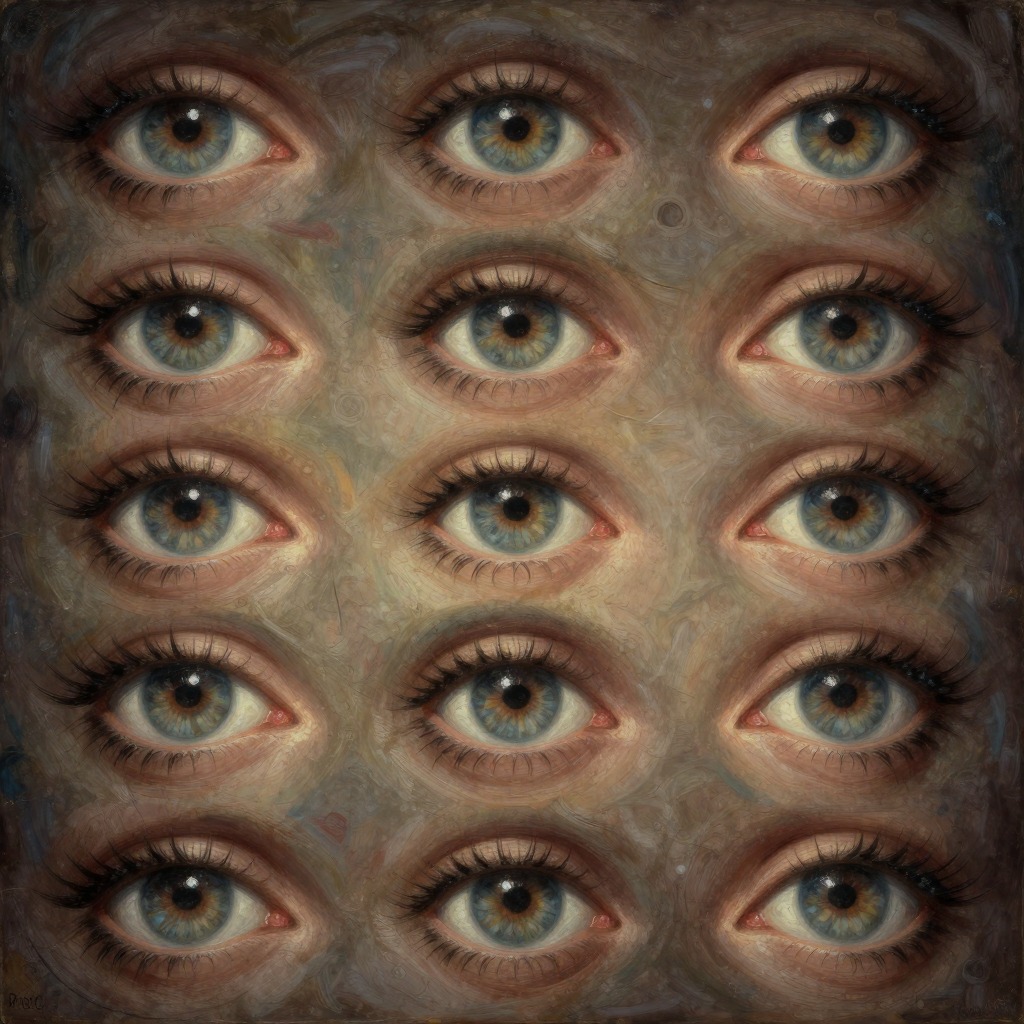
A pair o' lovely peepers!
The SandmanThe phrase "A pair o' lovely peepers!" is the grotesque sales pitch uttered by the optician and lens grinder Giuseppe Coppola when he first offers Nathaniel a set of eyeglasses, immediately triggering Nathaniel's traumatic memory of the Sandman and foreshadowing the story's central obsession with eyes, vision, and the boundary between the human and the mechanical.
Appearance and Context
The phrase appears in the scene where Coppola, having been rebuffed as a barometer salesman, steps fully into Nathaniel's room and, with a hoarse voice and a broad mouth twisted into an ugly laughter, declares: "Forget barometer, bah! I bring pair o' lovely peepers!" . The words are delivered in a heavily accented, broken German that marks Coppola as a foreigner—a Piedmontese mechanic—and the phrase itself is a jarring, almost comical reduction of human eyes to mere commodities. Nathaniel, already horrified by Coppola's resemblance to the childhood terror Coppelius, reacts with a cry of "Strange man, how can you have eyes for sale? Eyes? Eyes?" , a question that the story never fully answers but that reverberates through its entire plot.
Rhetorical and Thematic Function
The phrase operates as a piece of classical rhetorical irony: the surface meaning—an innocent offer of optical goods—is undercut by the deep, traumatic knowledge that Nathaniel and the reader share, namely that this same figure once threatened to tear out a child's eyes with glowing cinders. The word "peepers" is a colloquial, almost childish term for eyes, which makes the offer simultaneously more innocent and more sinister; it echoes the nursery-tale language of the Sandman who "flings a handful of sand in their eyes" while also pointing toward the literal, mechanical eyes that Coppola and Spalanzani have built into the automaton Olympia. The phrase thus condenses the story's central tension between the prosaic and the uncanny, the everyday and the monstrous.
Connection to the Eyes Motif
"A pair o' lovely peepers!" is the first explicit verbal link between the optical trade and the story's obsessive eye imagery. Immediately after uttering it, Coppola pulls out spectacles and eyeglasses until "the entire table was soon flickering and sparkling" with "a thousand eyes" that "peeped and twitched and stared at Nathaniel" (E00108–E00109). The phrase transforms the act of selling glasses into a kind of assault, a proliferation of disembodied gazes that overwhelm Nathaniel's senses. Later, when Nathaniel uses Coppola's looking-glass to gaze at Olympia, the phrase's promise of "lovely peepers" is fulfilled in the most disturbing way: Olympia's eyes, which at first appear "blank and dead," come alive under the lens, and the reader eventually learns that they are literal mechanical eyes, torn from the automaton during the fight between Spalanzani and Coppola and flung at Nathaniel's breast (E00149–E00150). The phrase thus becomes a dark prophecy: the "lovely peepers" are not living eyes but manufactured ones, and their beauty is a trap.
Narrative and Structural Significance
The phrase marks a turning point in Nathaniel's psychological trajectory. Before Coppola's visit, Nathaniel had resolved to banish the memory of Coppelius and to trust Clara's rational explanation that the Sandman was a figment of his imagination. The words "A pair o' lovely peepers!" shatter that resolution, reawakening the childhood terror and setting Nathaniel on the path that leads to his obsession with Olympia, his madness, and his suicide. The phrase is also a piece of narrative metalepsis: it is the moment when the story's own symbolic logic—the equation of eyes with identity, desire, and the soul—becomes explicit in the dialogue. When Nathaniel, moments before his death, spots Coppelius in the crowd below the tower and shrieks "Ha! Eyes a pretty! Eyes a pretty!" , he is repeating Coppola's sales pitch, now stripped of all commercial pretense and reduced to a madman's final recognition of the trap that has consumed him.