Coppola's looking-glass
The SandmanCoppola's looking-glass is the pivotal object through which Nathaniel's perception of reality is fatally distorted. A small, finely crafted pocket telescope sold by the optician Giuseppe Coppola—who is in truth the demonic Coppelius—the looking-glass possesses the uncanny power to make distant objects appear with unnatural clarity and, more disturbingly, to animate the lifeless. It is through this lens that Nathaniel first sees Olympia as a living, loving being, and it is the same instrument that, at the story's climax, reawakens his madness and leads him to his death. The looking-glass thus functions as a material conduit for the dark forces that have haunted Nathaniel since childhood, a device that collapses the boundary between objective sight and subjective delusion.
Purchase and First Use
Nathaniel acquires the looking-glass from Coppola during the optician's second visit to his room, an encounter that reopens the wound of his childhood trauma. After the terrifying episode in which Coppola spreads a thousand eyeglasses across the table—each one seeming to shoot blood-red rays at Nathaniel's breast—the young student calms himself by reasoning that Coppola is merely an honest craftsman, not Coppelius's cursed doppelgänger. To make amends for his earlier panic, Nathaniel decides to buy something. He reaches for a small, very finely crafted pocket looking-glass and, to test it, peers out of the window. Never in his life has he come upon a looking-glass that so clearly and sharply brings distant objects before his eyes in such clear focus. He unintentionally peers into Spalanzani's room, where Olympia sits as usual at her little table. Now for the first time Nathaniel espies Olympia's exquisitely lovely face. Only the eyes appear strange, blank and dead. But as he brings her face into greater and greater focus in the looking-glass, it seems to him as if Olympia's eyes flash open in moist moonbeams. It is as if she has only now acquired the power of sight; her glances grow livelier and livelier. Nathaniel lingers at the window, transfixed, unable to take his eyes off the stunningly lovely Olympia. He pays Coppola three ducats for the instrument, and the optician departs with a crafty smile and a strange sidelong look.
The Looking-Glass and the Transformation of Olympia
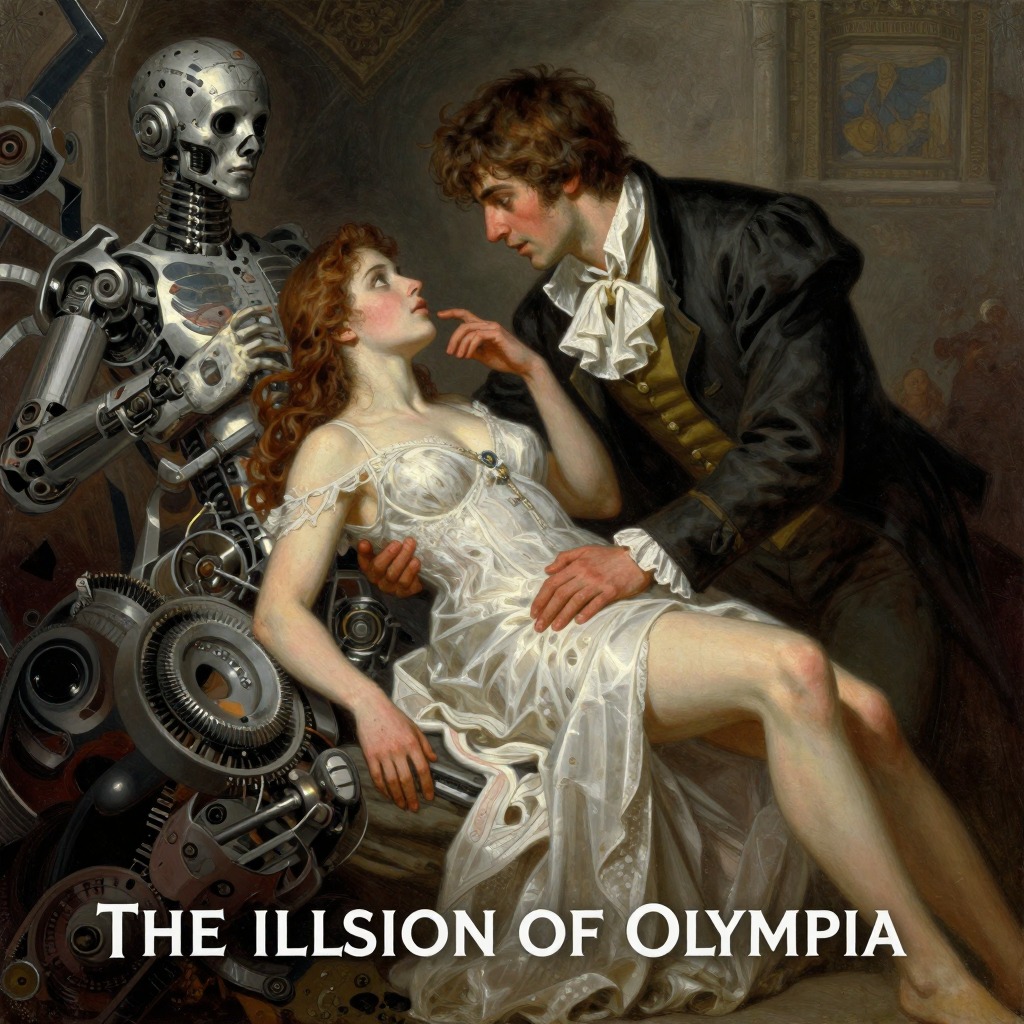
From the moment of its purchase, the looking-glass becomes the medium through which Nathaniel's love for Olympia is born and sustained. The day after the purchase, the curtain in Olympia's room is pulled shut, and Nathaniel cannot catch sight of her for three days. Desperately pining, he thinks of nothing but Olympia; Clara's image has been totally erased from his heart. At Spalanzani's party, Nathaniel uses the looking-glass to gaze at Olympia during the concert. Through its lens, he fathoms how ardently she peers in his direction, how every note seems to sound enveloped in a loving look that surges through his burning heart. The artful trills ring in his ear like the heavenly Hosannas of the spirit transfigured by love, and he cries out in rapture and pain: "Olympia!" The looking-glass thus does not merely magnify Olympia's features; it actively creates the illusion of life, warmth, and reciprocal love where none exists. It transforms a stiff, soulless automaton into the object of Nathaniel's total devotion, supplanting his genuine love for Clara.
The Looking-Glass and the Return of Madness
After Nathaniel's recovery from his first bout of madness—following the revelation that Olympia is a lifeless doll and his subsequent confinement in the madhouse—he returns to his family home, where Clara, his mother, and Lothar nurse him back to health. He becomes more gentle and childlike than ever, and no one reminds him of the recent past. The time approaches when the four happy people plan to move to a small country estate. At midday, Nathaniel and Clara climb the tall town hall tower to gaze out at the distant mountains. Standing arm in arm at the highest lookout gallery, Clara points to a strange little grey bush that seems to be slowly drawing near. Nathaniel mechanically reaches into his coat pocket; he finds Coppola's looking-glass and turns it sideways. There is Clara standing in the eye of the lens. A spasmodic quiver starts up in his veins and arteries; turning deathly pale, he peers at Clara, but soon sparks of fire flash from his rolling eyes. He lets out a horrible cry like a hunted animal, jumps high in the air, and with a curious cackle screams out shrilly: "Turn, little wooden doll, turn!" He grabs hold of Clara and tries to hurl her off the balcony. The looking-glass, which once gave Olympia the appearance of life, now strips Clara of her humanity, reducing her in Nathaniel's mad vision to the same wooden doll that had destroyed him. The object that had enabled his delusion now triggers its fatal return.
The Looking-Glass and the Final Fall
Lothar rescues Clara, and Nathaniel, now fully mad, flails about on the lookout gallery, jumping high in the air and crying: "Ring of fire, turn! Ring of fire, turn!" A throng gathers below, including the lawyer Coppelius, who has just come to town. Nathaniel suddenly stops dead in his tracks. He leans down, spots Coppelius below, and with a shrill shriek—"Ha! Eyes a pretty! Eyes a pretty!"—he leaps over the parapet. As Nathaniel lands, his skull smashes on the cobblestones. The looking-glass, which had first shown him Olympia's "eyes a pretty" and had then transformed Clara into a wooden doll, is the last object he touches before his suicide. It is the instrument that, from first to last, mediates his fatal relationship with the world of appearances, a device that gives the dead the semblance of life and the living the semblance of death.
The Looking-Glass as a Symbol of Mediated Perception
The looking-glass is more than a plot device; it is the story's central symbol of the dangerous power of optical mediation. Throughout the tale, Nathaniel's perception is repeatedly filtered through lenses—the glass door through which he first glimpses Olympia, the eyeglasses that Coppola spreads before him, and finally the looking-glass itself. Each lens promises clarity but delivers distortion. The looking-glass, in particular, does not simply magnify; it creates. It gives Olympia eyes that flash with life, and it turns Clara into a soulless automaton. It is the material embodiment of the dark force that Clara warns Nathaniel about: the power of belief to make phantoms real. The looking-glass is the object through which Nathaniel's subjective delusion becomes objective fact for him, the device that makes the unreal real and the real unreal. Its purchase for three ducats is the transaction that seals his fate, and its final appearance on the tower is the trigger that sends him to his death. The looking-glass is thus the story's most potent emblem of the uncanny power of representation itself—the ability of an image, once seen through a particular frame, to supplant reality and drive a person to destruction.