Nathaniel's madness
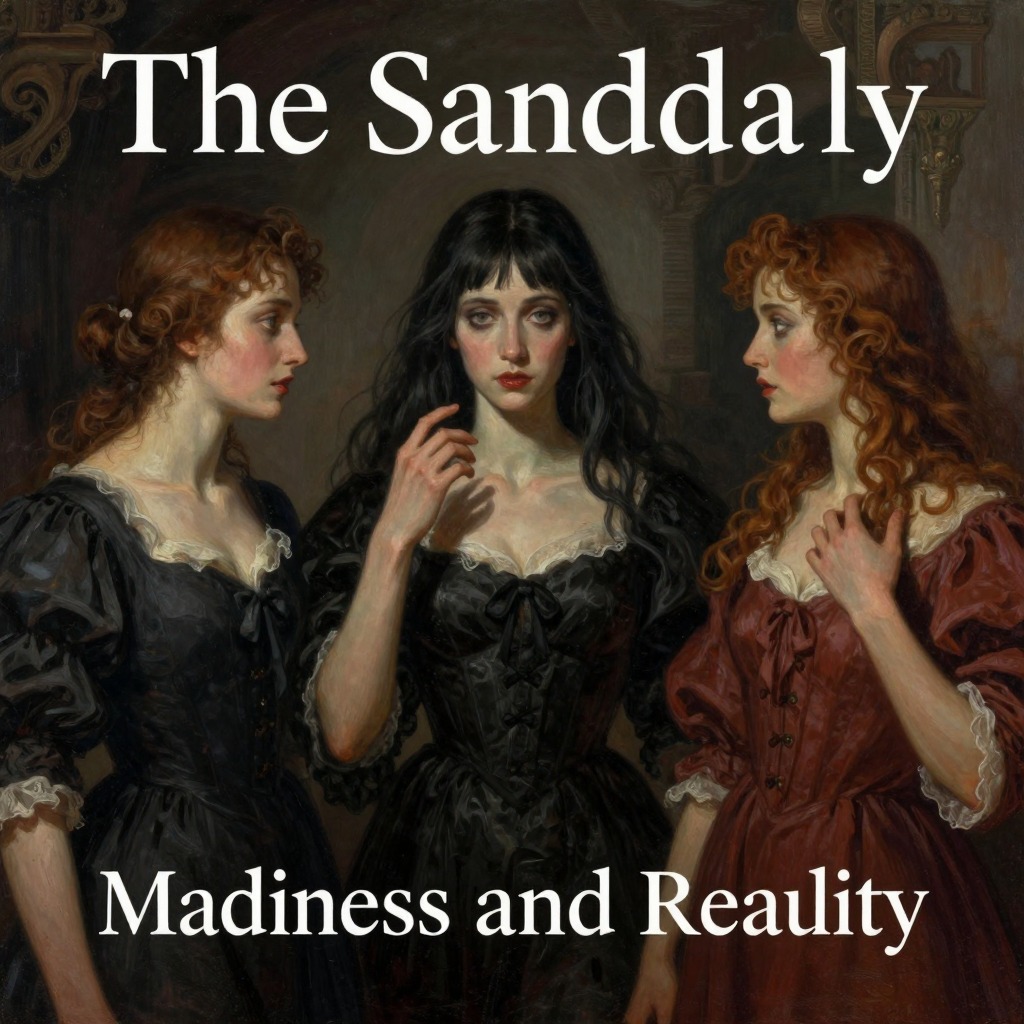
The SandmanNathaniel's madness is the central psychological catastrophe of E. T. A. Hoffmann's 'The Sandman', a recurring state of psychotic raving triggered by the traumatic return of repressed childhood terrors and culminating in his suicide. It manifests as violent delusions, compulsive repetition of the phrase 'wooden doll, turn!', and a fatal inability to distinguish between living beings and mechanical constructs, ultimately destroying his relationship with Clara and his own life.
Origins and First Outbreak
The seeds of Nathaniel's madness were sown in his childhood. His terror of the Sandman, a figure his nanny described as a bad man who flings sand in children's eyes and carries them off to the half-moon to feed his children, became fused with the real figure of the barrister Coppelius. Hiding in his father's study, Nathaniel witnessed Coppelius and his father conducting alchemical experiments at a hidden hearth. When discovered, Coppelius grabbed him, bared his teeth, and grumbled 'Little beast! Little beast!' before hurling him at the flames. Coppelius then grabbed glowing cinders, whispering 'Now we've got eyes – eyes – a lovely pair of children's eyes,' intending to strew them in Nathaniel's eyes. Only his father's desperate plea—'Master! Master! Let my Nathaniel keep his eyes! Let him keep them, I beg you!'—saved him. This trauma induced a high fever that kept Nathaniel bedridden for several weeks; his first clear words upon recovery were 'Is the Sandman still here?'
Recurrence and Delusional Fixation
Nathaniel's madness did not remain a single childhood episode. Years later, when the barometer salesman Giuseppe Coppola—whom Nathaniel immediately recognized as Coppelius—appeared, the old terror resurfaced. After purchasing a small, finely crafted pocket looking-glass from Coppola, Nathaniel used it to gaze into the room of Spalanzani's daughter, Olympia. Through the lens, Olympia's blank, dead eyes seemed to flash open in moist moonbeams, and her glances grew livelier. Nathaniel became transfixed, unable to take his eyes off her. Clara's image was totally erased from his heart; he thought of nothing but Olympia. At Spalanzani's party, he used the looking-glass to watch Olympia perform, and when her long trill pierced the air, he cried out in rapture and pain: 'Olympia!' He danced with her obsessively, ignoring the muffled laughter of other guests, and spoke fervently of his love in words that neither he nor she understood, to which Olympia only sighed 'Oh – Oh – Oh!' Nathaniel interpreted this as profound understanding, declaring, 'Only you, you alone completely understand me.'
The Revelation and Psychotic Break
The climax of Nathaniel's madness occurred when he burst into Spalanzani's study, drawn by a strange din. He found Spalanzani and Coppola fighting over Olympia, tugging and tearing her figure. In the struggle, Coppola yanked the figure free and swung it at Nathaniel, knocking him backwards over a work table. Then Coppola flung the figure over his shoulder and raced down the steps, its ugly dangling feet banging with a wooden thud. Nathaniel saw clearly that Olympia's deathly pallid wax face had no eyes, but black hollows in their stead; she was a lifeless doll. Spalanzani, bleeding from glass shards, cried out that Coppola had robbed him of his finest automaton—'twenty years' work – life and limb invested – the clockwork – speech – step – all mine – the eyes – the eyes robbed from you.' He then grasped a pair of bloody eyes from the floor and flung them at Nathaniel, striking him on the breast. At that moment, madness grabbed Nathaniel with its burning claws. He began to scream: 'Hopla – hopla – hopla! – ring of fire – ring of fire! Spin around, ring of fire – merrily – merrily! – wooden doll, hopla, lovely little wooden doll – turn turn!' He flung himself at Spalanzani, pressing his fingers to the Professor's throat, and would have strangled him if others had not intervened. Even the strong Siegmund could not restrain the madman, who kept screaming 'Wooden doll, turn, turn!' and lashing about with balled fists. It took the combined strength of many men to overpower him, fling him to the floor, and tie him up. His words dissolved into a terrible beastly bellowing, and he was taken to the madhouse in this pitiful state.
Relapse and Fatal Conclusion
Nathaniel eventually recovered, awakening in his father's house with Clara, his mother, and Lothar at his bedside. Every last trace of madness was gone, and he became more gentle and childlike than ever, recognizing Clara's heavenly pure spirit. The four happy people planned to move to a small country estate. But the madness was not truly vanquished. While walking through the city, Nathaniel and Clara climbed the tall town hall tower. Clara pointed out a strange little grey bush drawing near. Nathaniel mechanically reached into his coat pocket, found Coppola's looking-glass, and turned it sideways. There was Clara standing in the eye of the lens. A spasmodic quiver started up in his veins and arteries; turning deathly pale, he peered at Clara, then sparks of fire flashed from his rolling eyes. He let out a horrible cry like a hunted animal, jumped high in the air, and screamed: 'Turn, little wooden doll, turn!' With a great burst of strength, he grabbed Clara and tried to hurl her off the balcony. Lothar, hearing the commotion, broke down the locked doors and pulled Clara to safety just as she dangled over the edge by one hand. Nathaniel kept flailing about on the lookout gallery, jumping and crying 'Ring of fire, turn! Ring of fire, turn!' Below, the lawyer Coppelius had just arrived in town. Nathaniel spotted him, and with a shrill shriek—'Ha! Eyes a pretty! Eyes a pretty!'—he leapt over the parapet. His skull smashed on the cobblestones, and Coppelius disappeared into the crowd.
Thematic Significance
Nathaniel's madness is not merely a personal affliction but the story's central mechanism for exploring the terrifying permeability of the boundary between the human and the mechanical, the real and the imagined. His psychotic episodes are triggered by the literal or symbolic return of eyes—the childhood threat of having his eyes stolen, the bloody eyes of the automaton, Clara's eyes seen through Coppola's looking-glass. The phrase 'wooden doll, turn!' becomes his mad refrain, revealing that his deepest terror is the possibility that the beloved is an automaton, a fear that ultimately consumes him. His madness also dramatizes the conflict between the prosaic and the poetic worldviews: Clara's sensible, rational attempts to banish the Sandman by denying his power are powerless against the compulsive force of Nathaniel's delusions. In the end, his madness is both the consequence of a childhood trauma and the expression of a metaphysical dread that no amount of domestic happiness can cure.