Nathaniel's madness outbreak
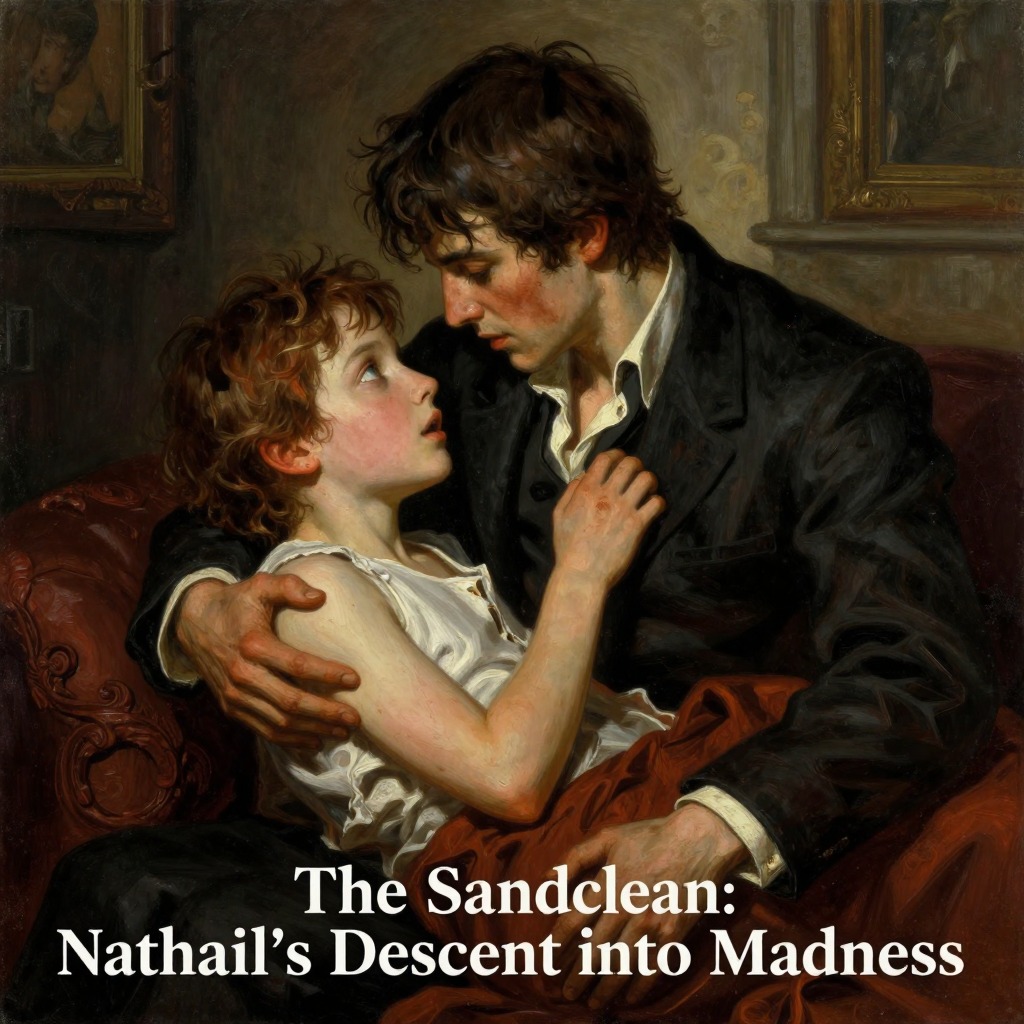
The SandmanNathaniel's madness outbreak is the pivotal moment in E. T. A. Hoffmann's "The Sandman" when the young student's carefully maintained grip on reality shatters completely. The scene erupts from the violent confrontation between Professor Spalanzani and the optician Coppola—who is revealed to be the dreaded Coppelius of Nathaniel's childhood—as they fight over the figure of Olympia. In that struggle, Nathaniel sees that Olympia is not a living woman but a wooden automaton, and the sight of her eyeless wax face, combined with the pair of bloody eyes flung at his chest, drives him into a frenzy of raving madness that marks the story's tragic turning point.
The Revelation and the Trigger
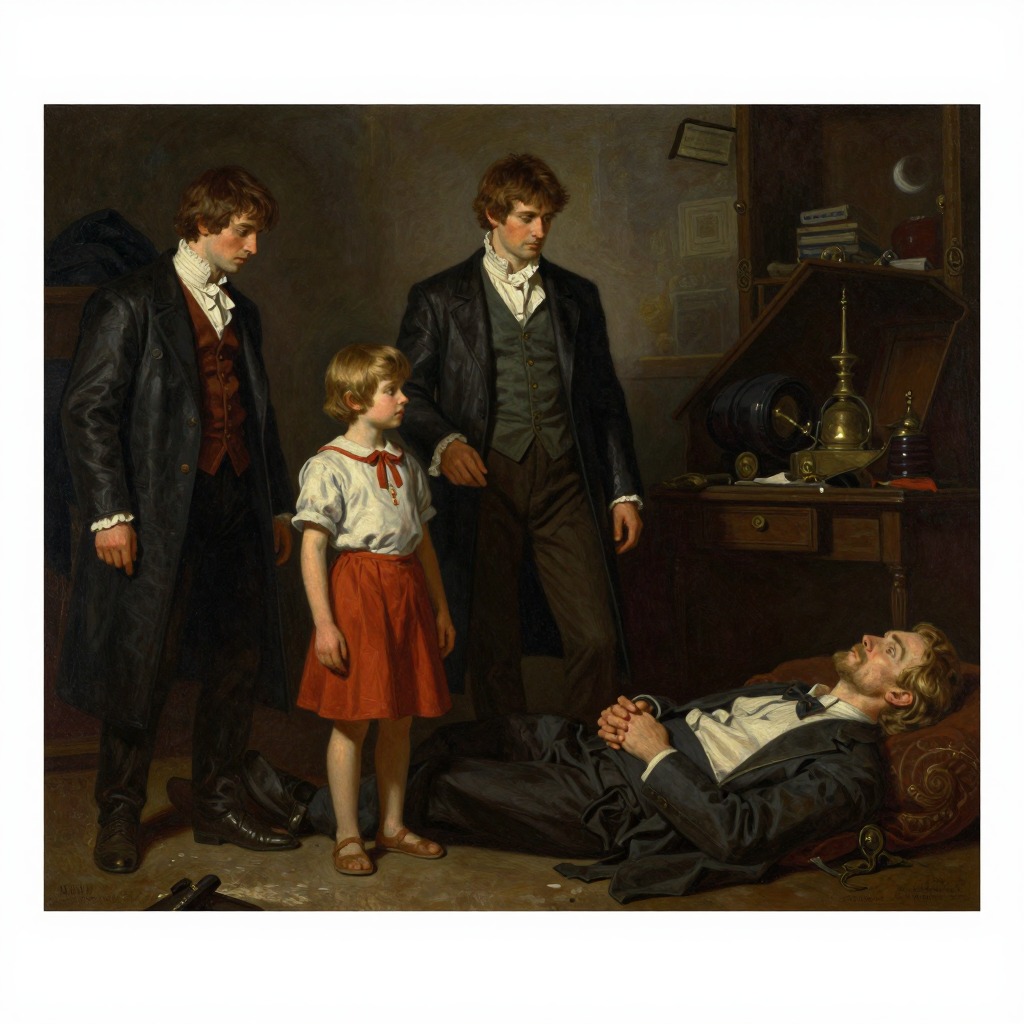
Nathaniel bursts into Spalanzani's study after hearing a strange din of stamping, clattering, and furious shouting. He finds the Professor and Coppola locked in a physical struggle over Olympia: Spalanzani holds her by the shoulders, Coppola by the feet, each screaming accusations about who made the eyes and who made the clockwork. As Nathaniel recoils in horror, Coppola wrenches the figure free and swings it at Nathaniel, knocking him backward over a work table covered with phials, retorts, and measuring glasses, which smash into a thousand pieces. Then Coppola flings the figure over his shoulder and races down the steps, the ugly dangling feet banging with a wooden thud and thump. Nathaniel, stunned, sees clearly that Olympia's deathly pallid wax face has no eyes—only black hollows. She is a lifeless doll.
The Eyes and the Descent into Raving
Spalanzani, bleeding from cuts on his head, chest, and arms, pulls himself together and shouts for Nathaniel to pursue Coppola, who has robbed him of his finest automaton—twenty years' work, the clockwork, speech, step—all his, except the eyes, which were stolen from Nathaniel. Then Nathaniel spots a pair of bloody eyes peering at him from the floor. Spalanzani grasps them with his uninjured hand and flings them at Nathaniel, striking him on the breast. At that instant, madness grabs him with its burning claws and bores into his heart of hearts, tearing his thinking and feeling to shreds. He begins to scream: "Hopla – hopla – hopla! – ring of fire – ring of fire! Spin around, ring of fire – merrily – merrily! – wooden doll, hopla, lovely little wooden doll – turn turn!" He flings himself at the Professor and presses his fingers to his throat, attempting to strangle him. Many people, roused by the racket, storm in, tear the raging Nathaniel from Spalanzani's neck, and revive the old man. Even the strong Siegmund cannot restrain the madman, who keeps screaming in a terrifying voice, "Wooden doll, turn, turn!" and lashes about with balled fists. It takes the combined strength of many men to overpower him, fling him to the floor, and tie him up. His words dissolve into a terrible beastly bellowing, and in this pitiful state, still raving in a ghastly frenzy, he is taken to the madhouse.
The Roots of the Outbreak
The madness outbreak is the culmination of a lifetime of psychological trauma. As a child, Nathaniel was terrorized by the figure of the Sandman, whom his nanny described as a bad man who flings sand in children's eyes and carries them off to the half-moon to feed his owl-beaked young. Nathaniel's childhood encounter with the Sandman—actually the barrister Coppelius—occurred when he hid in his father's study and witnessed Coppelius and his father working at a hidden hearth with alchemical instruments. Coppelius, upon discovering Nathaniel, grabbed him, bared his teeth, and hurled him at the hearth, singeing his hair. He then grabbed glowing cinders from the flames, intending to strew them in Nathaniel's eyes, and only his father's pleading—"Master! Master! Let my Nathaniel keep his eyes!"—stopped him. Coppelius then twisted Nathaniel's hands and feet, reinserting them here and there, until everything went dark. This childhood trauma, with its central motif of eyes being stolen or destroyed, is reawakened when Nathaniel, as an adult, encounters the barometer salesman who is actually Coppelius in disguise, and later when he purchases a looking-glass from Coppola that allows him to see Olympia's face. The revelation that Olympia is an automaton and that her eyes are not real—that the eyes he saw were bloody and detached—directly reenacts the childhood terror of having his eyes taken, and the madness that follows is the psychological collapse under the weight of that repressed memory finally breaking through.
The Aftermath and the Final Tragedy
Nathaniel's madness does not end with his confinement. After he awakens from the oppressive dream of his raving, he is nursed back to health by his mother, his beloved Clara, and his friend Lothar, and seems to recover completely. He becomes gentle and childlike, and plans to marry Clara and move with her, his mother, and Lothar to a small country estate. But the madness is only dormant. One day, as he and Clara stand on the highest lookout gallery of the town hall tower, Clara points out a strange little grey bush. Nathaniel mechanically reaches into his coat pocket, finds Coppola's looking-glass, and turns it sideways. Through the lens, he sees Clara. A spasmodic quiver starts up in his veins and arteries; turning deathly pale, he peers at her, and soon sparks of fire flash from his rolling eyes. He lets out a horrible cry like a hunted animal, jumps high in the air, and screams out shrilly: "Turn, little wooden doll, turn!" He grabs hold of Clara and tries to hurl her off the balcony. Lothar, hearing the commotion, breaks down the locked doors and saves Clara, but Nathaniel, now raving again, keeps flailing about on the lookout gallery, jumping high in the air and crying, "Ring of fire, turn! Ring of fire, turn!" When he spots Coppelius below in the market square, he shrieks, "Ha! Eyes a pretty! Eyes a pretty!" and leaps over the parapet. His skull smashes on the cobblestones, and Coppelius disappears into the crowd. The madness outbreak, therefore, is not a single episode but a recurring condition that ultimately destroys Nathaniel, demonstrating how the unresolved trauma of childhood, when triggered by the return of the repressed figure and the symbol of the eyes, can shatter the mind and lead to a fatal end.