Olympia's eyes
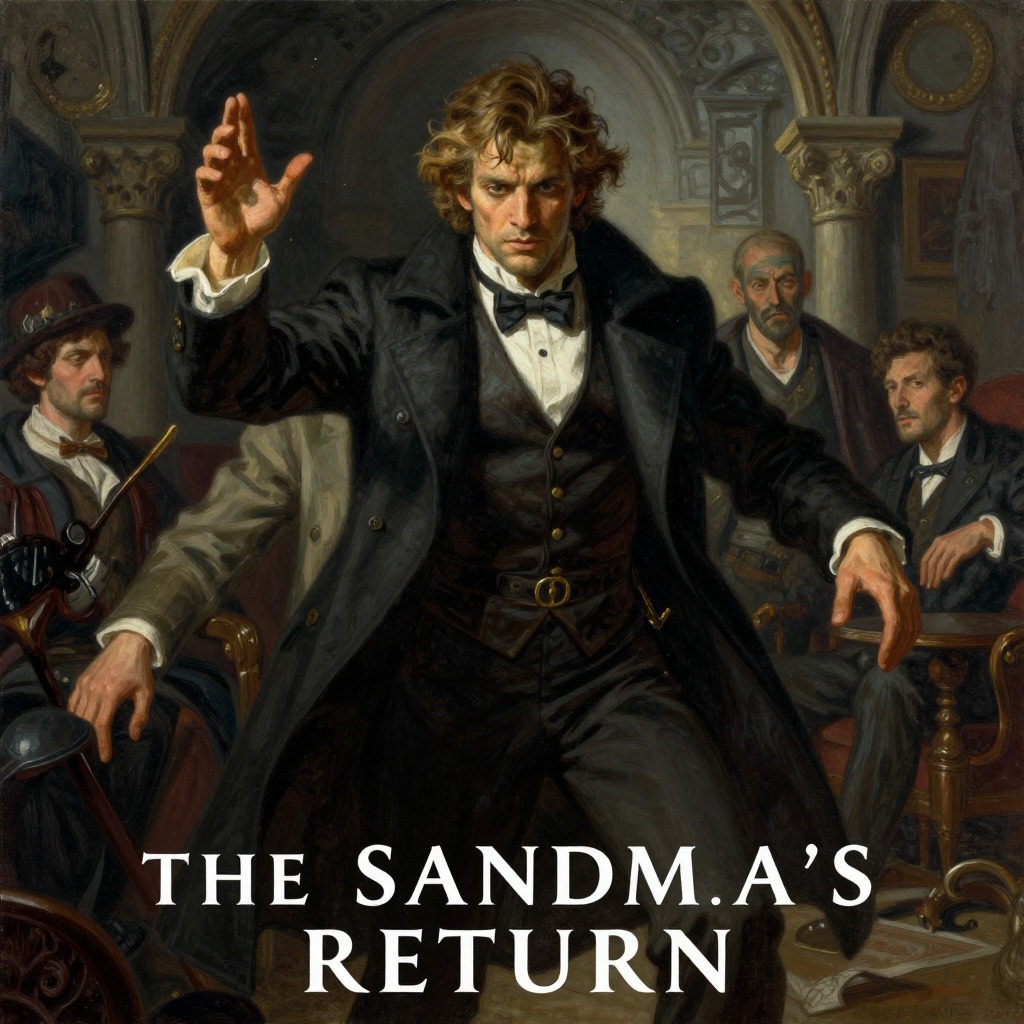
The SandmanOlympia's eyes are the most potent and terrifying object in E. T. A. Hoffmann's "The Sandman," the physical locus where Nathaniel's childhood trauma, his obsessive love, and the story's final catastrophe converge. They are not merely a feature of a beautiful face but a manufactured commodity, a site of violent conflict, and a trigger for madness. Their journey from blank, glassy orbs to bloody, detached objects encapsulates the story's central horror: the collapse of the boundary between the living and the mechanical, the real and the hallucinated.
Origin and Manufacture
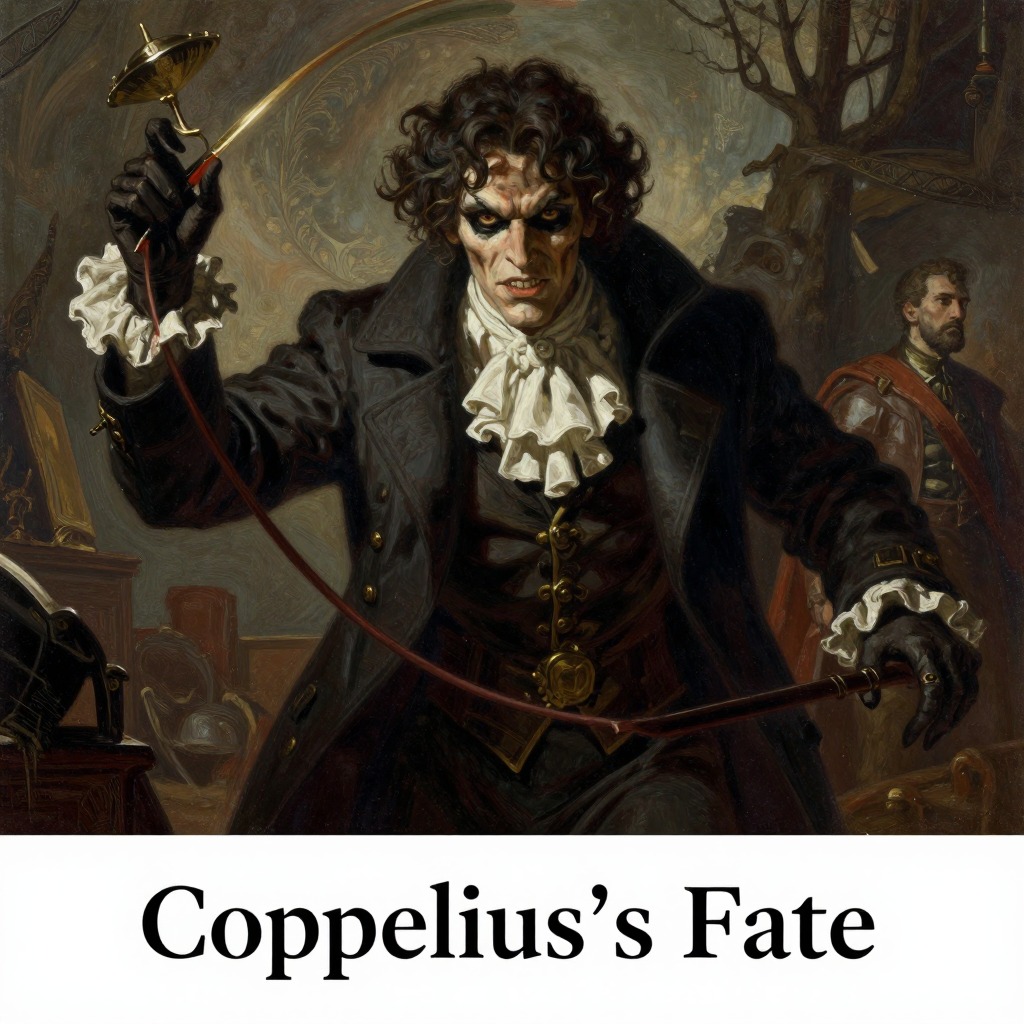
The eyes are the product of a sinister collaboration between the barrister Coppelius and the professor Spalanzani. During the violent revelation of Olympia's true nature, Spalanzani, in his fury, reveals the division of labor: "Did I put my life and limb on the line for that?" he screams, to which Coppelius retorts, "it was me, me who made the eyes!" Spalanzani counters, "And I the mechanical clockwork!" This exchange confirms that Olympia's eyes are not organic but crafted artifacts, the work of the same Coppelius who, years earlier, had threatened to tear out Nathaniel's own eyes as a child. The eyes are thus a direct material link to Nathaniel's primal trauma, a manufactured object that carries the Sandman's curse.
The Looking-Glass and the Illusion of Life
Nathaniel first perceives Olympia's eyes as lifeless. When he glimpses her through a crack in a door, he notes that "her eyes had something glassy about them" and that "it seemed to me as if she slept with open eyes." This initial impression of deadness is transformed only when he purchases a small pocket looking-glass from the optician Coppola—who is, unbeknownst to Nathaniel, Coppelius in disguise. Peering through the lens, Nathaniel sees Olympia's face with unprecedented clarity, and it seems to him "as if Olympia's eyes flashed open in moist moonbeams" and "as if she had only now acquired the power of sight." The looking-glass does not merely magnify; it actively creates the illusion of life, projecting Nathaniel's desire onto a blank surface. The eyes become the focal point of his delusion, convincing him that Olympia possesses a profound, loving spirit, even though she never speaks more than a few syllables.
The Violent Revelation
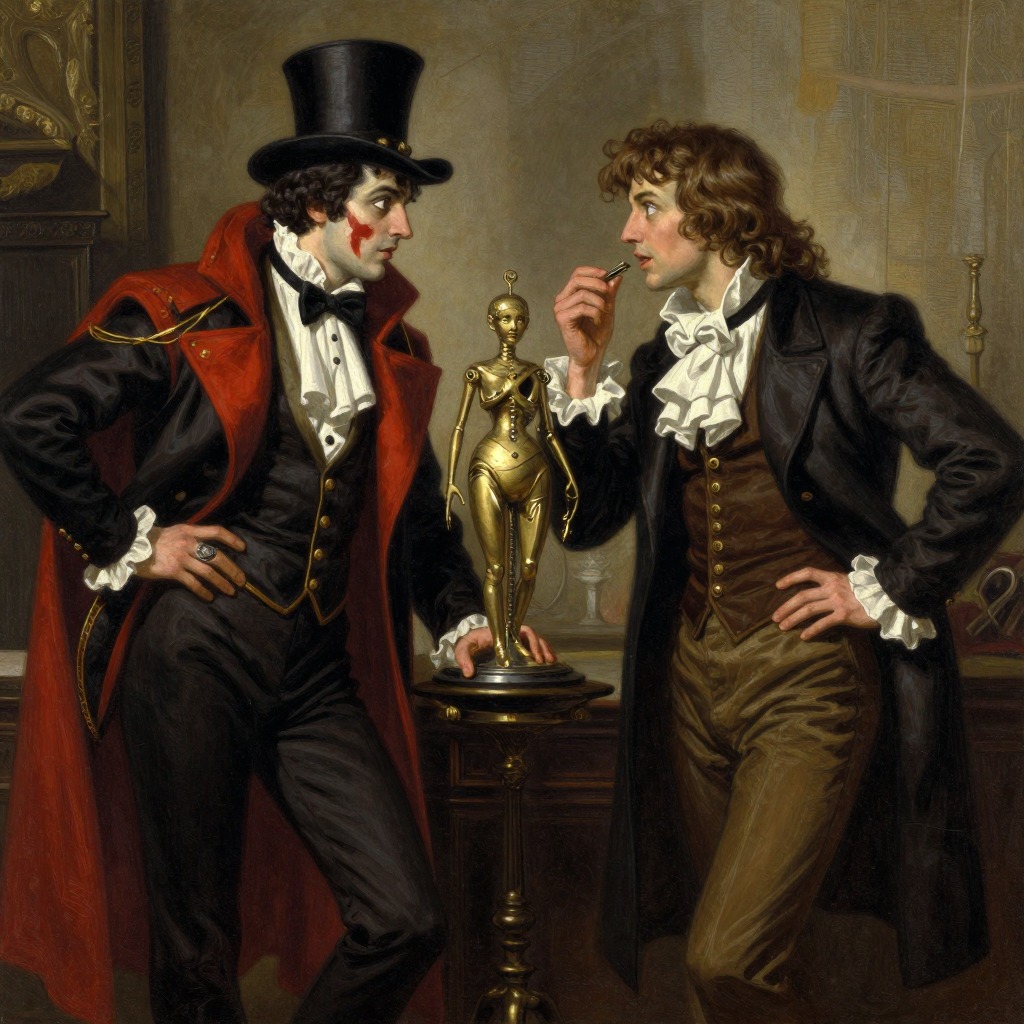
The illusion is shattered in a scene of grotesque violence. Bursting into Spalanzani's study, Nathaniel finds the professor and Coppola locked in a furious struggle over Olympia's body. "The Professor held a female figure by the shoulders, the Italian Coppola held her by the feet; they tugged and tore her here and there, furiously fighting for possession." In the chaos, Coppola yanks the figure free and flees, and Nathaniel sees the truth: "Olympia's deathly pallid wax face had no eyes, but black hollows in their stead; she was a lifeless doll." The eyes, the very organs that had seemed to him the windows of a soul, are revealed to be removable parts. Spalanzani, bleeding on the floor, then picks up a pair of bloody eyes from the floor and flings them at Nathaniel, crying, "there are her eyes!" The eyes, once the object of adoration, are now a projectile of horror, striking Nathaniel on the breast and driving him into immediate madness.
The Final Catastrophe
The eyes return one last time, in the story's final scene. Months later, seemingly recovered and reconciled with Clara, Nathaniel climbs the town hall tower with her. As they gaze at the landscape, Clara points out a strange bush. "Nathaniel mechanically reached into his coat pocket; he found Coppola's looking-glass and turned it sideways. There was Clara standing in the eye of the lens." The sight of Clara through the same instrument that had once transfigured Olympia triggers a catastrophic relapse. Nathaniel, seeing Clara's image, is seized by a spasm and begins to scream, "Turn, little wooden doll, turn!" He attempts to throw Clara from the tower. When he sees Coppelius in the crowd below, he shrieks, "Ha! Eyes a pretty! Eyes a pretty!"—the very phrase Coppola had used when selling the looking-glass—and leaps to his death. The eyes, the looking-glass, and the memory of Olympia are thus fused into a single, inescapable trigger that destroys Nathaniel. The object that once promised love and understanding delivers only madness and annihilation.