
Who Speaks, Who Describes, Who Belongs
The Satanic VersesThis thread explores how voice and naming create authority, impose identities, and sometimes allow marginalized people to reclaim the stories told about them.
increasing Bearing strength in each event
 decreasing
Bearing strength in each eventdecreasingThe Voice Without a Speaker
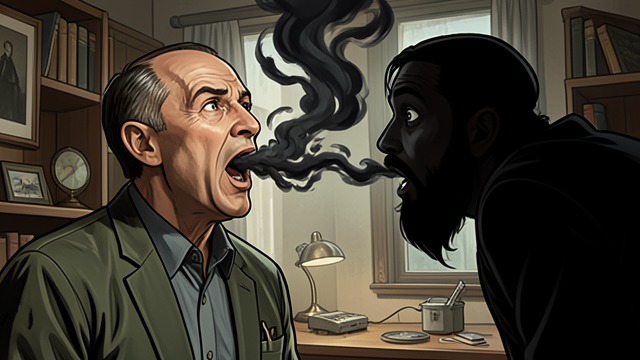
The Voice Without a Speaker
Speech as an event
In Mahound’s visions, Gibreel experiences words emerging through his mouth without feeling that they are his own. The image of the messenger as a postman captures the difficulty of locating the source of speech, while the Prophet’s listening remains entangled with his own questions and desires.
Authority through transmission
What becomes authoritative as revelation passes through a sequence of bodies and acts: vision, speech, memory, recitation, and recording. The novel does not grant any participant a simple position outside that chain from which the words could be verified.
This uncertainty matters because the words create a community and shape its rules. Whoever claims to speak for the divine also influences what others are permitted to believe and do.
The Scribe’s Altered Words
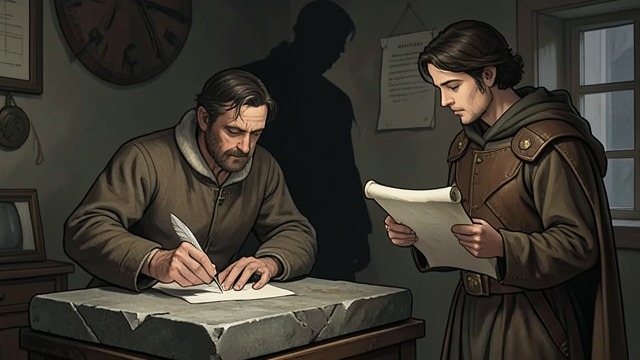
The Scribe’s Altered Words
A small intervention
Salman changes the words he is recording, beginning with a substitution that seems minor and proceeding to changes with greater theological consequences. Mahound accepts the altered recitation, and Salman faces the unsettling possibility that the scribe’s phrasing may pass for revelation.
A crisis of authorship
Salman’s experience makes writing an act of power rather than a neutral copy of speech. His position as a foreigner and educated scribe gives him access to the text, but not the authority to determine how others will interpret what he has done.
The episode makes the origin of religious language inseparable from its transmission. It also suggests that a community’s confidence in sacred wording can depend on human institutions and trust, both of which are vulnerable to failure.
The Arresting Description
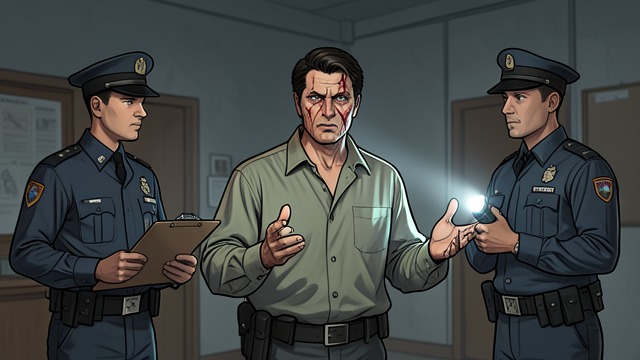
The Arresting Description
Identity rejected as evidence
The police and immigration officers treat Saladin’s altered body as proof that he is an illegal or dangerous person, even as he insists that he is a British citizen. His name, documents, and account of the plane disaster carry less weight than the image the officers believe they see.
A system that speaks over him
Saladin tries to recover his identity through official records and the Police National Computer. The database confirms his citizenship, but that confirmation does not undo the abuse or make the officers willing to trust his testimony.
The sequence shows description operating as an institutional force. A person may be legally legible and still be treated as the creature that racial prejudice has decided he must be.
The Reclaimed Devil Image
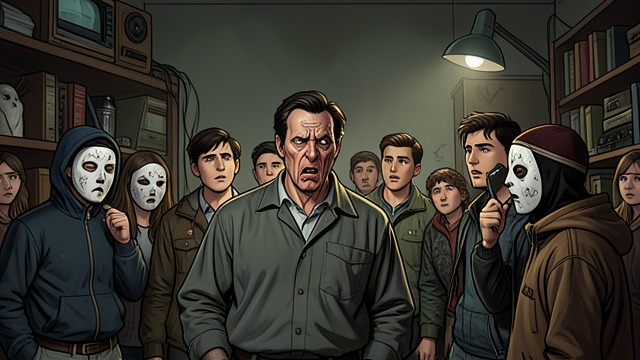
The Reclaimed Devil Image
A hostile image changes hands
As Saladin’s monstrous likeness becomes popular in Brickhall, young people adopt it as a sign of defiance. The same image that once marked him as an object of humiliation becomes something the community can wear, reinterpret, and use against the shame attached to it.
Reclamation is not restoration
Saladin does not control the meaning of his new public image, and he resists being turned into a symbol. Yet his neighbors’ appropriation of the image reveals that naming can be contested: a sign imposed from above may acquire a different force when those it stigmatizes claim it for themselves.
The episode’s ambiguity is important. The reclaimed devil can express solidarity and resistance, but it does not return Saladin to a stable self or undo the violence that made the image available.
The Camera’s Partial Story
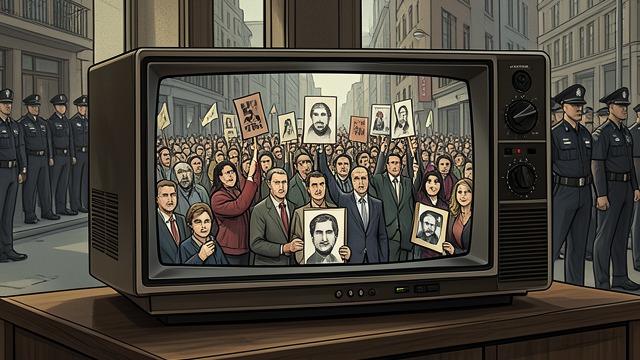
The Camera’s Partial Story
Visibility with a point of view
The television cameras record the police raid, the burning streets, and the arrest of people inside Club Hot Wax. Their lights make certain scenes sharply visible, while their distance, framing, and reliance on official statements leave other experiences outside the image.
Authority in the edit
The news report’s selection of details helps define the public meaning of the unrest. The camera appears to document events, but its position behind the police line makes that line part of what the audience learns to accept as the natural vantage point.
The scene extends the novel’s inquiry into voice and description from individuals to public media. A record can contain accurate details and still produce a distorted account through what it excludes, emphasizes, and treats as fact.
During Mahound’s visions on Mount Cone
Salman the Persian’s service as Mahound’s scribe
After Saladin is taken from Rosa Diamond’s house
As Saladin’s likeness spreads through Brickhall
During the police raid on Club Hot Wax
