
Faith, Doubt, and the Uncertain Voice
The Satanic VersesThis thread follows religious authority as it emerges through uncertain speech, political compromise, and the struggle to distinguish revelation from human desire.
increasing Bearing strength in each event
 decreasing
Bearing strength in each eventdecreasingA Crisis of Listening
A Crisis of Listening
The pressure to compromise
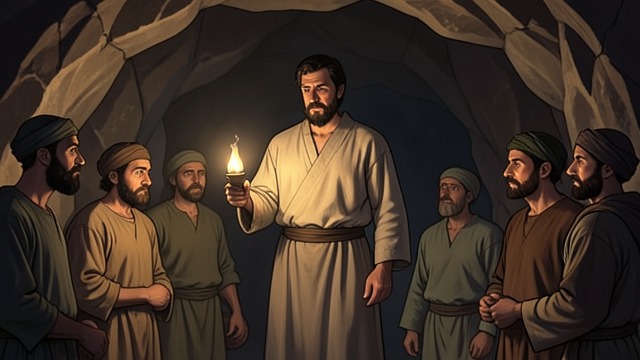
In Jahilia, Mahound’s message of one God meets public ridicule and political exclusion. Abu Simbel offers recognition and a place on the city council if the three goddesses receive a limited religious status.
Doubt enters the cave
Mahound considers whether compromise might bring his message to more people. He asks Gibreel for guidance, but the angelic figure who appears in his dreams does not supply an uncomplicated answer; the scene makes listening feel at once like receiving and asking.
The episode frames faith not as freedom from uncertainty, but as a confrontation with it. Mahound’s decision will affect both the content of belief and the political shape of the community that gathers around it.
Verses and Their Reversal
Verses and Their Reversal
A public concession
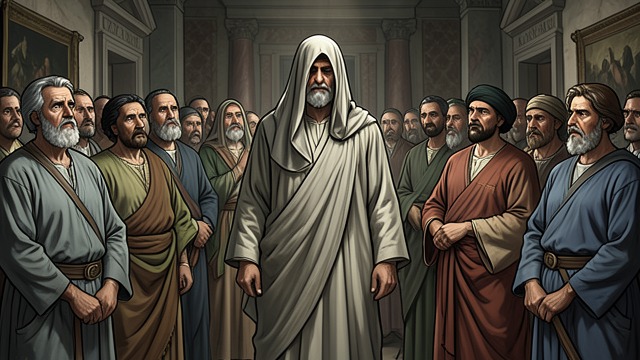
At a poetry gathering, Mahound recites verses that appear to honor Lat, Uzza, and Manat. The apparent recognition transforms the gathering: Abu Simbel and Hind publicly submit, while Mahound’s followers confront the possibility that their central claim has been compromised.
Repudiation without certainty
Mahound later announces that the verses came from Shaitan and replaces them with a denunciation of the goddesses. Yet Gibreel’s dream perspective preserves an unsettling complication: the same angelic voice delivers both the original verses and their repudiation.
The episode refuses to make revelation easy to verify. Political need, inner doubt, dream, and sacred authority overlap, leaving the question of who spoke—and what that means—open to interpretation.
The Scribe’s Test
The Scribe’s Test
Suspicion grows
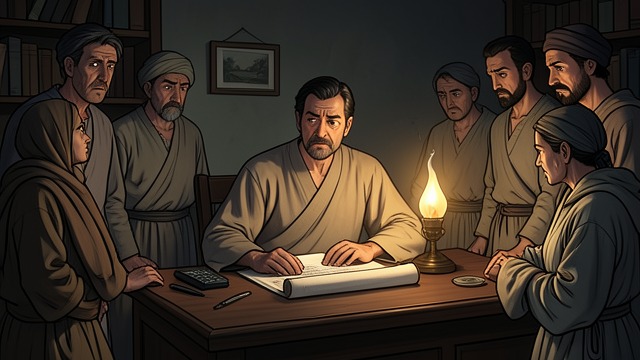
As Mahound’s community establishes its rules in Yathrib, Salman the Persian notices how revelations appear to confirm decisions Mahound has already made. His work as a scribe gives him a direct role in recording the words that will govern religious life.
A dangerous experiment
Salman alters the dictated wording, first slightly and then more substantially. Mahound accepts the altered text, and Salman is shaken by the possibility that his own language cannot be distinguished from revelation by the Messenger who receives it.
Salman’s test does not settle the origin of the words. Instead, it exposes a crisis of trust: the community’s sacred text reaches others through human listening, memory, and writing, all of which may be fallible or compromised.
Rules and Their Human Uses
Rules and Their Human Uses
Order as authority
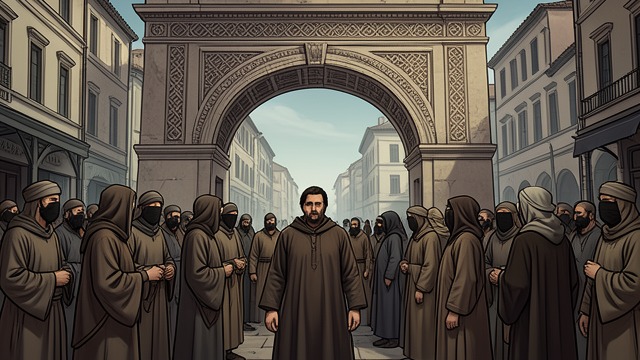
In Gibreel’s account of Yathrib, revelation becomes a growing body of detailed regulations, shaping daily behavior as well as religious allegiance. The rules promise coherence to a community under pressure, while their comprehensiveness makes ordinary life increasingly subject to religious authority.
Convenience and suspicion
Salman sees the rules as strikingly well-timed, especially when they benefit Mahound or protect the community’s interests. He wonders whether a divine messenger’s apparent judgments may reflect the needs of a successful businessman and leader.
The novel does not reduce law to cynicism or faith to manipulation. It asks how easily a framework presented as eternal truth can also organize power, and how difficult it is for followers to distinguish spiritual conviction from political usefulness.
A Question Without a Final Answer

A Question Without a Final Answer
The limits of explanation
Across the novel, characters experience visions, transformations, and apparent miracles that resist ordinary explanation. Some are interpreted as divine signs; others as delusion, grief, political spectacle, or the effects of illness.
The unresolved authority
The narrator declines to settle the boundary between God and the Devil, or to certify that either has directed events. Even Gibreel’s final actions do not turn his visions into a reliable theology; his certainty coexists with severe mental illness and personal violence.
Faith and skepticism remain active ways of reading the same events, not neat stages in a progression toward certainty. The novel’s spiritual argument lies in preserving that conflict without letting any voice claim unquestionable authority.
Mahound’s early preaching in Jahilia
During Mahound’s first major religious crisis in Jahilia
During Mahound’s years in Yathrib
After the migration to Yathrib
After the destruction of the Shaandaar Café
