Abu Simbel
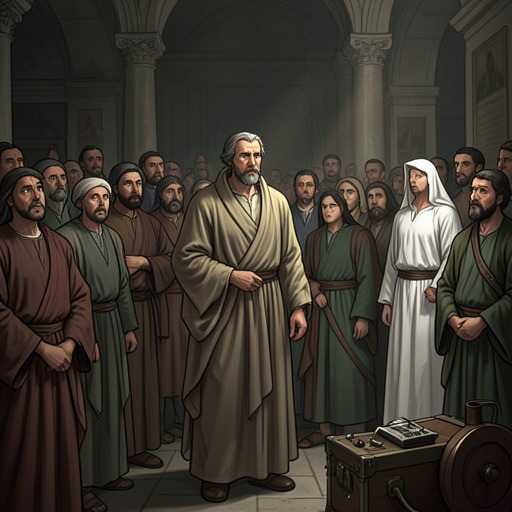
The Satanic VersesAbu Simbel is the Grandee of Jahilia, a merchant ruler whose wealth and authority are bound to the city’s temples and caravan trade. He first treats Mahound’s challenge as a problem to be managed: satire might discredit the new faith, and a bargain might make room for the old goddesses. But his eventual submission overturns the certainty on which his rule depends. In the novel’s dream narrative, the man who once presumed to test Mahound becomes the figure who surrenders Jahilia and unlocks its gates, while Hind, his wife, claims the power to define what their defeat means.
Identity and Sources of Power
Abu Simbel enters the story amid the crowded Feast of Ibrahim, where Jahilia’s perfumed fair displays the commercial order he commands. A tall man in loose white robes, he is head of the Council of Jahilia and immensely rich through camels, caravans, and the lucrative temples at the city gates. His household controls the temple of Lat at the southern gate, the Manat temple at the eastern gate, and the temple of Uzza in the north. Religion, municipal authority, and commerce are therefore not separate interests for him: the shrines provide a foundation for his wealth, and the city’s public rituals sustain the order in which his family rules.
The fair makes that order tangible. Merchants trade precious metals, cloth, arms, and grain; the Shark tribe divides the market into zones, with different groups controlling spices, textiles, precious goods, and entertainment. Pilgrims arrive with money to spend, while the city’s rulers draw income from the religious institutions that attract them. Abu Simbel’s position is powerful, but it is also exposed. A movement that rejects the city’s many gods in favor of one God threatens not only a set of beliefs but the temple revenues and commercial arrangements on which his status rests.
Jahilia’s public life has become increasingly licentious under the rulers’ policies, and Abu Simbel is associated with the city’s indulgence and disorder. The city is known for gambling, bawdy entertainment, and the exploitation of pilgrims; gangs of young members of the Shark tribe enforce their own law, and Abu Simbel is rumored to meet with their leaders and organize them. These details place him within a system that profits from the fair while permitting its abuses. His authority depends on more than personal wealth: it extends through temples, trade, and networks of force.
Baal and the Politics of Satire
Abu Simbel recruits Baal, the satirist, to write against Mahound and his followers. He approaches the poet at the fair with a show of geniality, steering him toward the House of the Black Stone under the pretext of clearing the way. There he describes the commission as a literary task and acknowledges that the arts of metrical insult are beyond his own abilities. Baal resists the idea that an artist should serve the state. Abu Simbel answers by reminding him that poets already write songs celebrating blood-feuds and assassinations, making the distinction between political service and established poetic work harder to maintain.
The exchange turns threatening when Abu Simbel invokes their supposed shared devotion to a mistress. Baal understands this to mean Lat, whose temple he worships and whose cult Abu Simbel’s household sponsors. The misunderstanding briefly reassures him, but Abu Simbel then makes clear that he meant Hind: he knows of Baal’s relationship with his wife. The exposure strips away Baal’s confidence. Abu Simbel uses that knowledge, as well as his political power, to force the poet into the commission.
Outside the House of the Black Stone, Abu Simbel identifies the people Baal is to attack: Khalid, Salman the Persian, Bilal, and their leader, Mahound. Baal mocks the idea that a small band of water-carriers, immigrants, and slaves could threaten a city with three hundred and sixty idols. Abu Simbel does not share his amusement. He orders Baal to turn his insults into verses and insists that the resulting work must be a masterpiece. The scene establishes both men’s different readings of the danger: Baal sees an easy target, while Abu Simbel recognizes that Mahound’s movement may unsettle the established order.
Abu Simbel’s private reflections sharpen that concern. He wonders why he fears Mahound, yet understands that the danger is not reducible to the movement’s numbers. He is a cautious man, attentive to what he can know and unsettled by what he cannot. Knowledge itself has become a need: he wants to know what is happening, including what he already suspects about Hind and Baal. Mahound is his enemy in part because the new movement represents an influence he cannot comfortably contain or fully comprehend.
The Proposed Compromise and Public Submission
Abu Simbel’s response to Mahound is not initially an attempt to destroy the new faith outright. He proposes a test and a compromise: if Mahound will recognize Lat, Uzza, and Manat as worthy of worship, the new community may be tolerated and officially acknowledged, and Abu Simbel will be elected to the city council. The offer would preserve the goddesses and incorporate Mahound’s movement into Jahilia’s existing political arrangements. Its promise of tolerance is also a means of limiting the movement’s challenge to the city’s religious and economic structure.
The proposal carries a risk for Mahound. Salman the Persian warns that if Mahound returns from Coney with a revelation approving the goddesses, Abu Simbel will be able to accuse him of inventing a message to suit the bargain. Mahound answers by describing his experience of listening to Gibreel as a kind of inward asking. The ensuing recitation appears to grant the goddesses a place, and the response in the gathering is immediate. Abu Simbel places his fingers beside his ears, proclaims the greatness of Allah, and kneels. Hind follows his lead. The movement of submission passes through the assembled crowd, row by row, while Khalid watches in horror and flees. Mahound remains standing.
Abu Simbel’s public gesture makes the compromise look like a victory for the Grandee and the goddesses he serves. Yet the scene does not settle the conflict. The altered religious message becomes a point of scandal and instability, and Abu Simbel’s apparent triumph belongs to a contested turning point rather than a secure resolution. His ability to stage a political-religious accommodation cannot ensure that he controls its meaning or its consequences.
Decline, Surrender, and the Fall of Jahilia
By the time Mahound is sixty-five, Jahilia has changed from a shifting, prosperous fairground into a poor and commonplace city. Mahound’s power has cut off its pilgrims and caravans, and the once-busy fairs have dwindled. Abu Simbel has aged with the city: his hair is white and thinning, his appearance worn, and his concubines have grown old. Hind, by contrast, seems not to have aged. She now believes that she, rather than her husband, rules Jahilia. The contrast between Abu Simbel’s decline and Hind’s apparent preservation makes the city’s changing balance of power visible within the marriage as well as in public life.
Abu Simbel’s surrender is narrated as one of Gibreel’s dreams. He appears at Mahound’s camp in an unexpected return to the political stage, accompanied by Khalid and Bilal. He has come alone to meet Mahound, and the dream presents him as having recovered some of his former strength for this last act of authority. He gives Jahilia over to Mahound, a decision Hind has failed to prevent.
When Abu Simbel returns home, Hind confronts the consequences in public. She strikes him and urges the crowd to tear him apart, accusing him of making a deal to save himself. Abu Simbel remains calm. He tells the people that Mahound has promised safety to anyone who enters his house and to those who stay at home behind closed doors. Hind rejects his assurances and calls on the people to resist Mahound in the name of Al-Lat. She presents herself as willing to fight and die for Jahilia, but the people begin to leave. Their departure exposes the weakness beneath the city’s boasts of greatness and invulnerability: they have trusted Hind’s defiance, but now accept Abu Simbel’s assessment that the city has fallen.
As the crowd disperses, Hind calls after them to come to the House of the Black Stone and sacrifice to Lat. No one returns. Abu Simbel tells her that, given what she has done to Mahound’s uncle, she should not be surprised that Mahound may treat her as an enemy in turn. He then leaves the balcony and goes down into the deserted streets to unlock the city gates. The gesture completes his reversal from guardian of Jahilia’s old order to the person who makes its transfer of power possible.
Hind, Revenge, and Narrative Significance
After Jahilia passes to Mahound, Hind retreats into a tower with old books written in scripts no one else in the city can decipher. For two years and two months she sees no other person, taking her meals outside the door and remaining hidden from the city. Abu Simbel continues to live with the consequences of the defeat, while Hind’s withdrawal leaves their marriage divided by opposing responses: his surrender and her refusal to accept the new order.
When Hind finally appears in his bedroom, dressed in jewels and apparently younger than before, she announces that revenge is a reason to celebrate. News soon arrives that Mahound has fallen fatally ill. Hind prepares a banquet, but Abu Simbel refuses to join her, calling her celebration obscene; he understands her feast as an attempt to answer Mahound’s illness with the memory of the violence she committed against his uncle. Hind eats alone while the city’s servants weep and leave her to her private triumph.
Abu Simbel’s arc binds religious conflict to the material and intimate structures of power. His temples, trade, political authority, knowledge of Hind’s affair, and attempted bargain all represent different ways of managing uncertainty. None gives him lasting command over the crisis. In the dream sequence, his surrender saves those who accept his instructions but cannot restore the city’s former strength or reconcile him with Hind. His final refusal to celebrate her revenge leaves him as a diminished but distinct counterpoint to her: he has yielded to the new political reality, while she turns loss into an uncompromising private act.