Alicja Cohen
The Satanic VersesAlicja Cohen is a Polish émigré, a survivor of a wartime prison camp, and the mother of Alleluia Cone and Elena Cone. Her life with Otto Cone is shaped by his effort to suppress the past and fashion the family as English; after his death, she reverses that project. She emerges as a practical, independent-minded presence in Alleluia Cone’s life, able to recognize both the costs of grand passion and the gendered pressures that make leaving a troubled relationship difficult.
Background and family life
Alicja’s experience of wartime imprisonment remains part of the family history, though Otto ensured that the camp’s name was never spoken during Alleluia Cone’s childhood. Alicja later explained that he wanted to behave as if the past had not happened. She remembers him as a good man, while also acknowledging that he could be appalling. Her retrospective tenderness does not erase the difficulties of living with his convictions and performances.
Otto’s aversion to communism sometimes took the form of deliberate provocation. At Christmas, despite his opposition to communism, he insisted on celebrating what he called an English custom with his Jewish family and guests. He then appeared in a pantomime costume, presenting himself as Mao and announcing that Christmas was dead and there would be no presents. The episode captures the contradictions Alicja lived with: a household staging its belonging to a host nation, led by a man who could turn that performance into mockery.
Otto’s project of Englishness
Otto tried to Anglicize the family, changing Cohen to Cone and reshaping names into English forms. Alicja objected that such a change was unnecessary in London, but understood that he wanted a clean slate, even at the expense of his Jewishness. His rejection of Polish literature was bound up with his sense that the language had been irreparably contaminated by history. He declared himself English, yet his thick East European accent and his extravagant, pantomime version of English gentility made that identity seem less settled than performed. He kept the heavy curtains drawn, as if the familiar street beyond them might give way to something incompatible with the life he had arranged indoors.
Alicja’s own accommodation to that arrangement ended with Otto’s death. He died after jumping into an empty lift shaft, but she refused to discuss why. Alleluia Cone, furious at first, pressed her with questions about whether the violence Otto had survived had ultimately prevailed, and whether his death could be reconciled with his life. Alicja answered only that her daughter had inherited his lack of restraint. The exchange leaves the cause of Otto’s act unresolved while showing how sharply the family’s responses to it diverged.
Life after Otto
After Otto’s death, Alicja returned to Cohen, the synagogue, Chanukah, and Bloom’s. She gave up the elegant manner and dress she had adopted in support of his desire for integration, describing the relief of no longer having to maintain that presentation. She stopped wearing makeup, put on simple floral-print dresses, and planted vegetables in the garden Otto had intended to keep as an English flower garden around a symbolic tree. Her changes are domestic and concrete: the imposed design gives way to a garden of her own choosing.
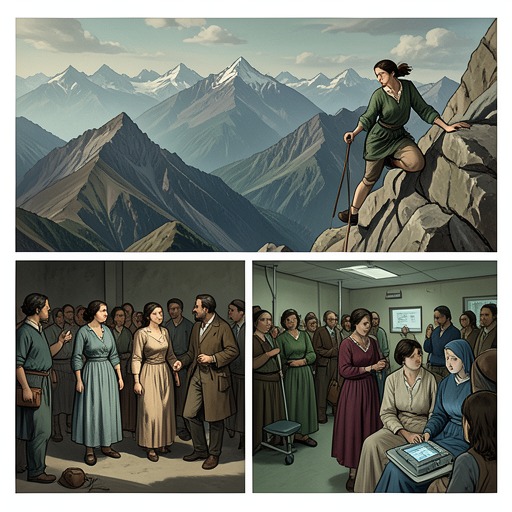
She also replaced Otto’s dinners of cerebral conversation with lunches of heavy stews and several puddings. The guests might include dissident Hungarian poets and Gurdjieffian mystics; sometimes the gathering instead settled into uncomfortable silence around the food. Alleluia Cone eventually withdrew from these Sunday rituals, sulking in her room until she was old enough to move out. Alicja accepted her departure. Her daughter’s turn away from the future Otto had imagined for her was, in Alicja’s eyes, understandable and even admirable: she chose action and mountains rather than the life her father had planned.
Counsel to Alleluia Cone
Alicja is less approving of her daughter’s relationship with Gibreel Farishta, the Indian film star who has returned to her life. She regards the attachment as an unfortunate grand passion and believes he is not in Alleluia Cone’s league, intending the phrase as a judgment about personal type rather than race or religion. Her daughter hears the remark as a racial or religious slight and answers that she does not like her own league. The disagreement exposes the distance between Alicja’s intended meaning and the harm her daughter hears in it, without cancelling the affection between them.
When Gibreel’s paranoid suspicions and repeated questioning leave Alleluia Cone feeling suffocated, she seeks her mother’s advice in Otto’s preserved study. Alicja names the problem as a woman’s life plans being smothered by a man’s, and points out how strange it is for her daughter to find herself without control. She recognizes that guilt over leaving a seriously unwell partner is not the only force holding Alleluia Cone there: grand passion and the desire for a child are entangled with that guilt. Her daughter initially insists on wanting a child of her own, then breaks down and nods. Alicja answers the distress with a mixture of bluntness and comfort, embraces her, and tells her that her own affairs are in better shape.
In another conversation, Alicja warns that Gibreel needs serious psychiatric care, using a story about a man who believes himself to be Napoleon and whose lie-detector result only confirms the limits of the test. Alleluia Cone pushes back, accusing her mother of being ready to lock him away and treat his mind as something to be purged. Their exchange does not settle what should be done about Gibreel; instead, it makes visible the conflict between Alicja’s alarm at his condition and her daughter’s resistance to coercive solutions. Across these conversations, Alicja’s counsel is neither simple approval nor withdrawal: she challenges Alleluia Cone, listens closely, and remains present when her daughter’s choices expose their differences.