Allah
The Satanic VersesAllah is at once a god within Jahilia’s crowded pantheon and the sole deity proclaimed by Mahound’s Submission. The novel makes that apparent contradiction central to its treatment of divine authority: Allah is acknowledged as having overall standing among the city’s gods, yet people favor more specialized idols, while the source of Mahound’s revelations remains bound to uncertain acts of listening, speaking, and remembering.
Allah in Jahilia’s Pantheon
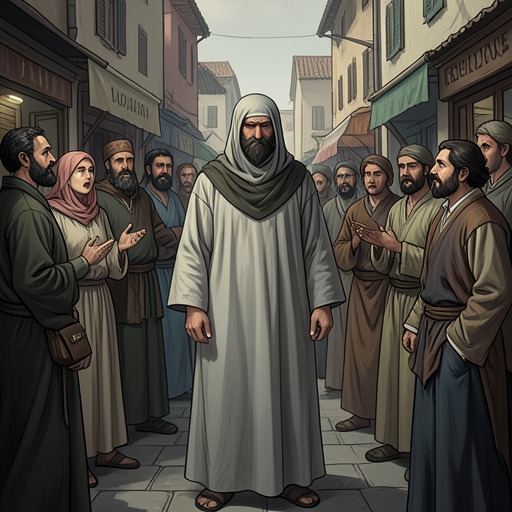
In Jahilia, Allah is described as meaning simply the god. The inhabitants recognize that he has a kind of overall authority, but he is not especially popular in an age of specialist statues. His position differs from that of the many deities attached to particular needs, places, and devotees. The novel thus introduces Allah not as an uncontested presence outside the local religious order, but as one figure within a crowded sacred landscape, where rank and devotion do not necessarily coincide.
That arrangement becomes visible at the shrines of Uzza, Manat, and Al-Lat, the three best-loved goddesses. Mahound’s opponent Abu Simbel proposes that Allah approve their worship in exchange for official tolerance of Mahound’s followers and a seat for him on Jahilia’s council. The proposal turns theology into a political bargain: religious recognition would bring immediate protection, but at the price of qualifying the claim that there is no god but God. Mahound’s companions reject that concession, while Mahound himself pauses over its spiritual and practical consequences.
The Bargain and Mahound’s Doubt
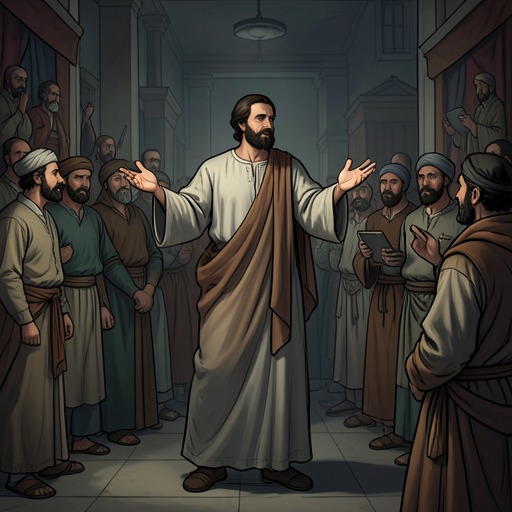
Mahound presents the offer to his followers as a small concession involving only three of the three hundred and sixty idols in the House of the Black Stone. The water-carrier Khalid reacts at once against it; Bilal calls the group back to its creed, and Salman the Persian warns that a revelation approving the goddesses would make Mahound appear to have arranged divine speech to suit Abu Simbel’s offer. He also argues that compromising the creed would undermine the followers’ credibility and strength.
Mahound’s response is not simple certainty. He tells Salman that listening is also a form of asking, and that Gibreel’s appearances often seem to come from within his own deepest self. In the ensuing inward crisis, Mahound considers whether the goddesses might be angels, whether they could be Allah’s daughters, and whether accepting them might save the people of the city. He also questions his own motives, including the possibility that he wants power or a place on the council. The novel gives the decision its force by making both the political temptation and the uncertainty about revelation part of the same deliberation.
Revelation and Its Retraction
The revelation scene intensifies that uncertainty through the relation between Mahound and Gibreel Farishta. Gibreel experiences himself as both watching from above and emerging from within Mahound, linked to him by a cord of light; the narrative cannot settle which of the two is dreaming the other. Mahound’s anguish becomes the occasion for the encounter, but Gibreel remains without answers when Mahound silently asks what he should recite. The scene makes divine communication powerful and consequential without giving Gibreel secure knowledge of its source.
At a poetry gathering, Mahound announces that he brings verses from a greater source than the poets, and Abu Simbel insists that the world must hear them if the words are truly divine. Mahound begins reciting the verses called The Star. After affirming the truth of his vision, he recites lines that name Lat, Uzza, and Manat and grant their intercession. Hind rises; Abu Simbel and then Hind bow in submission, as shouts and devotion to Al-Lat spread through the gathering. The scene’s immediate political effect appears to validate the bargain, and the audience witnesses a dramatic change in the Grandee’s conduct.
After another struggle with Gibreel, however, Mahound wakes and declares that the earlier words came from the Devil, not the angel. He returns to Jahilia intending to expunge the verses. The distinction he makes between the two revelations does not resolve the novel’s uncertainty: Gibreel’s account states that he delivered both the verses and their repudiation. The same voice, in other words, serves both the affirmation and its reversal. Allah’s authority is invoked on both sides of the change, while the narrative withholds an independent test that would conclusively identify which speech was divine.
Divine Authority Beyond the Recitation
The novel returns to this problem through Gibreel’s later visionary experience. As he suffers and waits for answers, Allah, whom the passage also associates with God and Ishvar, does not appear. What recurs instead is the scene of Mahound listening and Gibreel’s uncertain double position within it. The absence matters: the visions repeatedly stage divine authority, but the presence of the Supreme Being remains unavailable to the character who longs for an answer.
A different political use of revelation appears in the Imam’s imagined revolution in Desh. Bilal’s voice travels by surreptitious radio transmission from Kensington into the dreamed-of country and emerges as the Imam’s speech. The Imam presents revelation to Mahound as complete, treats further knowledge as delusion, and casts history, progress, science, and rights as deviations from the path. Here Allah’s completed revelation becomes the warrant for a revolt against history. The passage also makes the transmission concrete: a trained, authoritative voice carries the Imam’s doctrine across distance and changes its apparent speaker, echoing the novel’s broader concern with how sacred authority reaches its audience.
Other scenes extend that concern without settling it. Alicja Cohen recounts a case in which a man who believes himself to be Napoleon fails a lie-detector test that nevertheless indicates he is lying; Alleluia answers with Blake’s idea that a firm conviction can make a belief effective. At a mosque, Mirza Saeed challenges Ayesha because she reports an angel’s information through her own interpretations rather than quoting the angel directly. These episodes place religious claims alongside rival tests of truth, including medical and evidentiary ones, without reducing the contest to a simple opposition between reason and faith.
Text, Voice, and Interpretive Significance
The novel’s acknowledgements state that its Quran quotations are composites of the English versions by N. J. Dawood and Maulana Muhammad Ali, with additional touches by the author. This paratext locates the book’s sacred language within a process of translation and composition. Within the narrative, too, words pass through several agents: a revelation is heard, spoken by Gibreel, received by Mahound, written down by scribes, challenged by followers, and later repudiated. The subsequent account of Salman the Persian’s alterations to the written revelations further dramatizes how small changes can escape notice and become part of a sacred text as it is recorded.
Allah consequently functions less as a character who directly enters the action than as the center of disputes over authority, worship, and the provenance of speech. Jahilia’s polytheistic order acknowledges his rank without making him its most beloved god; Mahound’s creed demands exclusive devotion; and the revelation episode exposes how fragile the boundary between divine command and human utterance can appear. The novel sustains that tension rather than resolving it, making uncertainty about who speaks—and who can know the speaker—a defining feature of Allah’s literary presence.