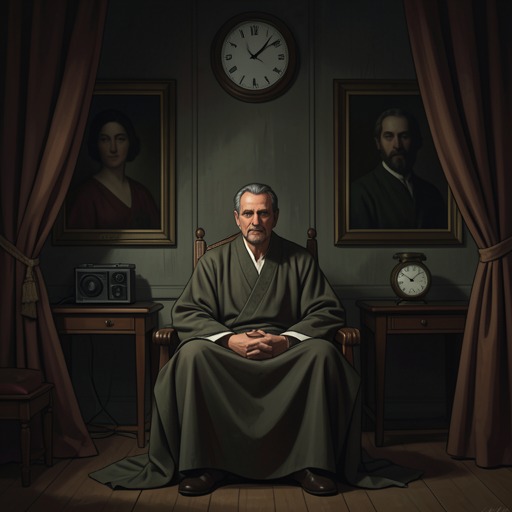
Ayesha portrait in the Imam’s bedroom
The Satanic VersesThe Ayesha portrait in the Imam’s bedroom is an unsettling exception to his rejection of images: it gives a visible, intimate presence to Empress Ayesha, his powerful adversary, and turns their opposition into a fixture of his private room. The portrait’s image of her holding a skull filled with dark red fluid also embodies the contrast the Imam draws between her and his own austere devotion to water.
Placement and Appearance
The portrait hangs in the Imam’s bedroom, facing the hard cot where he lies. The woman depicted is known for her profile, compared to that of a Grecian statue, and for black hair described as reaching the length of her height. The scale and placement make the image more than one of the conventional views of Desh that the Imam keeps on postcards: it is a potent icon occupying the most private space in his rented home.
The portrait presents Empress Ayesha holding a human skull filled with dark red fluid. This detail connects her image to the Imam’s accusation that she drinks blood, and gives the portrait a force quite different from the ordinary landscape and mosque scenes on his mantelpiece.
An Exception to the Imam’s Rule
The Imam is described as an enemy of images. When he moves into the flat, the pictures already on its faded, olive-striped walls seem to remove themselves rather than endure his unspoken disapproval. Yet he permits a small group of postcards depicting his homeland to remain, and keeps the portrait in his bedroom. The contrast makes the portrait’s presence significant: the Imam’s prohibition is not a simple refusal of representation, since this image of his adversary remains close to him.
He calls Empress Ayesha his enemy and his other, and keeps her portrait beside the place where he sleeps. Far away in Desh, she too is imagined as holding or concealing his portrait. The two figures are thus linked by reciprocal images as well as by their plans for each other’s deaths. The portrait makes that distant political antagonism present within the Imam’s domestic space.
Blood and Water
The portrait becomes part of the Imam’s contrast between Empress Ayesha and himself. He drinks filtered water constantly, treating its purity as a means of keeping himself clean, and his Imam’s Treatise on Water praises water as a preserver of life. Against this ideal, he sets the wine he attributes to Empress Ayesha and the skull of dark red fluid shown in her portrait. He reads the image as proof of her corruption, while the picture’s vivid opposition to his water-centred doctrine also exposes how intimately his self-conception depends on the enemy he condemns.
Narrative Significance
The portrait condenses the Imam’s divided relation to images, exile, and political conflict. His hostility to pictures coexists with the preservation of a powerful representation of Empress Ayesha; his insistence on rejecting her coexists with keeping her likeness close. The image therefore does not merely identify an antagonist. It gives the Imam’s faraway struggle a fixed presence in his bedroom and makes the opposition between blood and water visible in the objects and images that organize his private life.