Azraeel
The Satanic VersesAzraeel is the name Gibreel Farishta gives a trumpet he calls the Last Trump and the Exterminator of Men. It gathers the novel’s uncertain angelic imagery into a tangible object: a trumpet that Gibreel claims can carry out divine judgment, but whose meaning ultimately depends on his choices. It appears in visions, threats, and acts of spectacular destruction, becoming a measure of the distance between the role Gibreel performs and the person whose decisions remain at stake.
Identity and Introduction
The name enters a chapter headed Angel Azraeel, linking the instrument to the archangel of extermination. Before Gibreel obtains it, Azraeel appears in Saladin Chamcha’s double vision at the Friends Meeting House. As Saladin looks towards Mishal Sufyan, he sees flames on her forehead and imagines enormous wings casting a shadow. In one of the overlapping worlds he experiences, Azraeel swoops towards him; in the ordinary meeting hall, he tries to explain away what he sees. The angel is thus introduced not as a publicly verifiable visitor, but as part of a perception in which the everyday and the phantom world occupy the same moment.
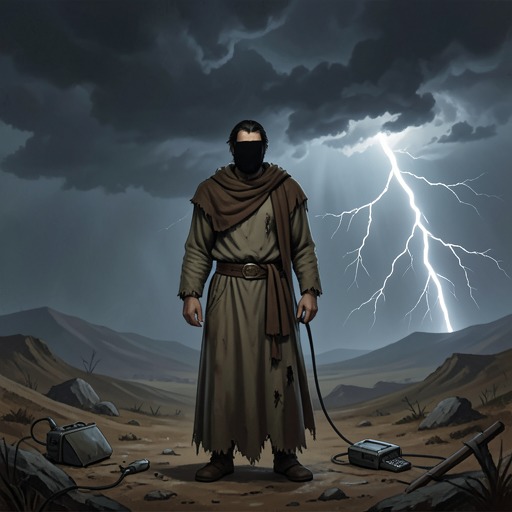
Gibreel’s own conduct soon gives that vision a material counterpart. Three days before Saladin travels with Alleluia Cone to find him, Gibreel has stolen car keys and driven the wrong way up a motorway exit. He tells police that he will summon Azraeel, his lieutenant, to bring divine vengeance. The doctors interpret his possessive jealousy as something that can help set off his madness. His announcement therefore has two registers: it is a threat uttered amid a mental crisis, and a preview of the supernatural identity he will soon try to make real.
The Trumpet and Its Naming
Gibreel acquires the trumpet at Fair Winds, where John Maslama’s employees watch their usually self-possessed employer suddenly defer to an unshaven customer. Gibreel pays for the instrument despite Maslama’s attempt to refuse payment, then identifies himself to the shop as God’s right hand. He names the trumpet Azraeel, the Last Trump, and the Exterminator of Men. The employees see a bright glow around his head, a detail that makes the transaction seem like an apparition while keeping it within an ordinary shop and a witness’s account.
The object gives Gibreel’s grand claims a focus that can be carried, hidden, and raised to his lips. At first he keeps it in his capacious pocket, and its threatened use becomes a question rather than an accomplished judgment. The narrative explicitly leaves open whether he is to act as an agent of wrath or love, and whether the fatal trumpet should remain concealed or be sounded. Its power is inseparable from a choice: possession alone does not settle how Gibreel will use it.
Azraeel in Action
That choice first takes a decisive form when pimps approach a group of women who have been kneeling before Gibreel. He waits among them, then takes out Azraeel and presses it to his lips. Fire emerges from the golden trumpet and consumes the approaching men so completely that even their shoes are gone. Gibreel leaves behind the women’s gratitude and carries the instrument with him. After this act, he understands himself as the Archangel Gibreel, the angel of the Recitation, with power to make the innermost desires of other people real. In his account of that power, he is not only an exterminator: he also presents himself as a fulfiller of dreams and a quencher of desires. Azraeel makes punishment and wish fulfilment aspects of the same frightening capacity.
In Brickhall, Gibreel raises the trumpet amid residents moving through the district in groups, some carrying weapons. Its music accompanies the spread of multicoloured fires through the housing estate. Flames grow among discarded possessions and dreams, climb the towers, and form a tangled, luminous growth. The fire does not remain simply a weapon aimed at an individual enemy; it becomes part of a city-wide upheaval in which Gibreel appears to shape the scene through the trumpet. This expansion from targeted punishment to engulfing spectacle makes Azraeel an instrument of both personal judgment and a much larger, unstable vision.
Saladin, Recognition, and the Unresolved Test
During the blaze around the Shaandaar Café, Azraeel leaps into Gibreel’s hand without being summoned. At the same instant, Gibreel catches Saladin’s eye and recognizes the adversary behind the harm he has suffered. He sees that the evil he had attributed to an external invader is, instead, rooted in Saladin’s own nature. The recognition changes the stakes of the trumpet: Gibreel now holds an apparent means of destroying the man he has come to regard as his enemy, but the encounter also exposes the limits of treating evil as something that can be simply identified and eliminated.
Gibreel enters the burning café, where Saladin lies fallen amid fire and collapsing beams. He asks why Saladin acted as he did, then dismisses the question as futile, acknowledging the shared human capacity for reckless action without explaining away the betrayal. Saladin tries to ask forgiveness and for pity, but can produce only broken sounds. Gibreel repeats his own description of their actions as foolish, while the fire closes in around them. At this point the narrative frames his decision as a contest between vengeance and forgiveness, character and destiny. Azraeel remains in his hand, but the supplied episode does not resolve whether he will sound it against Saladin.
Narrative Significance
Azraeel turns Gibreel’s shifting identity into an object with practical consequences. The trumpet is named after an exterminating angel, yet Gibreel’s understanding of himself expands after he uses it: he imagines a power that can grant desires as well as consume those who receive them. The contrast makes his claim to divine authority unstable. Each time he raises the instrument, the reader must distinguish between the force of his conviction, the visions accompanying it, and the actions he actually takes.
The episode also echoes the novel’s wider uncertainty about revelation and who speaks through an apparent messenger. In the earlier account of Mahound’s recitation, Gibreel presents himself as the source of both the verses and their repudiation, while Mahound understands the first recitation as the Devil’s deception and the later one as angelic. That history does not establish Azraeel as an independent being; rather, it sharpens the uncertainty around Gibreel’s angelic roles. The trumpet’s name may promise a final, absolute judgment, but its appearance at the café leaves Gibreel with a decision the narrative refuses to make for him.