Changez Chamchawala
The Satanic VersesChangez Chamchawala is Saladin Chamcha’s formidable father: a wealthy industrialist, philanthropist, philanderer, and prominent figure in the nationalist movement. His authority in the family is expressed through practical power and intimate tests, especially with his son. Their relationship shifts from childhood fear and adult estrangement to a late, fragile reconciliation, as Changez’s terminal illness exposes a tenderness that years of conflict had obscured.
Identity and Family Authority
Changez is a large, influential man who has built his public standing as the country’s leading manufacturer of agricultural sprays, fluids, and artificial fertilizer. The novel places this public stature beside a private habit of intrusion: he can approach his son unexpectedly and interrupt what the boy is doing. His command within the household is not merely a matter of wealth. He makes affection and approval difficult to distinguish from discipline, leaving Saladin to anticipate the trap even when his father appears to offer a gift.
His study helps define this contradiction. It contains thousands of books, including a ten-volume Richard Burton translation of the Arabian Nights, but the books are left unread and gradually deteriorate. Nearby stands a polished copper-and-brass lamp resembling Aladdin’s fabled container. Changez keeps it for himself, forbids his son to rub it, and promises that Saladin will inherit it one day. The promise gives the boy an image of future fulfilment: a time when his troubles might end and his wishes be granted. The lamp thus becomes both a coveted object and a measure of the distance between father and son.
Gifts, Tests, and Estrangement
That distance is established early through a wallet. When Saladin, aged ten, finds a billfold full of pounds sterling near his home at Scandal Point, Changez appears and takes it from him. Years later, in a hotel near the site of the Tyburn tree, he returns the same wallet and presents the gesture as recognition that his son has become a man. The apparent inheritance of money is another of Changez’s traps: Saladin has been deceived by such offerings before, and this time the gift carries an immediate demand that he pay the bills while they are in London. Changez’s lesson is that the promised reward may conceal an obligation, and that a son remains subject to his father even when treated as an adult.
The family’s ruptures deepen after Nasreen Chamchawala dies during an air-raid alert. Less than a year later, Changez remarries without warning; his new wife is also called Nasreen, a fact that provokes Saladin into writing an angry letter. Changez responds with a brief declaration that their family ties are irreparably broken and responsibility rests with his son. After a year of silence, however, he sends a letter of forgiveness. Its account of a parent’s anger quickly giving way to recognition that a child does not know what he is doing reframes their conflict in terms of parental love, without erasing the hurt or the years of separation.
Conflict at the Family Home
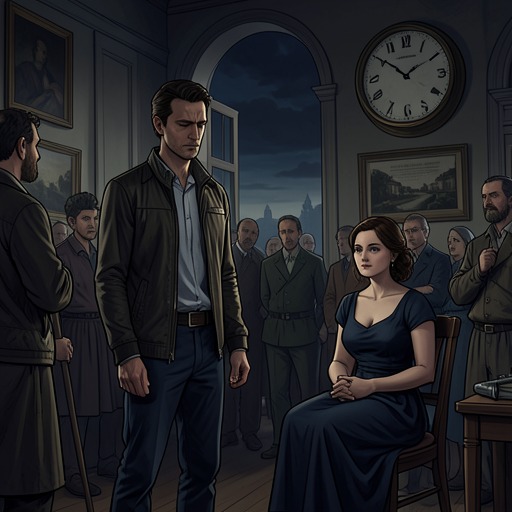
When Saladin later returns to the family home, Changez’s household unsettles the familiar roles. Kasturba, once Saladin’s ayah, is now beside Changez as his wife; Changez places an arm around her while Zeeny Vakil watches. Saladin asks after his stepmother, but Changez rebukes him, saying that she will not meet him and questioning whether he is still a son to either of them. The encounter converts private estrangement into a confrontation in the house itself.
Saladin tries not to fight, but bursts into an accusation about the harm Changez’s money has done to the people around him, naming Kasturba and Vallabh. His anger is directed not only at his father’s conduct but at the apparent corruption of the household and of the man Saladin had once depended on. The scene does not settle their dispute; it makes plain how much resentment remains beneath the formal language of family connection, forgiveness, and paternal authority.
Return and Reconciliation
After Changez suffers a heart attack, the two men have little real contact. Saladin sends a short message reporting that he survived the Bostan disaster, and Changez replies tersely that the information was already known. The next substantial communication comes in a telegram from Nasreen II: Changez is in the terminal stages of multiple myeloma, and Saladin must come quickly if he wants to see his father. Despite their history of severed ties, Saladin discovers that reaching Mumbai has become imperative. He struggles to obtain a visa, then makes the journey.
Changez is gravely ill, but the cancer has, unexpectedly, brought the men closer. As Saladin enters the room, Changez turns toward him and reaches out; Saladin bows his head beneath his father’s hand. Saladin experiences this renewed love as a quiet, life-giving feeling, and finds himself reconnecting with earlier versions of himself, including the name Salahuddin that he had set aside. He sees Changez’s illness as having stripped away some of the domineering and cruel qualities that shaped their past, revealing a mischievous, loving, brilliant father whom he wishes he could have known throughout his life.
Their reconciliation takes practical form when Changez asks Saladin to shave him. Saladin gently guides the shaver across his father’s face and continues to touch his cheeks after the task is done. The small act contrasts with the old contests and withheld affection: care is now offered without a trick or demand. Nasreen II observes how closely Changez watches his son. Their closeness is real, but it arrives under the pressure of an ending neither can reverse.
Death and the Inherited Lamp
When Changez’s diagnosis is finally spoken openly, he accepts that he is dying and says he does not expect an afterlife. His fear is not death itself so much as pain that might deprive him of dignity. Saladin reassures him that, so far, he has been spared the pain he feared. Changez relaxes and tells his son that the lamp will belong to him after all. The inheritance comes not as the childhood promise of limitless wishes, but as a final acknowledgment between father and son.
Near death, Saladin speaks to Changez in Urdu, telling him that the family is beside him and loves him. Changez gives a small nod, then turns inward. He does not speak the name of God as he dies. During the final medical efforts, Saladin sees terror appear in his father’s face; afterward, he finds Changez’s mouth curved in a smile. The uncertainty between those expressions leaves Saladin with no simple account of what his father saw or experienced. It also marks the limits of reconciliation: affection has returned, but death remains unknowable.
After the funeral, Saladin goes into Changez’s study, where his father’s slippers and the imprint left in the bed preserve the ordinary traces of his absence. He takes the copper-and-brass lamp from its shelf and rubs it three times. All the lights come on at once, and Zeeny Vakil enters. The scene gives the childhood object a final, startling effect without explaining it as a fulfilled wish. Changez’s legacy is therefore both tangible and unresolved: a lamp passed on at last, and a relationship whose deepest estrangement was answered only near the moment of loss.