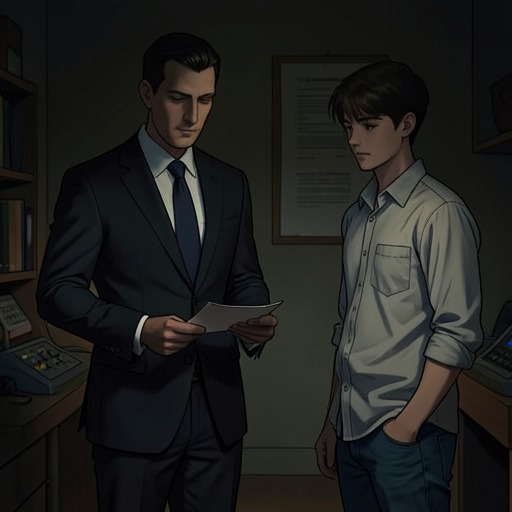
Changez Chamchawala’s death
The Satanic VersesChangez Chamchawala’s death brings Salahuddin Chamchawala into an intimacy with his father that their earlier estrangement had obscured. As cancer rapidly takes Changez’s strength, he speaks plainly about dying and his fear of losing dignity; Salahuddin, in turn, learns to stay beside him through the final hours, the family’s mourning, and the burial. The death closes Changez’s life but leaves his son facing questions that no explanation can settle.
Diagnosis and acceptance
The family tells Changez the diagnosis after first deciding that he should know. When the specialist, Panikkar, offers to take charge of the conversation, Salahuddin objects, though his mother, Nasreen Chamchawala, and Kasturba urge him not to turn the moment into a confrontation. Changez then makes the announcement himself: his cancer is far advanced, and he had suspected as much from the beginning. His clear, deliberate manner gives the news neither the force of a surprise nor the shape of a denial. He has already understood what the family is trying to tell him.
Later, alone with his son, Changez says that he has no illusions about what follows death and is not afraid of dying at his age. His particular fear is pain, because he believes it could strip him of dignity. Salahuddin tells him that the doctors think he has been spared that suffering. The reassurance visibly eases Changez, and his composure allows Salahuddin to see how much he had needed to hear it. He tells his son that the lamp will be his after all. In this quiet exchange, a practical bequest sits beside a more intimate inheritance: the image of a father who can acknowledge death without turning away from it.
The final hours
Changez’s condition worsens over the course of the day. When he becomes too weak to manage without help, Salahuddin carries him and calls for the car. Changez recognizes that the decline is moving quickly. Salahuddin, who has insisted that the truth be spoken, now gives his father comforting assurances that he will recover. The reversal exposes how difficult truth becomes when it means accepting an imminent loss rather than naming a diagnosis.
Salahuddin drives Changez to Breach Candy Hospital, about half a mile away, with Nasreen and Kasturba beside him. The journey ends in the emergency ward, where a young doctor tells the family that Changez is unlikely to survive. Salahuddin’s first response is anger: he has continued to imagine that the doctors will repair the crisis and send his father home. As the medical staff try to help, the family is asked to prepare for the end. Salahuddin summons the two women to say goodbye, then feels ashamed that he has made them confront the news so abruptly. The scene turns on the distance between medical knowledge and the hope he has not yet surrendered.
At last, Salahuddin finds words in Urdu that he had not used for a long time and tells his father that the family is with him and loves him. Changez cannot answer, but Salahuddin believes he gives a small nod. The possibility of recognition matters to the son, even though he cannot be certain of it. Changez then seems to turn inward. Salahuddin understands this as a final lesson in meeting death directly. He also notices that his father never speaks the name of God while dying, a silence that intensifies rather than resolves the questions surrounding his last moments.
Death and unanswered questions
After the staff’s efforts fail, Salahuddin returns to his father’s bedside. He remembers the terror that had appeared on Changez’s face just before the final attempt to revive him; when he sees him afterward, the expression has become a smile. The contrast offers no clear account of what Changez experienced. Salahuddin is left asking himself what his father saw and what could explain both the fear and the final change in his face. The event’s emotional conclusion is therefore not an answer but a pair of expressions that resist interpretation.
The family takes Changez home in an ambulance, and those who come to mourn begin arranging the funeral. Nasreen and Kasturba sit with other women as mourners recite the qalmah. Salahuddin is irritated by the repeated prayers but cannot bring himself to ask that they stop. When the mullah prepares Changez for burial, Salahuddin insists on helping even though his presence is not needed. He connects this choice to the courage he believes he witnessed in his father: because Changez faced death, Salahuddin feels he must face its physical and communal rituals too. The mullah’s practical manner and casual conversation sit uneasily beside the son’s sense that this is an intensely personal loss.
At the grave, Salahuddin climbs down and helps receive his father as he is lowered. This final act of care completes the movement from the son’s initial difficulty speaking to his willingness to stand beside his father through death and burial. It does not resolve his uncertainty about the terror, the smile, or what may follow death. Instead, Changez’s death leaves Salahuddin with the knowledge of his father’s acceptance, the memory of their last exchange, and an unanswered encounter with mortality.