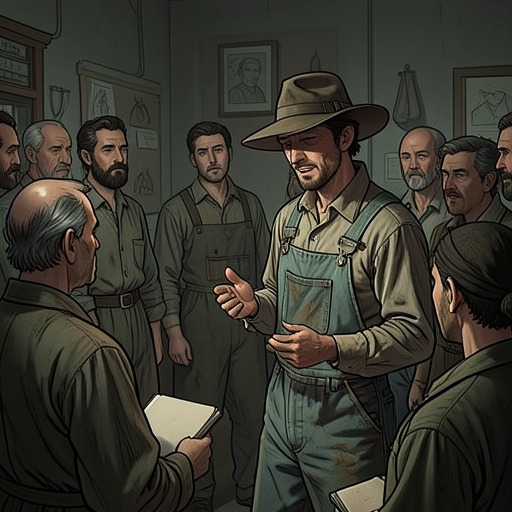
Club Hot Wax
The Satanic VersesClub Hot Wax is an underground nightclub about a mile from the Shaandaar Hotel, formerly known as the Blak-An-Tan. Its dance floor, political waxworks, and Sewsunker Pinkwalla’s performances make it a venue where entertainment and migrant history meet. Later, it shelters Saladin Chamcha during his metamorphosis and recovery, then becomes a gathering point amid rising racial conflict and a target of a highly mediated police raid.
Setting and Nightlife
On a star-crossed, moonless night, people from across the neighborhood converge on Club Hot Wax and descend through an unmarked door. Inside, dancers move under shifting lights, while other figures appear frozen among them. The club is presented as a busy, shared social space, but its concealed entrance and subterranean setting also distinguish it from the streets above. Music, bodies, and spectacle fill the room; the motionless wax figures make the past part of the same scene.
The club’s host is Sewsunker Pinkwalla, a seven-foot albino with pale hair and eyes and unmistakably Indian features. The narration describes him as an East-Indian man from the West Indies who has never seen India, a layered identity that makes him an emblematic host for a venue shaped by migration. Onstage, he acts as deejay and performer, addressing the crowd in rhythmic, politically charged rhymes. His persona turns the nightclub into more than a place to dance: the audience answers him, directs the spectacle, and helps make its political feeling public.
Waxworks and Political Spectacle
The figures displayed around the dance floor are waxworks representing history. Among them are Mary Seacole and Abdul Karim, also known as the Munshi, whose prominence and treatment are set against the racial barriers of their times. Other tableaux connect the history of empire and slavery to the club’s present: the black clown of Septimius Severus, George IV’s barber with Grace Jones, and Ukawsaw Gronniosaw dancing with Ignatius Sancho, identified as the first African writer published in England. These figures are not merely background decoration. Their stillness contrasts with the living dancers, while their presence claims a place in the history from which migrants have often been excluded.
The club also displays wax villains, including Mosley, Powell, and Edward Long. Their placement opposite the historical figures turns the room into a charged visual argument about racism and power. Pinkwalla’s performance voices indignation at anti-immigrant prejudice and insists on migrants’ contribution to the nation. The crowd then calls for a figure to be melted. Attendants wheel out Hell’s Kitchen, a large, illuminated microwave cabinet fitted with the Hot Seat. The evening’s chosen effigy is a Maggie figure, recognizable by her coiffed hair, pearls, and blue suit; the audience chants as Pinkwalla switches on the machine. The effigy melts, and the dancing resumes. The ritual is staged as entertainment, but it also gives collective anger a visible target and a shared form.
Refuge and Saladin Chamcha’s Restoration
Club Hot Wax acquires a different function when Mishal Sufyan and Hanif Johnson ask Pinkwalla to help Saladin Chamcha. Pinkwalla sees Chamcha climbing into the back of his van near the Shaandaar Hotel. Fear and excitement compete in his response: Chamcha is both a frightening presence and the hero of Pinkwalla’s private imaginings. After the two visitors urge him to consider Chamcha’s future, Pinkwalla agrees to drive him away; Hanif rides beside him, while Mishal travels out of sight with Chamcha.
Near four in the morning, they settle Chamcha in the empty, locked-up nightclub. Pinkwalla finds sleeping bags in a back room, and the club gives Chamcha shelter when he has nowhere else to go. Hanif tries to make him understand that his presence may matter to the community as well as to himself, but Chamcha does not respond with interest. Alone among the waxworks, he fixes on the face of Gibreel Farishta, whom he understands as his adversary and counterpart. The club’s collection of historical figures becomes the setting for a private transformation: Chamcha’s attention and hostility are directed toward Gibreel, and the wax figures take on Gibreel’s features in his perception.
The night ends in devastation. When Mishal, Hanif, and Pinkwalla return hours later, furniture has been broken and every waxwork, whether villain or historical figure, has melted. At the center of the wreckage lies Chamcha, asleep and apparently restored to human form. The narration presents his concentrated hatred as the force associated with this change. Thus the club’s melting spectacle, ordinarily controlled by a switch and performed for an audience, is echoed by a transformation that overwhelms the entire room. Chamcha’s restoration does not leave the club untouched: the site of his refuge is also the scene of its destruction.
Rising Conflict and the Police Raid
As anger grows after Uhuru Simba’s death and the continuing Granny Ripper murders, Club Hot Wax remains part of the neighborhood’s political life. Police presence in Brickhall increases, and community members gather at the club alongside the Shaandaar Hotel and the Pagal Khana. At Club Hot Wax, the figure selected for melting is now the community liaison officer, shown perspiring and already beginning to melt. The choice marks a shift from the recurring attack on a national political figure to a local representative of authority, amid disputes over policing and the treatment of black and Asian residents. Hanif Johnson warns that another murder could intensify the already volatile situation.
When the police raid Club Hot Wax, television cameras arrive in time to record it. The account draws attention to what the cameras can and cannot show: a helicopter’s lights make the state’s advance into a striking image, while rotor noise obscures the crowd’s sound. A reporter stands behind a barrier formed by officers in riot helmets and shields, delivering a factual account from a protected position. The camera’s elevated, shielded view is not neutral; its need for safety and order determines where it can look from and what remains distant. Club Hot Wax is therefore represented not only as a venue where political feeling takes theatrical form, but also as a contested space seen through the machinery of state power and news coverage.
Narrative Significance
Across these episodes, Club Hot Wax changes from nightlife venue to historical display, emergency shelter, scene of supernatural-seeming destruction, and focus of a police operation. Its wax figures make history visible within the present, while Pinkwalla’s performances and the crowd’s responses turn that history into public argument. Chamcha’s restoration gives the club an intimate role in his personal arc; the later raid places it within the wider conflict over race, policing, and who controls the account of events. The club’s repeated transformations make it a compact stage on which spectacle, memory, anger, and authority meet.