Desh
The Satanic VersesDesh is both a homeland and a political image in the Imam’s exile: a place reduced to postcards and remembered heat, yet made vividly present through radio, dream, and the prospect of revolution. The distance between the country itself and the Imam’s London refuge gives Desh its double force. It is the home he cannot inhabit, and the future he seeks to recover by refusing the present.
A homeland in images
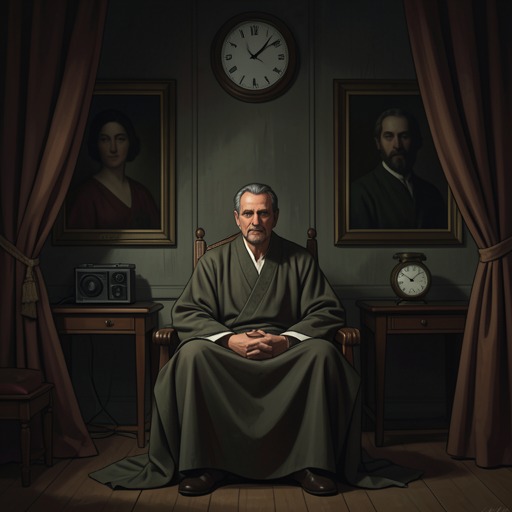
The Imam calls his homeland simply Desh. In his London flat, a few postcards preserve its recognizable features: a mountain above a city, a village beneath a great tree, and a mosque. These small, conventional views stand out in a home otherwise emptied of pictures. The Imam opposes images, and the pictures that once decorated the flat seem to have disappeared under the force of his disapproval. Yet images of Desh remain, as does a portrait of his adversary, Empress Ayesha, hung opposite the hard cot in his bedroom. The homeland is therefore not represented through a broad or ordinary domestic life; it is condensed into a handful of views and held in tension with the image of the ruler the Imam seeks to overthrow.
That tension extends beyond the pictures. The Imam and Empress Ayesha, separated between London and Desh, keep one another’s portraits close and plot each other’s deaths. In the Imam’s imagination, Desh is at once a country beneath a postcard mountain and the seat of a political power embodied by the Empress. Its identity is inseparable from the conflict over who will rule it.
The exile’s substitute country
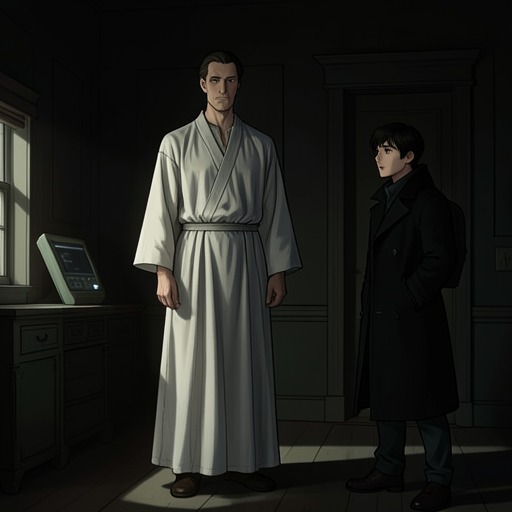
The Imam’s actual residence occupies floors three through five of a London mansion block. It supplies his immediate political base: rifles, short-wave radios, rooms where young men in suits speak urgently into several telephones, and a retinue organized around the exiled leader. Alcohol, playing cards, dice, and ordinary domestic life are absent; the only woman in the described rooms is the portrait on the bedroom wall. The flat functions as a surrogate homeland, but also as a waiting room, a place organized around the expectation of return rather than settlement.
Its physical arrangements imitate the climate the Imam longs for. The central heating runs day and night, the windows stay shut, and the effort to reproduce Desh’s dry heat turns the interior into an artificial version of home. At night, when the curtains part, the London moonlight enters as a reminder of the cold foreign setting rather than a comforting view of the city. Elsewhere, exile is marked by hurried, expensive furniture, bookcases holding files instead of books, takeaway food, and a shower whose temperature changes when someone uses a kitchen tap. These details make the refuge an awkward, provisional household. Even putting down roots appears to the exile like an admission of defeat.
Foreignness and the refusal of London
The curtains are kept closed because the Imam regards the outside world as a threat of foreignness. London gives him sanctuary, but he resents his dependence on it and resolves to remain ignorant of the city around him. On rare outings for air in Kensington, eight young men in sunglasses and bulging suits surround him. He folds his hands and fixes his gaze ahead, trying to avoid taking in any part of the city he despises. His intended return to Desh is imagined as a return without contamination: he wants to arrive able to claim that exile has not altered him.
That stance sharpens the contrast between the homeland and the place where the Imam must wait. London is not merely distant from Desh; it is the condition that makes the longing for Desh constant. The Imam’s flat, with its closed windows and simulated heat, enacts this contradiction. It preserves the idea of home by shutting out the actual surroundings, while its dependence on those surroundings exposes the fragility of that preservation.
Radio, dream, and revolution
Desh becomes more than a remembered landscape when the Imam’s message travels over clandestine radio waves. Bilal, an American convert chosen for his trained, commanding voice, sings the Imam’s political song over a ham radio in Kensington. In the dream, that voice reaches Desh and emerges as the Imam’s own address to his people, calling for an uprising against Empress Ayesha’s state. The radio links the exile’s London rooms to the homeland without bringing the Imam physically back; voice and transmission temporarily bridge the distance.
The Imam’s political aim is framed as a revolt against history itself. He rejects progress, science, and rights as deviations from a completed revelation, and imagines that undoing history will reveal paradise. Bilal initially objects to the claim that his voice represents the power of the West, since he too belongs to an oppressed people. The Imam answers by distinguishing oppression from the habits of power: in his view, proximity to power teaches its manner and posture, even to those it subordinates. The exchange makes the radio voice an instrument of political argument as well as a means of mobilization.
The dream then gives Desh a landscape beyond the few postcard images: a vast reddish country of flat-topped trees and mountains, with a conical mountain above a sprawling city and the Empress’s palace on its lower slopes. Gibreel sees the streets filled with people moving toward the palace gates, where the household guards wait in ranks with machine guns. The crowd’s scale transforms separate marchers into a single, many-headed movement. The passage ends as the marchers come within range of the guns; the scene establishes the stakes of the uprising, but the available account does not resolve its outcome.