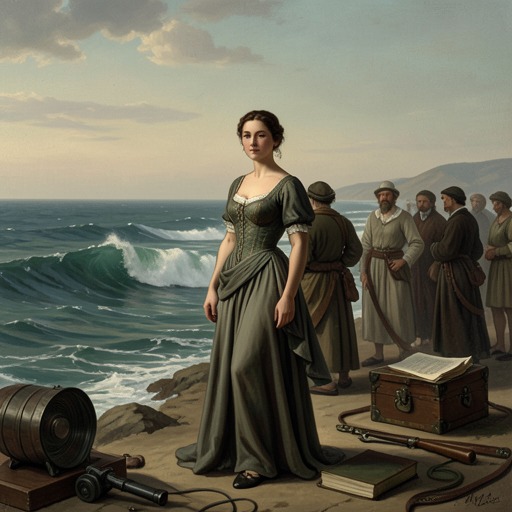
Drought along the Indian pilgrimage route
The Satanic VersesDrought along the Indian pilgrimage route turns water into both an urgent necessity and a promise on which the Titlipur pilgrimage depends. The failing rains drive people and animals south in search of water, while Gibreel’s dream enlarges the crisis into a landscape of environmental ruin and deprivation. Against that scarcity, the pilgrims’ march toward the sea carries an expectation of miraculous passage that the ending does not fulfill for them.
Drought as a Material Crisis
The signs of drought are immediate and public: the rains appear likely to fail, and thin cattle move across the landscape looking for a drink. Families travel south with their possessions loaded onto weakened donkeys, also hoping to find water. The words “Love is Water,” painted on a scooter factory wall, give the crisis an unusually stark expression: water is at once a basic need and an emblem of what people desire or lack.
The drought does not affect everyone in the same way. During the pilgrimage, Mirza Saeed Akhtar protests that the villagers are walking toward salt water rather than the fresh water that people elsewhere need to survive. His outburst sets the pilgrims’ religious expectation against the practical urgency of drought-driven migration. The road gathers people moving in search of water, but the Titlipur group follows a different promise.
The Dream’s Enlarged Landscape
Gibreel dreams of a drought that renders the crisis more absolute. The land has browned beneath rainless skies; abandoned buses and ancient monuments lie among the fields, and trees stand exposed as erosion strips away the soil. In this vision, even the animals and trees are caught in the search for water. The dream turns a failure of rain into a broader image of a landscape unable to sustain life.
Its human consequences are equally central. Farmers without other means of support are made to work for the state, digging a reservoir beside the trunk road to hold rain that never comes. The reservoir is an empty answer to an absent resource. The dream also places this labor beside the precarious lives of people without secure shelter or work, making drought not merely a natural hardship but a condition that intensifies existing poverty. Mirza Saeed’s thoughts register the distance between his own circumstances and theirs, even as the vision subjects him to the landscape’s vulnerability.
The Pilgrimage Through Scarcity
The march itself proceeds under difficult conditions. The villagers travel at the pace of the slowest pilgrim, with delays caused by children’s sickness, official harassment, and a broken cart wheel. They manage only about two miles a day, with roughly 150 miles still to cover before reaching the sea; the journey is expected to take about eleven weeks. The slow pace makes the pilgrimage a sustained exposure to the route rather than a single act of departure.
Mirza Saeed follows in an air-conditioned car, repeatedly leaving it to urge Mishal Akhtar to stop walking and accept his help. She refuses to abandon the pilgrimage, and her mother tells him to leave the walkers in peace. After his chauffeur quits the car to join the pilgrims, Saeed must drive himself; when anxiety overtakes him, he stops and runs among the marchers, pleading and offering inducements. His car represents shelter from the heat, but it cannot persuade Mishal to turn back or make the pilgrims’ chosen destination less compelling to them.
By the ninth week, the story of the village walking to the sea has drawn journalists, politicians, commercial sponsors, tourists, and other onlookers. The pilgrims’ journey is thus exposed to competing interpretations and attempts to use it, even as the drought gives the march a material urgency beyond spectacle. When the group reaches the shore, the city’s paved approach gives way to sand and refuse before they see the Arabian Sea. The longed-for water is finally present, but its presence alone cannot guarantee that the promised passage will occur.
The Sea and the Limits of Deliverance
The pilgrimage began with Ayesha’s announcement that the villagers would walk to the sea and cross its opened waters on foot. That expectation gives the drought a religious dimension: after travelling through a landscape where people search for water to live, the pilgrims look to the sea for a passage toward salvation. The two forms of water are not interchangeable, however. Saeed has already challenged the journey’s practical logic by distinguishing the salt sea from the water sought by drought-stricken families.
At the sea, the pilgrims enter the water and disappear; none returns to the surface. Saeed and several other survivors are rescued, and officials later question them about the expedition. The conclusion leaves the promised miracle unresolved while making the outcome of the pilgrimage unmistakable for those who vanish. In this contrast, drought’s scarcity and the sea’s abundance converge without becoming a simple answer to one another: water remains necessary, desired, and perilous, rather than a guarantee of deliverance.