Empress Ayesha
The Satanic VersesEmpress Ayesha is the distant ruler whom the Imam treats as his enemy and opposite: she embodies the power he means to overthrow, while his rhetoric casts her world as corruption and historical time. In Gibreel Farishta’s dream of revolution in Desh, that political opposition becomes supernatural. Ayesha emerges from the palace as Al-Lat, confronts Gibreel, and falls as the Imam’s followers take power. The episode makes her at once a political adversary and a figure through whom the dream exposes the violence and uncertainty of the Imam’s promised new order.
Identity and Exile
In the Imam’s rented London apartment, Ayesha is present first as an image. The Imam rejects most pictures, which seem to remove themselves from the walls when he arrives, but keeps conventional postcards of Desh and a portrait of the Empress in his bedroom, facing the hard cot where he lies. She is his powerful enemy and his other: an absent ruler held close in representation, just as the narrative imagines that she keeps his portrait near her in her own palaces. Their distance does not lessen their antagonism. The two are described as plotting each other’s deaths.
The portrait’s force comes partly from its contrast with the Imam’s preferred image of himself. He drinks filtered water constantly and makes its purity a political and spiritual principle. Ayesha’s portrait associates her instead with a skull holding dark red liquid, while the Imam accuses her of drinking wine. These details belong to his hostile account of her, not to an independent description of her daily life. They turn the opposition between water and wine into a shorthand for the conflict he imagines: his ascetic purity against her rule, which he defines as decadent and doomed.
The Imam’s Political Image of Ayesha
The Imam’s broadcasts, carried by Bilal over clandestine radio waves, present Ayesha’s government as tyranny and make her the central object of revolutionary denunciation. The Imam’s language extends the conflict beyond one ruler: he identifies history itself—with progress, science, and rights—as an enemy, and promises a revolt against it. Ayesha thus serves both as a political target and as the personification of a world the Imam wants to erase. His certainty that her state is evil is part of the force of his campaign, but the dream does not offer a neutral account of her rule to confirm his charges.
That distinction matters because the story’s view of Ayesha is mediated. The Imam’s portrait and speeches supply the political frame; Gibreel’s dream supplies the scenes in which that frame takes supernatural form. Even Jerusalem, the destination invoked during the flight toward Desh, slides between a place and an idea. Ayesha appears within this unstable imaginative geography as the ruler whose defeat the Imam calls for, but also as more than a simple emblem of a political regime.
Revolution and the Appearance of Al-Lat
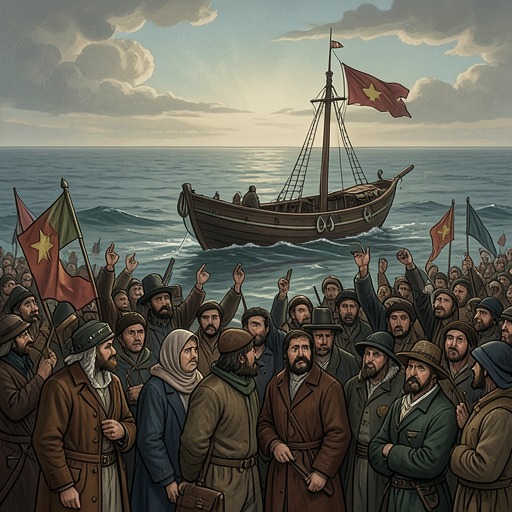
In the dream, Gibreel carries the Imam toward Desh, passing over a vast, hot landscape to the city beneath the mountain shown on the Imam’s postcard. The palace is the destination of a mass procession. The people move along the roads toward its gates, where guards wait with machine guns; when the crowd reaches them, the weapons fall silent and the procession continues. The Imam interprets this victory as the fulfillment of his promise that his followers will recover a timeless existence, free from clocks and birthdays.
The palace’s defeat is followed by an apparition. Its lights go out, a cry rises from within, and a black-winged figure emerges from the golden dome. Gibreel recognizes Al-Lat bursting from Ayesha’s shell. The appearance turns the Empress into a mythic presence without settling whether the vision reveals an independent supernatural reality or translates the Imam’s political struggle into dream imagery. Ayesha is no longer only the distant woman in the portrait: in the dream she is embodied as the goddess whom the Imam’s revolution must confront.
The Imam orders her killed and sends Gibreel against her. Gibreel understands that the Imam is making him fight on the cleric’s behalf, and that the battle may destroy both combatants. Ayesha’s manifestation and Gibreel strike at one another; weakened, she falls. Gibreel then sees the Imam transformed into a monstrous figure at the palace gates, swallowing the people as they pass through. The vision therefore refuses to make the revolution’s victory uncomplicated: the ruler falls, but the new authority appears capable of consuming the very crowd whose advance secured its triumph.
Aftermath and Narrative Significance
After Al-Lat falls, her body shrivels away, leaving a dark stain. At the same time, every clock in the capital begins chiming without stopping, passing beyond ordinary measures of the hour. The Imam’s promised end of historical time is announced through the very instruments that measure it. Ayesha’s defeat is therefore bound to the dream’s central contradiction: the revolution claims to abolish time, yet its conclusion is marked by time sounding everywhere, beyond count.
Ayesha’s role is shaped by the contrast between the Imam’s confident political story and the dream’s unstable images. His account makes her the enemy to be removed; the dream gives that enemy a divine and mythic form, then places Gibreel between her and the Imam’s power. Her appearance as Al-Lat does not provide a straightforward account of the Empress’s thoughts or aims. Instead, she remains a figure seen through competing forms of representation: the Imam’s portrait and propaganda, and Gibreel’s vision of a battle whose apparent resolution produces another unsettling image of power. The episode makes her downfall part of the Imam’s imagined return to Desh, while leaving the meaning of that victory—and the reality of its supernatural terms—open to doubt.